Downers Grove in DuPage County, Illinois — The American Midwest (Great Lakes)
Indian Boundary
⎯⎯⎯
Carriage Step

Photographed by Sean P. Flynn, April 12, 2025
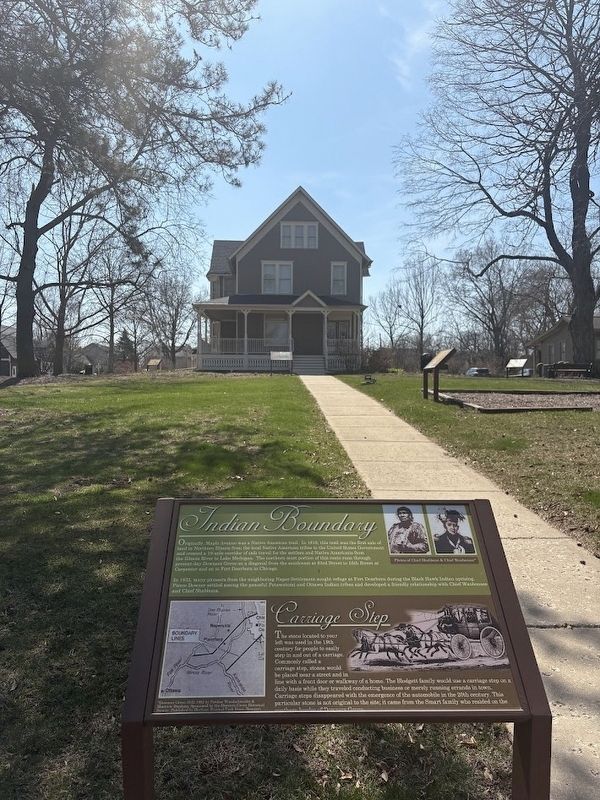
1. Indian Boundary / Carriage Step Marker
Indian Boundary
Originally, Maple Avenue was a Native American trail. In 1816, this trail was the first sale of land in Northern Illinois from the local Native American tribes to the United States Government and created a 10-mile corridor of safe travel for the settlers and Native Americans from the Illinois River to Lake Michigan. The northern most portion of this route runs through present-day Downers Grove on a diagonal from the southwest at 63rd Street to 55th Street at Carpenter and on to Fort Dearborn in Chicago.
In 1832, many pioneers from the neighboring Naper Settlement sought refuge at Fort Dearborn during the Black Hawk Indian uprising. Pierce Downer settled among the peaceful Potawatomi and Ottawa Indian tribes and developed a friendly relationship with Chief Waubonsee and Chief Shabbona.
Carriage Step
The stone located to your left was used in the 19th century for people to easily step in and out of a carriage. Commonly called a carriage step, stones would be placed near a street and in line with a front door or walkway of a home. The Blodgett family would use a carriage step on a daily basis while
this page online
Topics and series. This historical marker is listed in these topic lists: Indigenous Peoples and Communities • Settlements & Settlers • Wars, US Indian. In addition, it is included in the Black Hawk War series list. A significant historical year for this entry is 1816.
Location. 41° 47.575′ N, 88° 0.324′ W. Marker is in Downers Grove, Illinois, in DuPage County. It is on Maple Avenue east of Lyman Avenue, on the right when traveling east. The marker is in front of the Downers Grove Museum. Touch for map. Marker is at or near this postal address: 831 Maple Avenue, Downers Grove IL 60515, United States of America. Touch for directions.

Regionally, this marker is in Greater Chicago. It is also in the American Midwest. Globally, it is in North America, on the Great Lakes, in the Western Hemisphere, in the Western World, and in the Anglosphere.
Photographed by Sean P. Flynn, April 12, 2025
2. Indian Boundary / Carriage Step Marker
Other nearby markers. At least 8 other markers are within walking distance of this marker: The Indian Boundary Line (a few steps from this marker); 1832 Log Cabin Footprint (a few steps from this marker); 1846 Blodgett House (within shouting distance of this marker); 1892 Blodgett House (within shouting distance of this marker); Underground Railroad (within shouting distance of this marker); Charles Blodgett (within shouting distance of this marker); Israel and Avis Blodgett (within shouting distance of this marker); The Israel Blodgett House (within shouting distance of this marker). Touch for a list and map of all markers in Downers Grove.
More about this marker. An older plaque related to the Indian Boundary Line can be found on the right side of the sidewalk.
Regarding Indian Boundary / Carriage Step. The 20-by-70-mile strip of land referenced on this plaque connected Lake Michigan with the Illinois River near present-day Ottawa, Illinois. The land was ceded by the Ojibwe, Ottawa and Potawatomi

Photographed by Sean P. Flynn, April 12, 2025
3. Downers Grove Museum
The marker is just left of the sidewalk up to the house. The "carriage step" can be seen to the left of the marker.
Remnants of this "Indian Boundary" can be found not just in Downers Grove, where the local YMCA is called the Indian Boundary Y, but across the modern map of Chicagoland. Several diagonal streets north and west of Chicago roughly line up with the northern border, including Rogers Avenue on Chicago's far north side and another section further west bordering the Sauganash and North Park neighborhoods; Forest Preserve Drive on the northwest side; and short Indian Boundary Roads in suburban River Grove (near Grand Avenue) and Melrose Park (near North Avenue). Additionally, an Indian Boundary Line Road in far southwest suburban Plainfield

Photographed by Wikipedia Commons
4. Chief Waubonsie
Also see . . .
1. Treaty with the Ottawa, Etc. Via the Forest County Potawatomi website, the text of the Treaty of St. Louis, signed August 24, 1816, which ceded land that includes modern-day Downers Grove. (Submitted on April 18, 2025, by Sean P. Flynn of Oak Park, Illinois.)
2. Downers Grove Historical Society official site. (Submitted on April 18, 2025, by Sean P. Flynn of Oak Park, Illinois.)
Credits. This page was last revised on October 6, 2026. It was originally submitted on April 18, 2025, by Sean P. Flynn of Oak Park, Illinois. This page has been viewed 350 times since then and 87 times this year. Photos: 1, 2, 3, 4. submitted on April 18, 2025, by Sean P. Flynn of Oak Park, Illinois.
