
Montmartre in Paris in Département de Paris, Île-de-France, France — Western Europe
Le parc d’artillerie de Montmartre
⎯⎯⎯
The Montmartre Artillery “Park”
| — | Histoire de Paris | — |
Photographed by Andrew Ruppenstein, April 12, 2025
1. Le parc d’artillerie de Montmartre Marker

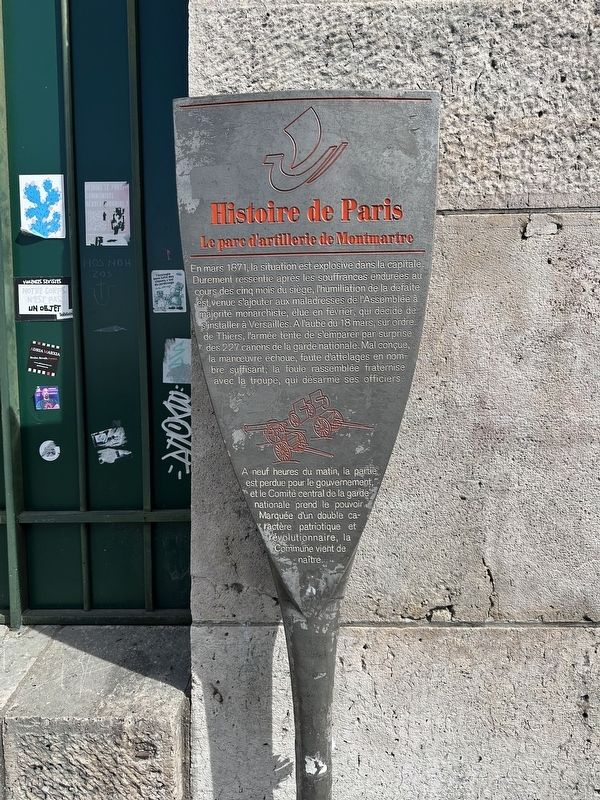
En mars 1871, la situation est explosive dans la capitale. Durement ressentie après les souffrances endurées au cours des cinq mois du siège, l'humiliation de la défaite est venue s'ajouter aux maladresses de l'Assemblée à majorité monarchiste, élue en février, qui décide de s’installer à Versailles. A l'aube du 18 mars, sur ordre de Thiers, l'armée tente de s'emparer par surprise des 227 canons de la garde nationale. Mal conçue, la manoeuvre échoue, faute d'attelages en nombre suffisant; la foule rassemblée fraternise avec la troupe, qui désarme ses officiers. A neuf heures du matin, la partie est perdue pour le gouvernement, et le Comité central de la garde nationale prend le pouvoir. Marquée d'un double caractère patriotique et révolutionnaire, la Commune vient de naître.
In March 1871, the situation in the capital was explosive. Keenly felt after the suffering endured during the five-month siege, the humiliation of defeat was compounded by the clumsiness of the monarchist-majority Assembly, elected in February, which decided to relocate to Versailles. At dawn on March 18, on Thiers' orders, the army attempted to seize the 227 cannons of the National Guard by surprise. Poorly conceived, the maneuver failed due to a lack of sufficient teams; the assembled crowd fraternized with the troops, who disarmed their officers. By 9:00 a.m., the game was lost for the government, and the Central Committee of the National Guard seized power. Marked by a dual patriotic and revolutionary character, the Commune was born.
Topics and series.
this page online
Location. 48° 53.174′ N, 2° 20.496′ E. Marker is in Paris, Île-de-France, in Département de Paris. It is in Montmartre. It is at the intersection of Rue Azaïs and Rue du Mont-Cenis, on the left when traveling east on Rue Azaïs. Touch for map. Marker is at or near this postal address: 2 Rue Azaïs, Paris, Île-de-France 75018, France. Touch for directions.

Regionally, it is in the North Atlantic Region, Europe, the European Union, Atlantic Europe, the Schengen Area, Western Europe, a coastal Mediterranean country, and the Western World. Historically, it finds itself in what was once a French colony and also the Roman Empire.
Other nearby markers. At least 8 other markers are within walking distance of this marker: Maurice Drouard (within shouting distance of this marker in Ile-de-France); Saint-Pierre de Montmartre (within shouting distance of this marker); Cimetière du Calvaire / Calvary Cemetery (within shouting distance
Photographed by Andrew Ruppenstein, April 12, 2025
2. Le parc d’artillerie de Montmartre Marker - wide view
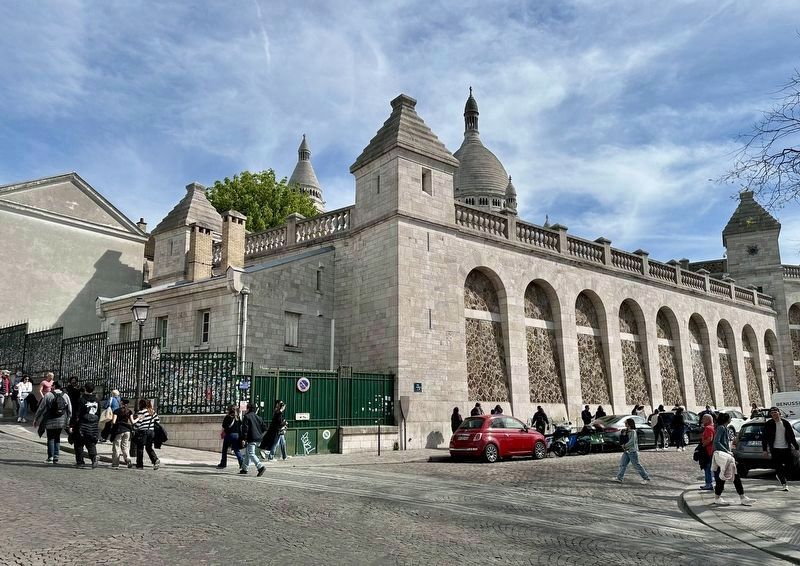
The marker is visible here at the corner of the building, which is an enclosed reservoir (ca. 1887), with a couple of tall bits of the Basilique du Sacré-Coeur visible behind that.
Also see . . . Les canons de la Commune (Les Amies et Amis de la Commune de Paris de 1871, in French). Excerpt (in translation):
The Strategic Importance of Cannons: These attempts to recapture the cannons exacerbated the situation: since these weapons had been purchased by public subscription, the people of Paris believed that they belonged to the Republican Federation of the National Guard, not to an army in the pay of the monarchists.(Submitted on April 19, 2025.)
Furthermore, without cannons, the people would be defenseless against possible attacks by government troops, as during the workers' uprising of June 1848.
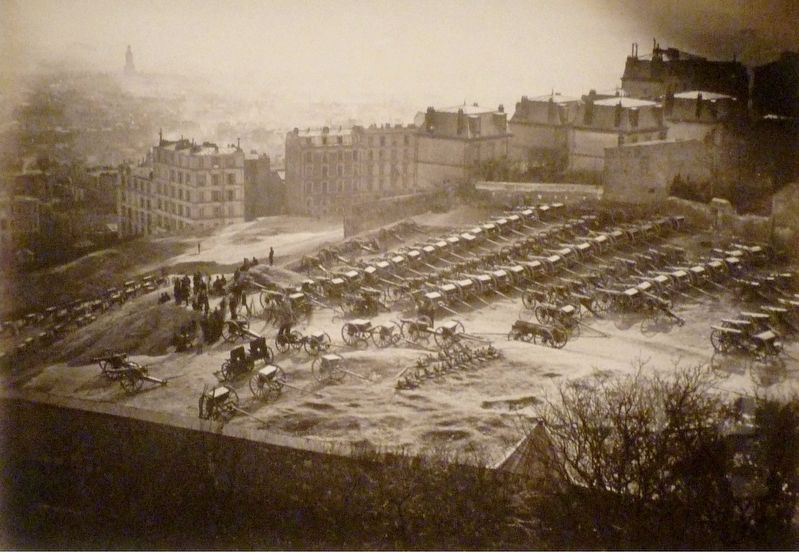
Cannons were an integral part of barricade construction during times of insurrection. The increasing number of revolts using barricades demonstrated to Parisians their military value infighting against a regular army.courtesy Wikimedia Commons, circa March 18, 18713. The Montmartre Artillery “Park” on the Montmartre ButteThe view of the cannons to be seized, but which were not, hence the birth of the Commune on that day.
Additional keywords. panneau
Credits. This page was last revised on April 19, 2025. It was originally submitted on April 18, 2025, by Andrew Ruppenstein of Lamorinda, California. This page has been viewed 165 times since then and 30 times this year. Photos: 1. submitted on April 18, 2025, by Andrew Ruppenstein of Lamorinda, California. 2, 3. submitted on April 19, 2025, by Andrew Ruppenstein of Lamorinda, California.
