Blanding in San Juan County, Utah — The American Mountains (Southwest)
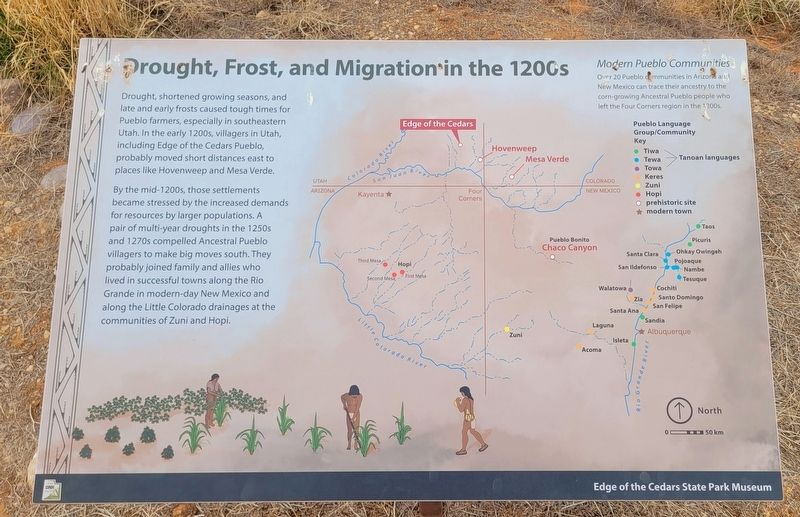
Drought, Frost, and Migration in the 1200s
Photographed by James Hulse, March 28, 2025
1. Drought, Frost, and Migration in the 1200s Marker
By the mid-1200s, those settlements became stressed by the increased demands for resources by larger populations. A pair of multi-year droughts in the 1250s and 1270s compelled Ancestral Pueblo villagers to make big moves south. They probably joined family and allies who lived in successful towns along the Rio Grande in modern-day New Mexico and along the Little Colorado drainages at the communities of Zuni and Hopi.
Modern Pueblo Communities
Over 20 Pueblo communities in Arizona and New Mexico can trace their ancestry to the corn-growing Ancestral Pueblo people who left the Four Corners region in the 1,200s.
Pueblo Language Group/Community Key
Tiwa - Taos, Sandia, Picuris, Isleta (Tanoan languages)
Tewa - Santa Clara, San Ildefonso, Ohkay Owingeh, Pojoaque Nambe, Tesuque (Tanoan languages)
Towa - Walatowa (Tanoan languages)
Keres
this page online
Zuni - Zuni
Hopi - Third Mesa, Second Mesa, First Mesa
prehistoric site - Mesa Verde, Chaco Canyon, Hovenweep, Edge of the Cedars
modern town - Albuquerque, Kayenta
Erected by Edge of the Cedars State Park Museum.
Topics. This historical marker is listed in these topic lists: Anthropology & Archaeology • Indigenous Peoples and Communities • Settlements & Settlers.
Location. 37° 37.88′ N, 109° 29.45′ W. Marker is in Blanding, Utah, in San Juan County. It is at the intersection of West 400 North and 600 W on West 400 North. The marker is located on the grounds of the Edge of the Cedars State Park Museum. Touch for map. Marker is at or near this postal address: 660 W 400 N, Blanding UT 84511, United States of America. Touch for directions.

Regionally, this marker is in Canyon Country. It is also in the American Mountain West, on the Colorado Plateau, and at the Four Corners. Globally, it is in North America, the Western Hemisphere, the Western World, and the Anglosphere. Historically,

Photographed by James Hulse, March 28, 2025
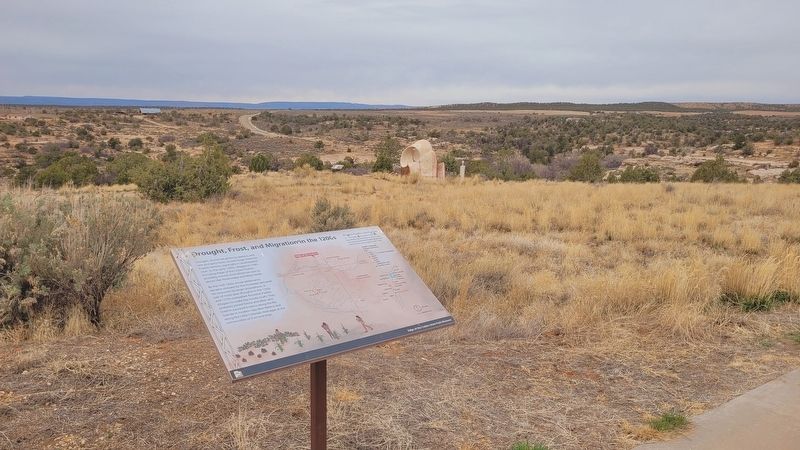
2. The view of the marker along the trailway
Other nearby markers. At least 8 other markers are within walking distance of this marker: Exposure and Safe Keeping (here, next to this marker); Leaving the Pieces In Place (a few steps from this marker); Living in the Earth: A Look Inside a Kiva (a few steps from this marker); Trade with Far Off Places (within shouting distance of this marker); A Great House and a Great Kiva (within shouting distance of this marker); Can a Sliver of Light Have Meaning? (within shouting distance of this marker); Explore the Edge Of the Cedars Chacoan Great House Site (within shouting distance of this marker); C.C.C. (approx. 0.3 miles away). Touch for a list and map of all markers in Blanding.
Credits. This page was last revised on April 19, 2025. It was originally submitted on April 19, 2025, by James Hulse of Medina, Texas. This page has been viewed 156 times since then and 29 times this year. Photos: 1, 2. submitted on April 19, 2025, by James Hulse of Medina, Texas.
