Blanding in San Juan County, Utah — The American Mountains (Southwest)
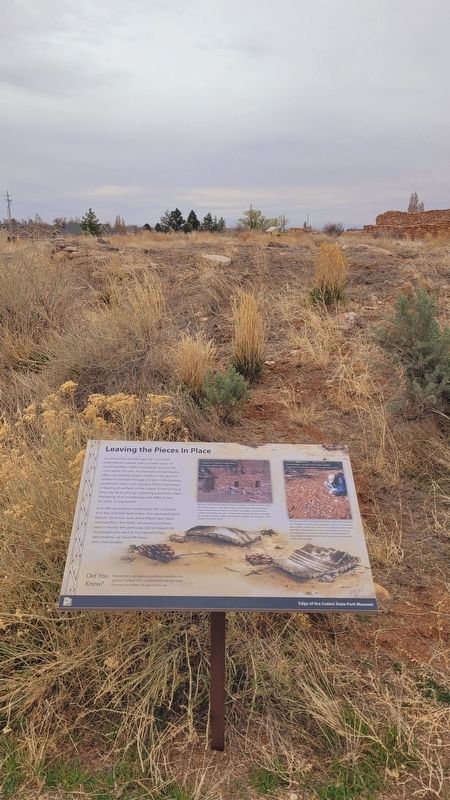
Leaving the Pieces In Place

Photographed by James Hulse, March 28, 2025
1. Leaving the Pieces In Place Marker
Scientific excavation is essentially the controlled and documented destruction of an archaeological feature. Once soil, rock, and artifacts have been removed from the earth, we cannot put them back in exactly the same way. Out of respect for the people who used to live here and their descendants, we have left many sites unexcavated.
Did You Know?
Researchers can examine pottery sherds on the ground surface of an undisturbed site and date the place to within 25 years of its use.
Captions
(Photo #1) Turkey Pen Pueblo at Cedar Mesa. Courtesy of BLM Utah. 1978.
Removal of artifacts and disturbing the layers of earth in which they are buried results in the destruction and disappearance of pieces of our shared human history. Artifacts have been removed from Turkey Pen Pueblo for over 130 years. As a result, we can no longer use artifacts on the surface of the site to reliably tell the story of the people who lived there.
(Photo #2) Archaeologist, Jonathan Till, studies pottery fragments near Bullet Canyon on Cedar Mesa. 2018.
The dark grey dirt indicates that these potsherds were part of a "midden," an intentional deposit of pottery fragments, stone flakes, hearth ash, and charcoal. Because the artifacts were left undisturbed, we can assess when the site was occupied, how the site functioned, and what kinds of long-distance relationships the site occupants had with other communities.
Erected by Edge
this page online
Topics. This historical marker is listed in these topic lists: Anthropology & Archaeology • Indigenous Peoples and Communities. A significant historical year for this entry is 1978.
Location. 37° 37.885′ N, 109° 29.448′ W. Marker is in Blanding, Utah, in San Juan County. It is at the intersection of West 400 North and 600 W on West 400 North. The marker is located on the grounds of the Edge of the Cedars State Park Museum. Touch for map. Marker is at or near this postal address: 660 W 400 N, Blanding UT 84511, United States of America. Touch for directions.

Regionally, this marker is in Canyon Country. It is also in the American Mountain West, on the Colorado Plateau, and at the Four Corners. Globally, it is in North America, the Western Hemisphere, the Western World, and the Anglosphere. Historically, it finds itself in what was once New Spain and also Mexico’s Alta California.

Other nearby markers. At least 8 other markers are within walking distance of this marker: Exposure and Safe Keeping (here, next to this marker); Drought, Frost, and Migration in the 1200s (a few steps from
Photographed by James Hulse, March 28, 2025
2. The view of the unexcavated area and marker
Photographed by James Hulse, March 28, 2025
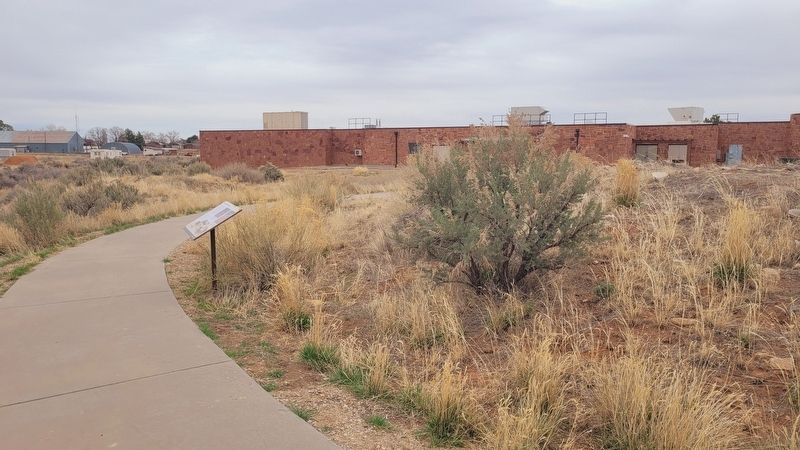
3. The view of the marker along the trailway
Photographed by James Hulse, March 28, 2025
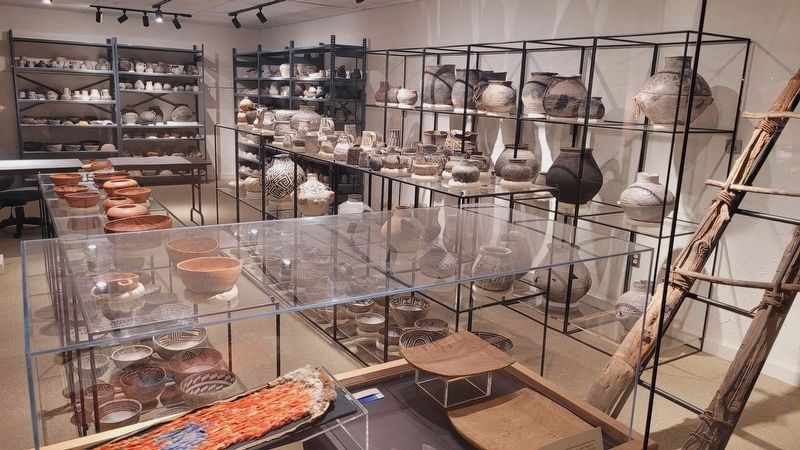
4. Pottery sherds and clay pots located in the museum
Credits. This page was last revised on April 19, 2025. It was originally submitted on April 19, 2025, by James Hulse of Medina, Texas. This page has been viewed 110 times since then and 16 times this year. Photos: 1, 2, 3, 4. submitted on April 19, 2025, by James Hulse of Medina, Texas.
