Galway in County Galway, Connacht, Ireland — Irish West ((Éire) North Atlantic Ocean)
Tourist Information
Eolas Cuartaíochta
Photographed by William Fischer, Jr., April 6, 2025
1. Tourist Information Marker

[Historical information excerpts]
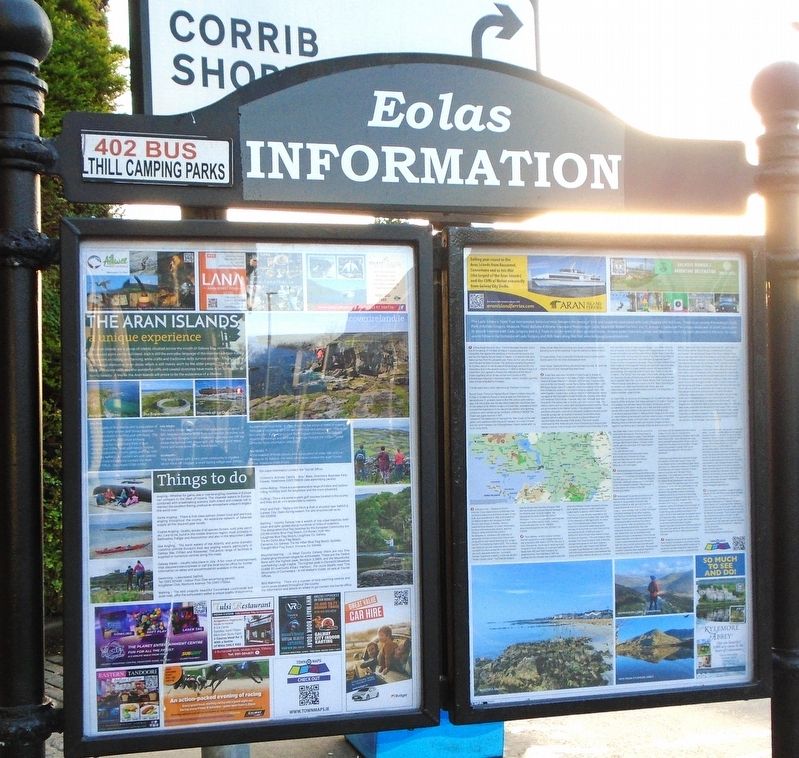
The Aran Islands a unique experience
[left panel, not transcribed as tourist focused]
[Right panel]
The Lady Gregory Yeats Trail incorporates historical sites between the towns of Gort and Loughrea associated with Lady Gregory and W.B. Yeats.... Writers, poets, historians, artists and musicians have long been attracted to the area. We invite you to follow in the footsteps of Lady Gregory and W.B. Yeats along this trail.
① Kilmacduagh Monastic Site - The Kilmacduagh Monastic Site is one of the jewels of the West of Ireland. It exudes peace and tranquillity. Set against the backdrop of the Burren Mountains, this site has the highest Round Tower in Ireland. It is Ireland's Pisa, as it leans two feet from the perpendicular. There are the ruins of seven churches and an abbot's house. The cemetery contains the grave of St. Colman, patron of the diocese of Kilmacduagh and founder of a monastery here in the seventh century. In 1879 Sir William Gregory of Coole Park, Gort agreed to finance the restoration of the Round Tower regarding which he had written from Ceylon
this page online
Kilmacduagh deserves to be known better; visitors "stumble" place and are enthralled by its beauty.
The Monastic Ruins, often referred to as The Seven Churches.
Round Tower: This is the highest Round Tower in Ireland, being 120 ft. high. It is Ireland's Pisa as it leans at least two feet from the perpendicular. It probably dates to the 10th century and tradition says that the builder was the legendary tradesman, the Goban Saor. At the behest of Sir William Gregory of Coole Park, renovations which included the restoration of the cap and the addition of a lightning conductor, were carried out by the Board of Works in 1878/9. The Tower was again repaired in 1971.
Cathedral: The oldest part of Teampaill Mor Mac Duagh is the west gable. Later additions were the south transept, Our Lady's Chapel and the north transept, the O'Shaughnessy Chapel, named after the local ruling family.
Glebe House: Seancloch is a large two-storey, castellated structure standing north of the cathedral. It was the bishop's or abbot's house.
O'Hynes Abbey: This is a beautiful thirteenth century building which stands apart from the other
Photographed by William Fischer, Jr., April 6, 2025
2. Tourist Information Marker
Other Ruins: Teampaill Mhuire, situated across the road; St. John the Baptist Church and Teampaill Beg Mac Duach
② Coole Park was once the home of Lady Gregory, dramatist. folklorist and co-founder of the Abbey Theatre with William Butler Yeats and Edward, Martyn. In the early 20th century, Coole was the centre of the Irish literary revival. Yeats, George Bernard Shaw, John Millington Synge, Sean O' Casey all came to experience its magic; their initials are carved on the world famous autograph tree in the walled garden. Coole is now a nature reserve of international repute, managed by the National Parks and Wildlife Service and comprising 405 hectares (1000) Acres of woods, lake, river, turlough and bare limestone. The nature reserve is open daily with marked trails.... Coole Park which together with the adjoining Garryland, is a Nature Reserve of approximately 405 hectares (1000 acres). The seven woods celebrated by W.B. Yoats are part of the 6 kilometres of nature trails taking in woods, river, turlough, bare limestone and Coole lake.
Coole Park the family home of Lady Augusta Gregory,
Photographed by William Fischer, Jr., April 6, 2025
3. Tourist Information Marker
At Coole Park, we invite you to investigate for yourself the magic and serenity of the landscape that Yeats captured in his poetry. Through this website, you will learn about the history of the park, and its connections to the literary world, and it also provides a guide to the natural history and wildlife of the park and surrounding areas. Coole estate was purchased in 1768 by Robert Gregory on his return to Ireland following service with the East India Company. It remained with the Gregory family until 1927 when it was sold to the state. Residing there at that time was Lady Augusta Gregory, already a legend in her lifetime as a dramatist, folklorist and co-founder of the then Abbey Theatre with W.B. Yeats and Edward Martyn. Lady Gregory's love of Coole and its 'Seven Woods', immortalised by Yeats, is manifested in her writings and those of her literary guests. "These woods have been well loved, well tended by some who came before me, and my affection has been no less than theirs. The generations of trees have been my care, my comforters. Their companionship has often brought me peace." Lady Gregory, Coole, 1931. She was one of the most important figures in the Irish Literary Revival of the early 20th century, not only because of her achievements as a playwright. but also because of the way she transformed Coole into a focal point for those who shaped that movement, making it a place they would return to time and time again to talk, to plan, to derive inspiration. But the woods and lakes at Coole were richer than Yeats divined.
The 'Seven Woods', which so enchanted Lady Gregory and her guests held whispers of a more ancient ancestry, of which the literary visitors were scarcely aware: remnants of the earlier natural forest cover, and the disappearing lake and river are part of the finest turlough complex not merely in Ireland but in all the world. Lady Gregory died on 22nd May 1932. In one sense, the magic of Coole has been in abeyance since the demolition of the house in 1941, a time when more immediate concerns occupied the minds of most people Coole-Garyland is now a statutory Nature Reserve managed by the National Parks & Wildlife Service, whose aim is to preserve its rich natural and cultural heritage. www.coolepark.ie
③ Kiltartan Cross - Situated at historic Kiltartan Cross, made famous by W.B. Yeats, this red brick building is an architectural gem. It was built as a schoolhouse in 1892 at the behest of Sir William Gregory and designed by Frank Persse, Lady Gregory’s brother. Now an award-winning museum, it houses memorabilia, furniture and manuscripts dealing with the Gregory family and the Irish Literary Renaissance. It contains a rich collection of genealogy and local history which has proved invaluable for the Ireland Reaching Out project and for The Gathering Ireland 2013. The building also holds an old Irish classroom which will take you back in time to school life in the nineteenth and early twentieth centuries. Comments include: “absolutely brilliant”, “could stay all day”, “lovely, friendly place”. The Kiltartan Gregory Cultural Society was founded in August 1990 with the broad aim of preserving the heritage of the Kiltartan area in South Galway. We highlight the work of the Irish Literary Renaissanc[e] and the part played by Lady Augusta Gregory and William Butler Yeats….
④ Thoor Ballylee A 16th Century Fortified Norman castle with a small cottage attached [to] it was acquired by WB Yeats in 1917 for the sum of thirty five pounds. He set about restoring it and renamed it Thoor Ballylee. He lived here with his family from 1921 until 1929. Following his departure from Thoor Ballylee in 1929 the building fell into disrepair and it wasn't until 1964 when the Kiltartan Society founded by the late Mary Hanley undertook a major restoration project partly funded by Bord Failte and the Yeats family. It was officially reopened by the poet Padraic Colum on Sunday 20th June 1965 on the centenary of WB Yeat's birth.
For many years Thoor Ballylee was a major tourist attraction in the South Galway area partly because of its proximity to Coole Park until the devastating floods of 1995 and again in 2009/2010 which forced Failte Ireland to close its doors to the public. The Lady Gregory Yeats Heritage Trail Group formed in 2010 to link the heritage sites between Gort and Loughrea connected with Lady Gregory and WB Yeats included Thoor Ballylee as a major site on the trail. Discussions have taken place between the group and Failte Ireland late last year and since then Failte Ireland have carried out restoration work within the building. The Group hope to persuade Failte Ireland to reopen Thoor Ballylee as it is a very important part of the literary and heritage trail of South Galway.
A plaque on the nearby wall commemorates W.B. Yeats' sojourn at Thoor Ballylee.
I, the poet William Yeats
With old mill boards and sea green slates,
And smith work from the Gort forge,
Restored this tower for my wife George;
And may these characters remain
When all is ruin once again.
⑤ Killinane Graveyard is located in the townland of Castleboy in the parish of Kilchreest, Co Galway.... The graveyard is located within the domain of the Old Roxborough Estate.
⑥ Roxborough House was once home to the Persse Family and many family members are interred in the graveyard including Lady Gregory's family, as well as local Church of Ireland families thus its inclusion in the Lady Gregory Yeats Heritage Trail. In 2006 Kilchreest Castleday Heritage Group, after receiving funding from the Heritage Council and from Galway County Council commissioned Moore Archaeological & Environmental Services to survey the site.
With the permission of the Church Representative Body they then undertook the clean up of the graveyard which was hidden from view by brambles, briars, bushes and heavy undergrowth. It had become totally overgrown and neglected over the years. It was a huge undertaking but all the work to date has been carried out by local volunteers who give generously of their time. The group are currently collecting data, reading headstone inscriptions and are hoping that all this information will be digitised later this year by Galway County Council. This will prove invaluable for descendants of families laid to rest there tracing their roots. Although there are some unmarked graves within the grounds it is hoped that this project will assist them. In early spring the graveyard is awash with colour, snowdrops, bluebells and daffodils grow in abundance.
The Roxborough Gates were restored through the initiative of the Lady Gregory Yeats Trail Group. Repair works to the entrance gates which date back to c 1860 were carried out by Mathieu & Mitchell who are master craftsmen in stone masonry and also with the help of local volunteers. The conservation works were completed in 2012. This project was sponsored by Galway Rural Development and Galway County Council. The cast-iron gates were made by Richard Turner who also participated in the design of the Palm House at Kew Gardens, England. The gateway creates a handsome, sweeping entrance and forms an interesting roadsite feature.
Augusta Perrse was born at Roxborough on the 15th of March, 1852. She later became Lady Gregory - Irish dramatist, forklorist, patron of W.B. Yeats and co-founder of the Abbey Theatre, Dublin. Her ancestor Dean Dudly Persse was granted lands here in this region by the Crown and built his mansion house at Cregarosta, later changing the name to the Borders' name Roxborough, the Persse family having come from Northumberland, England. Roxborough was the seat of the Persse family for 245 years but sadly the 18th century mansion was destroyed by fire in 1922 during the Irish Civil war.
⑦ Woodview House is set at the foot of the Slieve Aughty Mountains in South East Galway. The Walled Garden at Woodville consists of 1.5 acres and has been beautifully restored with colorful herbaceous borders, espaliered fruit trees, vegetable garden, rose garden and serene water-fountain. Another feature of the garden is a surviving Dovecote which is one of the few remaining "Garden Follies" in the West of Ireland and is now home to a family of white fantail doves. The adjoining Stables of cut stone exhibits the history of Woodville and surrounding locality. The museum has on display, old photos of various members' of the Persse family, including Adelaide Lane nee Persse, mother of Hugh Lane the famous art collector. Various books belonging to the family including one signed by Lady Augusta Gregory, dated 1898. Numerous letters from family members dated from the beginning of the last century, old receipts, vintage farm machinery and other artifacts. All revealing an eye catching view of life in South Galway at the turn of the last century.
⑧ St. Brendan's Cathedral - Loughrea gets its name from the Irish Baile Locha Riach, the town of the Grey Lake. The Cathedral lies on the northern shore of this beautiful lake. St. Brendan's Cathedral is a "Treasure House of Celtic Revival Art". Loughrea is the Cathedral Parish of the Diocese of Clonfert. There are two churches in the parish: the Carmelite Abbey and St. Brendan's Cathedral. The foundation stone of the Cathedral was laid on October 10, 1897. Although small in size it is large in its interior magnificence. It has been described as the jewel in the crown of the Celtic Revival.
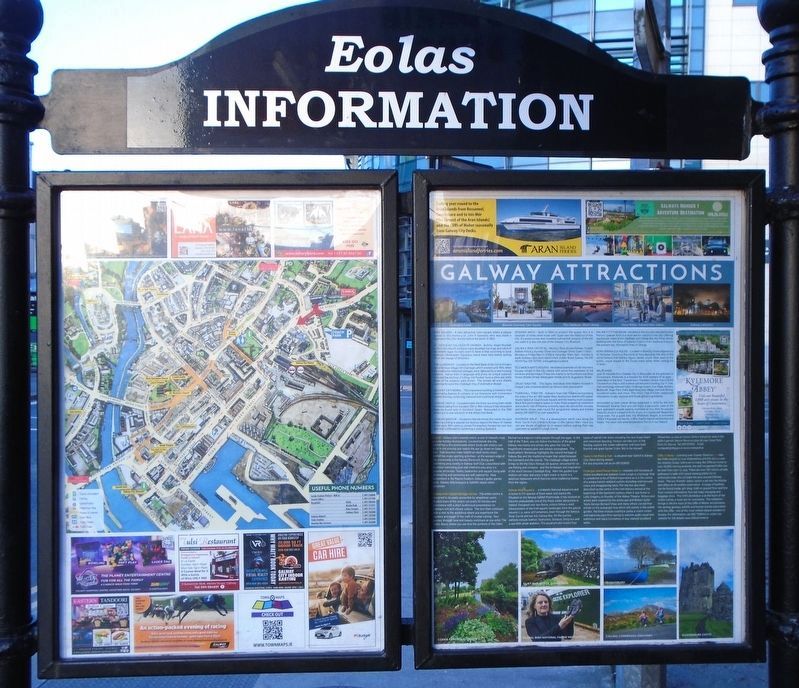
[Kiosk opposite side excerpts focused on Galway City]
EYRE SQUARE - A very attractive town square, where a plaque stands to the memory of John F. Kennedy, who was made a Freeman of the City shortly before his death in 1963.
ST. NICHOLAS' COLLEGIATE CHURCH - Built by Anglo-Norman in 1320, this church contains many excellent carvings and relics of the Middle Ages. Its main claim to fame is that according to local tradition, Christopher Columbus heard mass here before setting off on his voyage of discovery.
THE CLADDAGH - Located on the West Bank of the Corrib Estuary was a famous village, the Claddagh, which existed until 1934 when the traditional thatched cottages were replaced by a new housing scheme. Native Irish in language and dress, its unique customs included the election of a King. His 'hooker' bore a white sail, while those of his subjects were brown. The women all wore shawls, customarily wore the Claddagh ring of distinctive design.
GALWAY CATHEDRAL - This impressive building is Galway's most dominating feature. It consists of cut limestone with Connemara marble flooring combining classical and traditional designs.
LYNCH'S CASTLE - Unquestionably the finest surviving town castle Ireland, dating from the early 15th or 16th century. It has decorative features found only in Southern Spain. Renovated in the 19th century, it is now a branch of the Allied Irish Bank.
LYNCH'S WINDOW - Situated in Market Street, this marks the spot where according to popular but dubious legend, the Mayor of Galway the early 16th century, James Fitzstephen, hanged his own son, who had confessed to murdering a visiting Spaniard.
SPANISH ARCH - Built in 1594 to protect the quays, this is a reminder of times when trade with Spain was the lifeblood of the city. Excavations has also revealed substantial remains of the old city walls. It is also the site of the Galway City Museum.
OLD MERCHANT'S HOUSES - Mutilated examples of old merchant houses remain in the city centre, with some fine examples of old windows and doorways. These are mainly to be found around Shop Street, Middle Street, Abbeygate Street and St. Augustine Street.
GALWAY CITY MUSEUM - situated in the city centre, behind the historic Spanish Arch, is a must see for visitors to the city. Offering spectacular views of the Claddagh and Galway Bay, this three-storey building tells the story of Galway's history from medieval times to the present day.
NORA BARNACLE HOUSE - Located in Bowling Green adjacent to St. Nicholas' Church is the home of Nora Barnacle, the wife of the world famous Irish literary figure, James Joyce. Now open to the public, Joyce stayed in the house many times while visiting his in-laws.
Erected by Town Maps.
Topics. This historical marker is listed in these topic lists: Arts, Letters, Music • Parks & Recreational Areas • Settlements & Settlers • Women. A significant historical date for this entry is May 22, 1932.
Location. 53° 16.504′ N, 9° 2.773′ W. Marker is in Galway, Connacht, in County Galway. It is at the intersection of Forster Street (Connacht Route 336) and Fairgreen Road, on the left when traveling south on Forster Street. Touch for map. Marker is in this post office area: Galway, Connacht H91 PY7E, Ireland. Touch for directions.

Regionally, it is on the Atlantic Ocean, in the North Atlantic Region, on the Atlantic Arc, in Europe, on the Island of Ireland, on the Celtic Fringe, in the European Union, in Atlantic Europe, on one of the British Isles, in the Western World, and in the Anglosphere.
Other nearby markers. At least 8 other markers are within walking distance of this marker: In Memory of the Magdalen Women (within shouting distance of this marker); Seán Duggan (within shouting distance of this marker);
Also see . . . Lady Gregory Yeats Heritage Trail. (Submitted on April 23, 2025, by William Fischer, Jr. of Reynoldsburg, Ohio.)
Credits. This page was last revised on December 3, 2025. It was originally submitted on April 23, 2025, by William Fischer, Jr. of Reynoldsburg, Ohio. This page has been viewed 127 times since then and 37 times this year. Photos: 1, 2, 3. submitted on April 23, 2025, by William Fischer, Jr. of Reynoldsburg, Ohio.
