Cong in County Mayo, Connacht, Ireland — Irish West ((Éire) North Atlantic Ocean)
Cong Places to Visit
Information/Eolas
Photographed by William Fischer, Jr., April 8, 2025
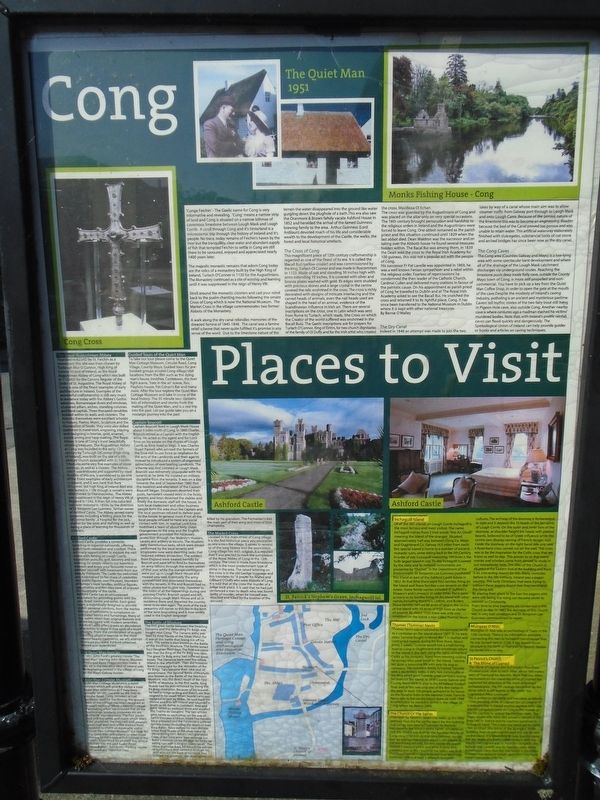
1. Cong Places to Visit Marker

'
The majestic monastic remains that adorn Cong today are the relics of a monastery built by the High King of Ireland, Turlach O'Connor in 1120 for the Augustinians. The Monastery continued as a site of worship and learning until it was suppressed in the reign of Henry VIII.
Stroll around the monastic cloisters and cast your mind back to the psalm chanting monks following the ornate Cross of Cong which is now the National Museum. The Market Cross in the village commemorates two former Abbots of the Monastery.
A walk along the dry canal rekindles memories of
this page online
The Cross of Cong
This magnificent piece of 12th century craftsmanship is regarded as one of the finest of its era. It is called the íBacall Buil (yellow crozier) and was commissioned by the king, Turlach Oí Connor and was made in Roscommon in 1123. Made of oak and standing 30 inches high with arms extending 19 inches, it is covered with silver and bronze plates washed with gold. Its edges were studded with precious stones and a large crystal in the centre covered the relic enshrined in the cross. The cross is richly decorated with designs of intricate interlacing
Photographed by William Fischer, Jr., April 8, 2025
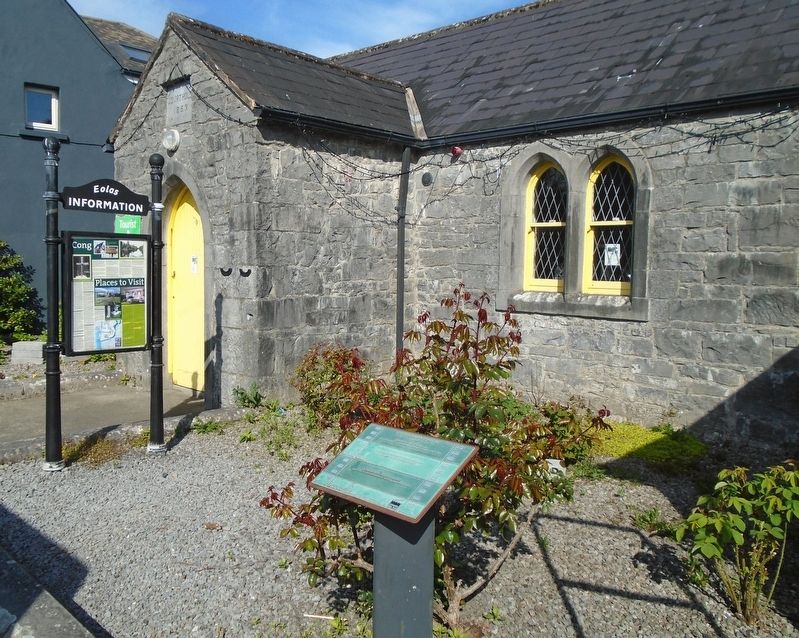
2. Cong Places to Visit Marker
There are several inscriptions on the cross, one in Latin which was sent from Rome to Turlach, which reads, íthe Cross on which the Creator of the world suffered was enshrined in the Bacall Buiú. The Gaelic inscriptions ask for prayers for Turlach O'Connor, King of Eirinn, for two church dignitaries of the family of Oí Duffy and for the Irish artist who created the cross, Maoiliosa Oí Echan.
The cross was guarded by the Augustinians of Cong and was placed on the altar only on very special occasions. The 16th century brought persecution and hardship to the religious orders in Ireland and the Augustinians were forced to leave Cong. One abbot remained as the parish priest and this situation continued until 1829 when the last abbot died. Dean Waldron was the successor and on taking over the Abbot[']s house he found several treasures hidden within. The Bacal Bui was among them, in 1839 the Dean sold the cross to the Royal Irish Academy for 100 guineas, this was not a popular act with the people of Cong.
His successor Fr Pat Lavelle was appointed in 1869, he was a well known Fenian sympathiser and a rebel within the religious order. Fearless of repercussions he condemned the then leader of the Catholic Church, Cardinal Cullen and delivered many orations in favour of the patriotic cause. On his appointment as parish priest of Cong he travelled to Dublin and at The Royal Irish Academy asked to see the Bacall Bul. He snatched the cross and returned it to its rightful place, Cong. It has since been transferred to the National Museum in Dublin where it is kept with other national treasures.
By Bernie O'Malley
The Dry Canal
Indeed in 1848 an attempt was made to join the two lakes by way of a canal whose main aim was to allow steamer traffic from Galway port through to Lough Mask and onto Lough Carra. Because of the porous nature of the limestone this was to become an engineering disaster because the bed of the Canal proved too porous and was unable to retain water. This artificial waterway elaborately finished with sluicegates, substan[t]ial locks of cut stone and arched bridges has since been now as the dry canal.
The Cong Caves
The Cong area (Counties Galway and Mayo) is a low-lying area with some spectacular karst development and where all of the drainage of the Lough Mask catchment discharges via underground routes. Reaching the limestone pools deep inside Kelly cave, outside the County Mayo town of Cong, is more self-propelled and non-commercial. You have to pick up a key from the Quiet Man Coffee Shop, in order to open the gate at the mouth of the cave. Despite the modesty of Ireland's caving industry, potholing is an ancient and mysterious pastime. Cavers tell mythic stories of the two fairy trout still living in Pigeon Hole cave, also outside Cong. Another nearby cave is where centuries ago a madman stashed his victims murdered bodies. Note that, with Ireland's prolific rainfall caves can flood quickly and dangerously. The Speleological Union of Ireland can help provide guides or books and articles on caving techniques.
The Royal Augustinian Abbey
Founded in 623AD by St. Feichin as a monestary [sic] this site was then chosen by Turlough Mor O Connor, High King of Connacht and of Ireland, as the Royal Augustinian Abbey of Cong which was built in 1120AD for the Canons Regular of the Order of St. Augustine. The Royal Abbey of Cong is one of the finest examples of early architecture in Ireland. Examples of the wonderful craftsmanship is still very much in evidence today with the Abbey's Gothic windows, Romanesque doors and windows, clustered pillars, arches, standing colum[n]s and floral capitals.
Three thousand cenobites resided within its walls and cloisters. The Abbotts themselves were excell[e]nt scholars in History, Poetry, Music, Sculpture and the illumination of books. [T]hey were also skilled craftsmen in metal work, engraving, inlaying and designing in bronze, gold, enamel, woodcarving and harp making. The Royal Abbey is one of Cong's most beautifully stricking [sic] treasures.
The Augustinian Abbey at Cong was founded in the early 12th century by Turlough OíConnor (High King of Ireland), was built on the site of a 6th century church associated with St. Feichlin. It features some very fine examples of stone carvings, as well as a cloister. The Abbey, which was endowed and supported by royal families of this era, is considered to be one of the finest examples of early architecture in Ireland, and it was here that Rory O'Connor, last high King of Ireland died and was buried in 1198 though [h]is remains were later moved to Clonmacnoise.
The Abbey was suppressed in the reign of Henry VIII of England in 1542. It then fell into ruins but was later restored in 1850[']s by the direction of Sir Benjamin Lee Guinness, former owner of Ashford Castle. The Abbey served many purposes including a hiding place for the OíConnor family, a hospital for the sick, shelter for the poor and starving as well as being a place of learning for thousands of scholars.
Ashford Castle
[not transcribed as info is strictly tourism related]
The Quiet Man lives on
In 1951 John Ford's greatest movie "The Quiet Man" starring John Wayne, Maureen O'Hara and Barry Fitzgerald was made. It was set in the beautiful west of Ireland with filming being centred in the village of Cong on the Mayo-Galway border.
Quiet Man Cottage Museum
Quiet Man Cottage Museum is a novel concept which will give the visitor a total Quiet Man experience as if they were actually 'on-set'. Located by the river at Circular Road, Cong, between actual locations used for the filming, the ground floor of the cottage has been designed as an exact replica of 'White-o-Mornin' Cottage. Painstaking effort has ensured that all the furnishings, artefacts, costumes etc are authentic reproductions. The four poster bed and the tables and chairs which 'Mary Kate' cherished, the thatched roof, emerald green half door and white washed front combine to charm all those who visit it. "Quiet Man Cottage Museum" is a must for any Quiet Man enthusiasts, or even those wishing to visit a typical Irish cottage of the 1920's....
Guided Tours of the Quiet Man
[not transcribed as info is strictly tourism related]
Captain Boycott
Captain Boycott lived in Lough Mask House about 4 miles north of Cong. In 1880 Charles Boycott retired as a Captain with the English army. He acted as the agent and for Lord Erne on his estate on the shores of Lough Corrib as Erne lived in Sligo. It was Charles Stuart Parnell who advised the farmers of the time not to use force as retaliation for the acts of the Landlords and their agents[. I]nstead he introduced a system of organised ostracisation of overbearing Landlords.
The scheme was first initiated at Lough Mask. Boycott was extremely unpopular with his tenants at [t]he time. He insisted on military discipline from the tenants. It was on a day towards the end of September 1880 that the isolation and alienation of the Captain Boycott began. Employees deserted their posts, harvesters ceased work in the fields, grooms and boys deserted the stables and finally the domestic staff left the house. In turn local tradesmen and other business people f[ro]m the area shun[ned] the Captain and the local postman refused to deliver post to the house. In general most if not all the local people refused to have any social contact with him.
In reprisal Lord Erne mobilised a team of about forty Ulster Orangemen to the area and the English government provided the necessary protection through Her Majesty's Huzzars, cavalry and artillery as escorts. The ritualistic, daily monotonous tasks, which were always performed by the local tenants and employees now were daunting tasks that required military protection. The soldiers from England were treated horridly by Boycott and were left to fend for themselves on army rations through the severe winter of that year while the [O]range contingent were put up in Lough Mask House and treated very well. Eventually the army sympathised and associated themselves with the tenants. In the end Boycott had no other choice but to give way.
However in the midst of all the happenings during one evening Charles Boycott upped and left, absconding Lough Mask House and all in residence there and departed the country never to be seen again. The work of the local peasantry still stands to this day in the form of the term boycotting and is now widely used in the English language[.]
The Battle of Moytura
The first great battle between the invading Dananns and the defending Fir Bolgs was fought near Cong. The Danann army was lead by King Nauda of the Silver Hand (for it was at this battle that Sreng cut off his arm). This battle is also known the Battle of the Southern Moytura. The battle lasted four slaughter filled days. The final outcome was that the King of Fir Bolg was slain. The great Fir Bolg army had suffered great losses The Dananns took over the whole island in the aftermath. They did however leave Connaught for the remnants of the Fir Bolgs. Tara became their new seat of government.
The Second Battle of Moytura, also known as the Battle of Northern Moytura, was the direct result of the First Battle of Moytura. In the first battle, King Nuada had his arm removed by Streng the Fir Bolg champion. Because of his wound, he had to resign as King and Balor's son Bres reigned in his stead. When Nuada's arm was replaced as new by Midac, he took back the throne and Bres left Ireland and returned in wrath to his father in Lochlann.
Bres and Balor raised an invasion army and assailed the Tuatha de Dananns. The two armies gave battle to each other on the eve of Samin (October 31st [?] 3330). The Danann force prevailed and the Formorians suffered terrible losses (including the death of their King Balor). Balor before his demise killed King Nuada of the silver hand by decapitating him. Balor's own grandson Luga of the long arms took revenge (on Balor's attempt on his life after his birth) by killing him with a sling or 'clann laval'[?]. The stone that Luga fired, hit Balor in his evil eye at such a place that carried it through his skull and out the back of his head. This fulfilled the prophecy that Balor would be killed by his grandson. The Formorian's lost the main part of their army and most of their champions.
The Market Cross
Located in the main street of Cong village it is the first historical piece you encounter as one enters the village. It serves to remind us of the long history and the association Cong village has with religion. It is reputed that it was erected to mark the completion of the Royal Abbey of Cong in the 12th century. The cross is made from limestone which is the most predominant type of stone in the area. The raised lettering on the cross is in the old Gaelige language and this translates to "A prayer for Niahol and Gilbard O'Duffy who were Abbotts of Cong.["] It is told that at the cross the murder of a judge took place. It is said that he had just sentenced a man to death who was found guilty of murder, when he himself was attacked and killed by the brother of the accused.
[Bottom right green-colored block, all focused on Inchagoill Island]
Inchagoill Island
Of all the 365 islands on Lough Corrib Inchagoill is the most famous and most visited. The name Inchagoill comes from 3 Irish words "
Sir Benjamin Lee Guinness purchased this island as part of the Ashford Castle estate in 1852. At that time there were four families living on the Island and these families were tenants on this estate. Some family names included O'Sullivan's[,] Kineavy's and Conway's. In older times there were as many as six families living on the Island with other names including Murphy's, Lydons and Butlers. These families farmed 80 acres of land in the centre of the island with 50 acres of high trees as shelter all around. By about 1935 there was only one inhabitant on the island, a man called Thomas Nevin.
Thomas (Tommie) Nevin
Thomas Nevin was employed by the Guinness family as a caretaker on the island about 1931. In his early years Tommie fought in World War I in Guillipi [Gallipoli?] and contracted malaria during his time there. About every 2 weeks Tommie would row a small fishing boat to Cong or Oughterard and sometimes return to the Island in the dark using the lights of Ashford Castle as his compass. Apart from meeting visiting fishermen who used [to] lunch on the Island, Tommie led quiet a lonesome life with only his dog as company. The Guinness family furnished Tommie with a dry battery radio, a very rare commodity at the time which gave Tommie great company during his years on the Island. In 1938 County Galway and County Kerry were to play in the All Ireland football final, and as this was only one of the few radios in the area, at least 100 people gathered in his house on the Island to listen to this National Event. Tommie Nevin was to live on the Island alone up until 1948 in which year he moved in to live in the village of Cong where he died in 1964.
The Church of the Saints
(
When one walks up the little pathway from the Pier on the Island the first building that comes into view is "
The Church is built of sandstone and their decorative doorways reflect at least 3 different European cultures. The archway of the doorway is Romanesque in style and it depects the 10 heads of the ten saints of Lough Corrib. On the outer and inner tiers of the doorway, at shoulder height are heads with platted beards, believed to be of Greek influence while the centre tiers display carving of French design. Just inside the doorway on the right hand side one sees a Byzantane cross carved out on the wall. This cross was to be the inspiration for the Celtic cross that we know so well to-day. This proves to us that many monks and scholars came from abroad to study in our monasteries here. The alt[a]r of the Church is situated at the Eastern End of the building and there is an interesting reason for this. Many centuries before in the 5th Century, Ireland was a pagan country. The early Christians that were trying to convert these pagans found that they worshiped the rising sun.
By placing their alt[a]rs to the East the pagans who were still facing the rising sun became easier to convert to Christianity. From time to time baptisms are carried out in this Church to-day. In 1862 the doorway of this Church was in very bad condition and Sir Benjamin Lee Guinness commissioned its repair.
Muirgeas O Nioc
Muirgeas O' Nioc was an archbishop of Tuam in the 12th Century. There is no information available connecting this man to Inchagoill Island except that he was buried here in 1128. A big square stone structure to the North of
St. Patrick's Church and the Stone of Lugnad
The stone of Lugnad and St.Patrick's church are situated quiet close to each other, about 100 meters west of
This is written in old Gaelic and translates as follows - "The standing stone of Lugnad Son of Limanin". It is believed that St Patrick and his nephew (who was also his navigator) came to Cong in the middle of the 5th Century to spread the Christian faith. The Pagan druids who were very powerful people at the time had St. Patrick and his nephew banished to Inchagoill Island. This is how the Island got its name -
Topics. This historical marker is listed in these topic lists: Parks & Recreational Areas • Religion & Religious Structures • Settlements & Settlers • Waterways & Vessels.
Location. 53° 32.444′ N, 9° 17.21′ W. Marker is in Cong, Connacht, in County Mayo. It is at the intersection of Abbey Street (Connacht Route 345) and Cong Street, on the right when traveling west on Abbey Street. Marker is in front of the former Courthouse. Touch for map. Marker is in this post office area: Cong, Connacht F31 Y681, Ireland. Touch for directions.

Regionally, it is on the Atlantic Ocean, in the North Atlantic Region, on the Atlantic Arc, in Europe, on the Island of Ireland, on the Celtic Fringe, in the European Union, in Atlantic Europe, on one of the British Isles, in the Western World, and in the Anglosphere.
Other nearby markers. At least 8 other markers are within walking distance of this marker:
Credits. This page was last revised on December 3, 2025. It was originally submitted on April 25, 2025, by William Fischer, Jr. of Reynoldsburg, Ohio. This page has been viewed 242 times since then and 73 times this year. Photos: 1, 2. submitted on April 25, 2025, by William Fischer, Jr. of Reynoldsburg, Ohio.
