Buckhannon in Upshur County, West Virginia — The American South (Appalachia)
Acer rubrum (red maple)
Photographed by Bradley Owen, March 10, 2025
1. Acer rubrum (red maple) Marker
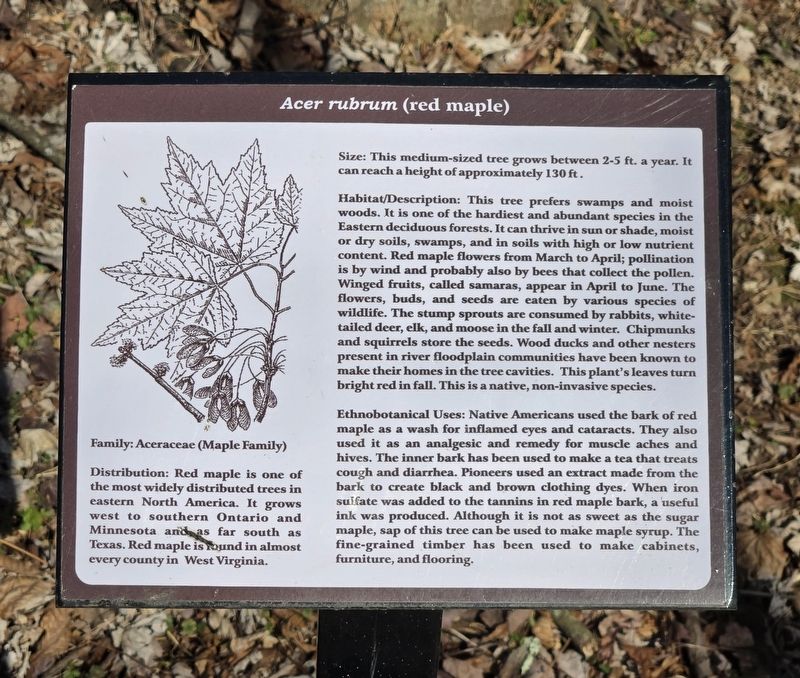
Family: Aceraceae (Maple Family)
Distribution: Red maple is one of the most widely distributed trees in eastern North America. It grows west to southern Ontario and Minnesota and as far south as Texas. Red maple is found in almost every county in West Virginia.
Size: This medium-sized tree grows between 2-5 ft. a year. It can reach a height of approximately 130 ft.
Habitat/Description: This tree prefers swamps and moist woods. It is one of the hardiest and abundant species in the Eastern deciduous forests. It can thrive in sun or shade, moist or dry soils, swamps, and in soils with high or low nutrient content. Red maple flowers from March to April; pollination is by wind and probably also by bees that collect the pollen. Winged fruits, called samaras, appear in April to June. The flowers, buds, and seeds are eaten by various species of wildlife. The stump sprouts are consumed by rabbits, white-tailed deer, elk, and moose in the fall and winter. Chipmunks and squirrels store the seeds. Wood ducks and other nesters present in river floodplain communities have been known to make their homes in the tree cavities.
this page online
Ethnobotanical Uses: Native Americans used the bark of red maple as a wash for inflamed eyes and cataracts. They also used it as an analgesic and remedy for muscle aches and hives. The inner bark has been used to make a tea that treats cough and diarrhea. Pioneers used an extract made from the bark to create black and brown clothing dyes. When iron sulfate was added to the tannins in red maple bark, a useful ink was produced. Although it is not as sweet as the sugar maple, sap of this tree can be used to make maple syrup. The fine-grained timber has been used to make cabinets, furniture, and flooring.
Erected 2017 by West Virginia Wesleyan College Department of Biology.
Topics. This historical marker is listed in these topic lists: Indigenous Peoples and Communities • Industry & Commerce • Science & Medicine.
Location. 38° 59.602′ N, 80° 13.033′ W. Marker is in Buckhannon, West Virginia, in Upshur County. It can be reached from Camden Avenue north of Walktrail Lane, on the left when
Photographed by Bradley Owen, March 10, 2025
2. Acer rubrum (red maple) Marker

Regionally, this marker is in North Central West Virginia. It is also in the American South, specifically in the Upper South, in Appalachia, and specifically in Northern Appalachia. Globally, it is in North America, the Western Hemisphere, the Western World, and the Anglosphere. Historically, it finds itself in what was once the territory of the Mississippian Culture.
Other nearby markers. At least 8 other markers are within walking distance of this marker: Ligustrum vulgare (Chinese or common privet) (here, next to this marker); Acer saccharum (sugar maple) (here, next to this marker); Tony Gum Bridge (a few steps from this marker); Chionanthus virginicus (fringetree) (a few steps from this marker); Euonymus atropurpureus (burning bush, eastern wahoo) (within shouting distance of this marker); a different marker also named Tony Gum Bridge (within shouting distance of this marker); Euonymus fortunei (winter creeper or Fortune's spindle) (within shouting distance of this marker); Asimina triloba (pawpaw, or West Virginia banana) (within shouting distance of this marker). Touch for a list and map of all markers in Buckhannon.
Credits. This page was last revised on April 29, 2025. It was originally submitted on April 29, 2025, by Bradley Owen of Morgantown, West Virginia. This page has been viewed 106 times since then and 15 times this year. Photos: 1, 2. submitted on April 29, 2025, by Bradley Owen of Morgantown, West Virginia.
