Fruita in Wayne County, Utah — The American Mountains (Southwest)
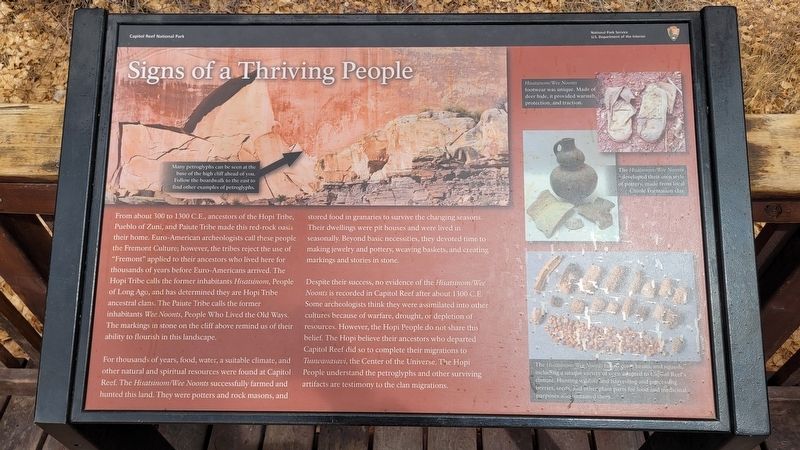
Signs of a Thriving People
Photographed by James Hulse, April 2, 2025
1. Signs of a Thriving People Marker
For thousands of years, food, water, a suitable climate, and other natural and spiritual resources were found at Capitol Reef. The Hisatsinom/Wee Noonts successfully farmed and hunted this land. They were potters and rock masons, and stored food in granaries to survive the changing seasons. Their dwellings were pit houses and were lived in seasonally. Beyond basic necessities, they devoted time to making jewelry and pottery, weaving baskets, and creating markings and stories
this page online
Despite their success, no evidence of the Hisatsinom/Wee Noonts is recorded in Capitol Reef after about 1300 С.Е. Some archeologists think they were assimilated into other cultures because of warfare, drought, or depletion of resources. However, the Hopi People do not share this belief. The Hopi believe their ancestors who departed Capitol Reef did so to complete their migrations to Tuuwanasavi, the Center of the Universe. The Hopi People understand the petroglyphs and other surviving artifacts are testimony to the clan migrations.
Captions
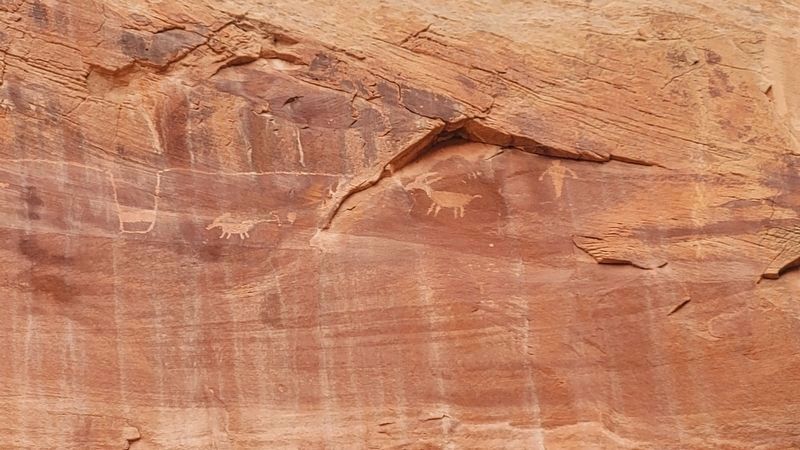
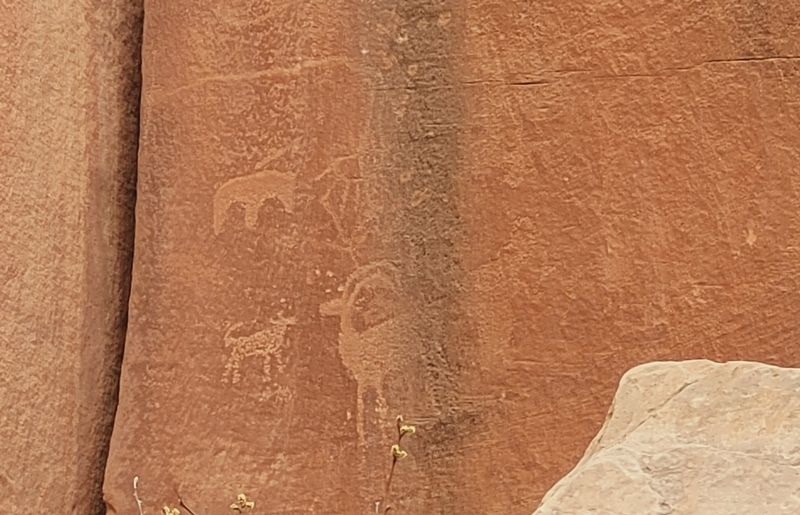
(Photo #1) Many petroglyphs can be seen at the base of the high cliff ahead of you. Follow the boardwalk to the east to find other examples of petroglyphs.
(Photo #2) Hisatsinom/Wee Noonts footwear was unique. Made of deer hide, it provided warmth, protection, and traction.
(Photo #3) The Hisatsinom/Wee Noonts developed their own style of pottery, made from local Chinle Formation clay.
(Photo #4) The Hisatsinom/Wee Noonts raised corn, beans, and squash, including a unique variety of corn adapted to Capitol Reef's climate. Hunting wildlife and harvesting and processing berries, seeds, and other plant parts for food and medicinal purposes also sustained them.
Erected by Capitol
Photographed by James Hulse, April 2, 2025
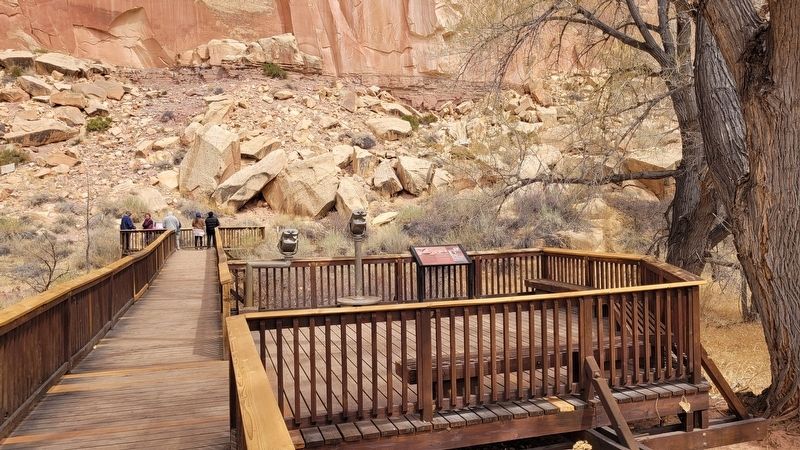
2. The view of the Signs of a Thriving People Marker along the boardwalk
Topics. This historical marker is listed in these topic lists: Agriculture • Indigenous Peoples and Communities. A significant historical year for this entry is 1300.
Location. 38° 17.29′ N, 111° 14.532′ W. Marker is in Fruita, Utah, in Wayne County. It is on State Road 24 1.1 miles east of Scenic Drive, on the right when traveling west. The marker is located on the boardwalk at the Petroglyphs Panels. Touch for map. Marker is at or near this postal address: 875 UT-24, Torrey UT 84775, United States of America. Touch for directions.

Regionally, this marker is in Canyon Country. It is also in the American Mountain West, on the Colorado Plateau, and at the Four Corners. Globally, it is in North America, the Western Hemisphere, the Western World, and the Anglosphere. Historically, it finds itself in what was once New Spain and also Mexico’s Alta California.

Other nearby markers. At least 8 other markers are within walking distance of this marker: Stories in Stone (within shouting distance of this marker); Holt Orchard (within shouting distance
Photographed by James Hulse, April 2, 2025
3. A view of more petroglyphs
Photographed by James Hulse, April 2, 2025
4. Petroglyphs east of the marker
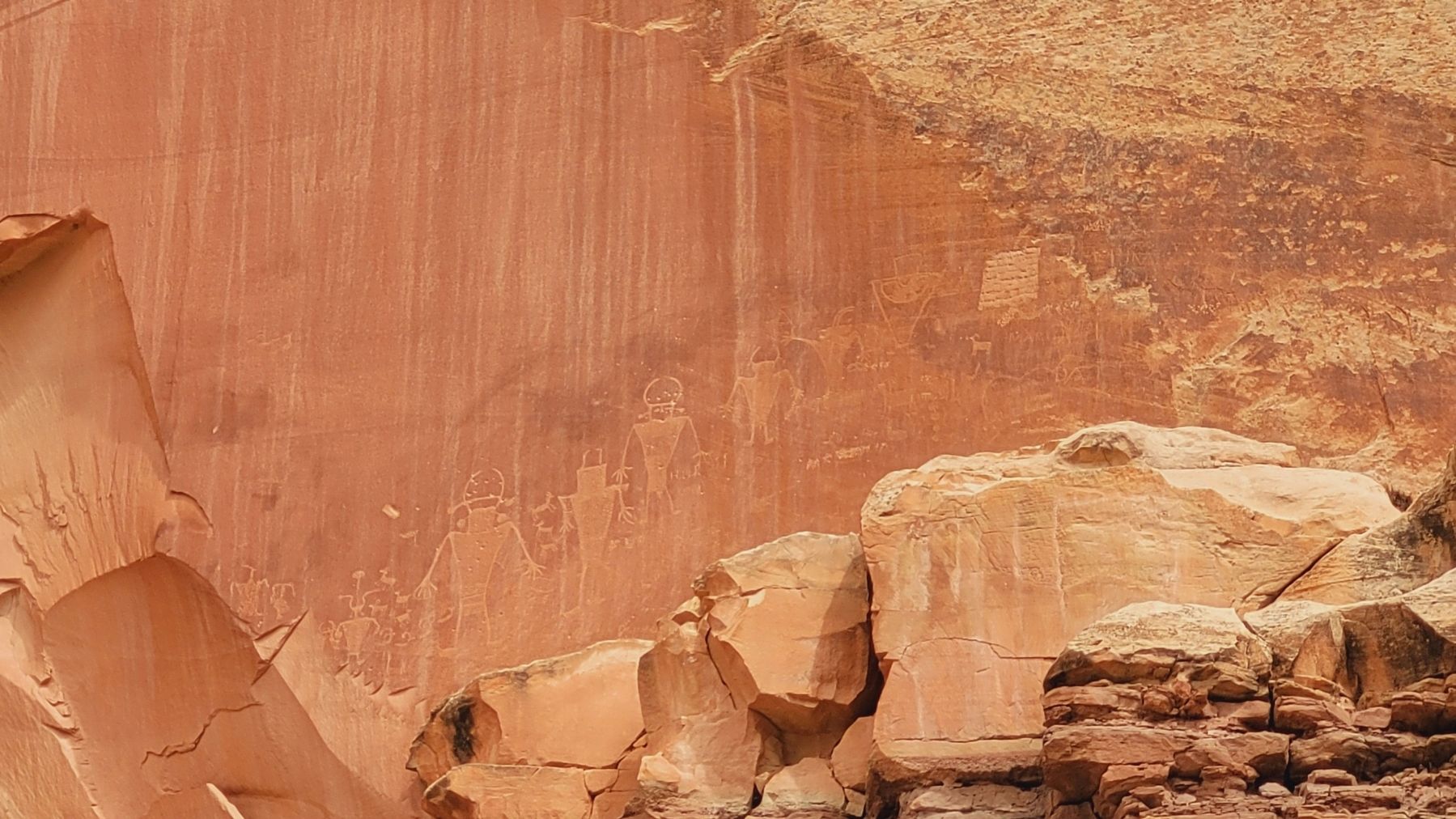
Photographed by James Hulse, April 2, 2025
5. Closeup of the main panel of petroglyphs
Credits. This page was last revised on May 2, 2025. It was originally submitted on May 1, 2025, by James Hulse of Medina, Texas. This page has been viewed 154 times since then and 25 times this year. Photos: 1, 2, 3, 4, 5. submitted on May 2, 2025, by James Hulse of Medina, Texas.
