
Canterbury in Kent, England, United Kingdom — Northwestern Europe (the British Isles)
Welcome to St Augustine's Abbey
Photographed by Ray Gurganus, March 29, 2025
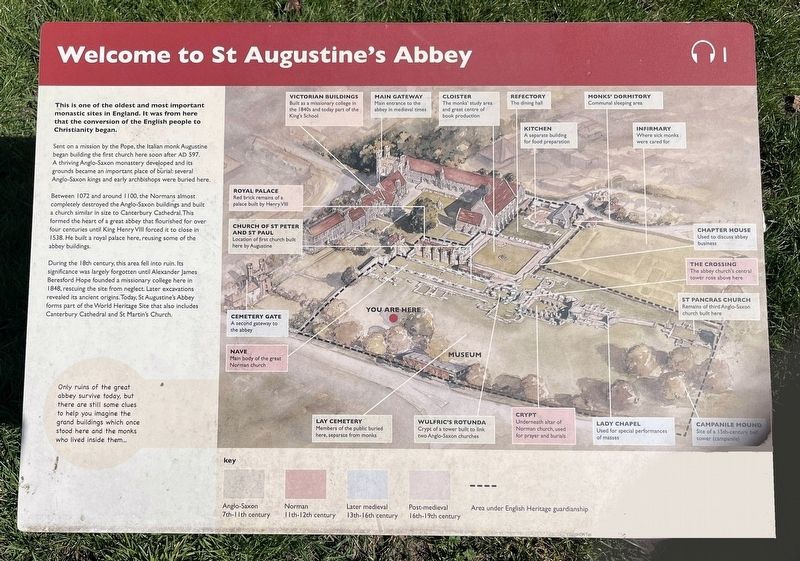
1. Welcome to St Augustine's Abbey Marker
This is one of the oldest and most important monastic sites in England. It was from here that the conversion of the English people to Christianity began.
Sent on a mission by the Pope, the Italian monk Augustine began building the first church here soon after AD 597. A thriving Anglo-Saxon monastery developed and its grounds became an important place of burial several Anglo-Saxon kings and early archbishops were buried here.
Between 1072 and around 1100, the Normans almost completely destroyed the Anglo-Saxon buildings and built a church similar in size to Canterbury Cathedral. This formed the heart of a great abbey that flourished for over four centuries until King Henry VIII forced it to close in 1538. He built a royal palace here, reusing some of the abbey buildings.
During the 18th century, this area fell into ruin. Its significance was largely forgotten until Alexander James Beresford Hope founded a missionary college here in 1848, rescuing the site from neglect. Later excavations revealed its ancient origins. Today, St Augustine's Abbey forms part of the World Heritage Site that also includes Canterbury
this page online
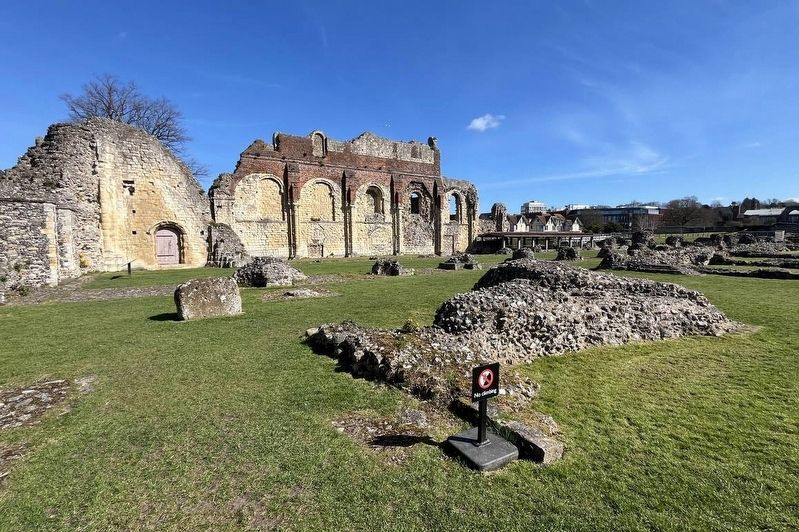
Only ruins of the great abbey survive today, but there are still some clues to help you imagine the grand buildings which once stood here and the monks who lived inside them...
Erected by English Heritage. (Marker Number 1.)
Topics. This historical marker is listed in these topic lists: Cemeteries & Burial Sites • Religion & Religious Structures • Wars, Non-US. A significant historical year for this entry is 597 CE.
Location. 51° 16.665′ N, 1° 5.255′ E. Marker is in Canterbury, England, in Kent. It can be reached from Longport west of England Route A257, on the left when traveling east. Touch for map. Marker is at or near this postal address: 15 Longport, Canterbury, England CT1, United Kingdom. Touch for directions.

Regionally, this marker is in the Greater South East. Globally, it is on the Atlantic Ocean, in the North Atlantic Region, in Europe, in Atlantic Europe, on one of the British Isles, in the Western World, and in the Anglosphere. Historically, it finds itself in what was once the Roman Empire.
Other nearby markers. At least 8 other markers are within walking distance
Photographed by Ray Gurganus, March 29, 2025
2. St Augustine's Abbey Ruins
Credits. This page was last revised on May 19, 2025. It was originally submitted on May 3, 2025, by Ray Gurganus of Washington, District of Columbia. This page has been viewed 96 times since then and 10 times this year. Photos: 1, 2. submitted on May 3, 2025, by Ray Gurganus of Washington, District of Columbia. • Devry Becker Jones was the editor who published this page.
