Buckhannon in Upshur County, West Virginia — The American South (Appalachia)
Fraxinus americana (white ash)
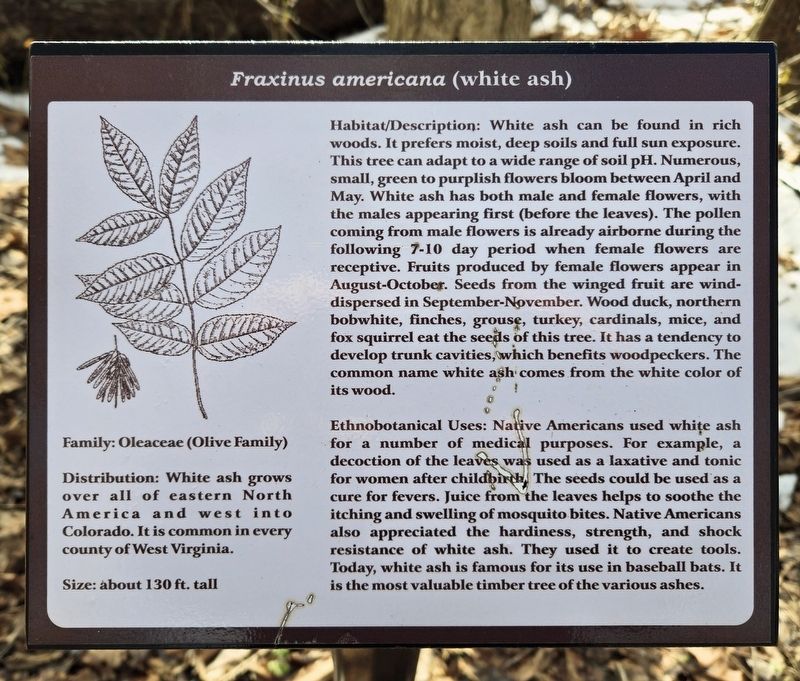
Photographed by Bradley Owen, February 24, 2025
1. Fraxinus americana (white ash) Marker
Family: Oleaceae (Olive Family)
Distribution: White ash grows over all of eastern North America and west into Colorado. It is common in every county of West Virginia.
Size: about 130 ft. tall
Habitat/Description: White ash can be found in rich woods. It prefers moist, deep soils and full sun exposure. This tree can adapt to a wide range of soil pH. Numerous, small, green to purplish flowers bloom between April and May. White ash has both male and female flowers, with the males appearing first (before the leaves). The pollen coming from male flowers is already airborne during the following 7-10 day period when female flowers are receptive. Fruits produced by female flowers appear in August-October. Seeds from the winged fruit are wind-dispersed in September-November. Wood duck, northern bobwhite, finches, grouse, turkey, cardinals, mice, and fox squirrel eat the seeds of this tree. It has a tendency to develop trunk cavities, which benefits woodpeckers. The common name white ash comes from the white color of its wood.
Ethnobotanical Uses: Native Americans used white ash for a number of medical purposes. For
this page online
Erected 2017 by West Virginia Wesleyan College Department of Biology.
Topics. This historical marker is listed in these topic lists: Indigenous Peoples and Communities • Industry & Commerce • Science & Medicine.
Location. 38° 59.597′ N, 80° 13.013′ W. Marker is in Buckhannon, West Virginia, in Upshur County. It can be reached from Camden Avenue north of Walktrail Lane, on the left when traveling north. Marker is located on the Buckhannon Nature Park and Learning Trail west of the Camden Avenue parking area. Touch for map. Marker is at or near this postal address: 8 Camden Avenue, Buckhannon WV 26201, United States
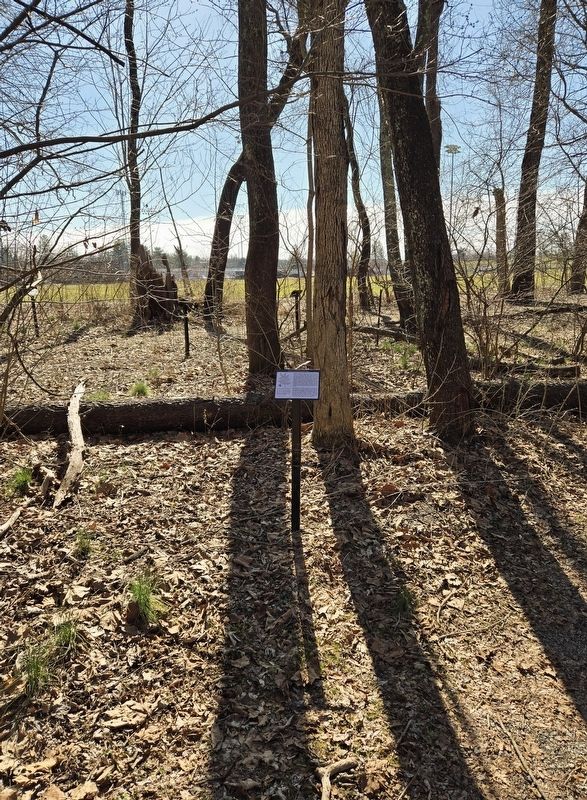
Photographed by Bradley Owen, March 10, 2025
2. Fraxinus americana (white ash) Marker

Regionally, this marker is in North Central West Virginia. It is also in the American South, specifically in the Upper South, in Appalachia, and specifically in Northern Appalachia. Globally, it is in North America, the Western Hemisphere, the Western World, and the Anglosphere. Historically, it finds itself in what was once the territory of the Mississippian Culture.
Other nearby markers. At least 8 other markers are within walking distance of this marker: Prunus serotina (black cherry) (here, next to this marker); Euonymus fortunei (winter creeper or Fortune's spindle) (here, next to this marker); Hydrangea arborescens (wild hydrangea) (a few steps from this marker); Ulmus americana (American elm) (a few steps from this marker); Lindera benzoin (spicebush) (a few steps from this marker); Acer saccharinum (silver maple) (a few steps from this marker); Baptisia australis (blue false indigo) (a few steps from this marker); Microstegium vimineum (Japanese stiltgrass) (a few steps from this marker). Touch for a list and map of all markers in Buckhannon.
Credits. This page was last revised on May 9, 2025. It was originally submitted on May 8, 2025, by Bradley Owen of Morgantown, West Virginia. This page has been viewed 137 times since then and 39 times this year. Photos: 1, 2. submitted on May 8, 2025, by Bradley Owen of Morgantown, West Virginia.
