Charleston in Charleston County, South Carolina — The American South (South Atlantic)
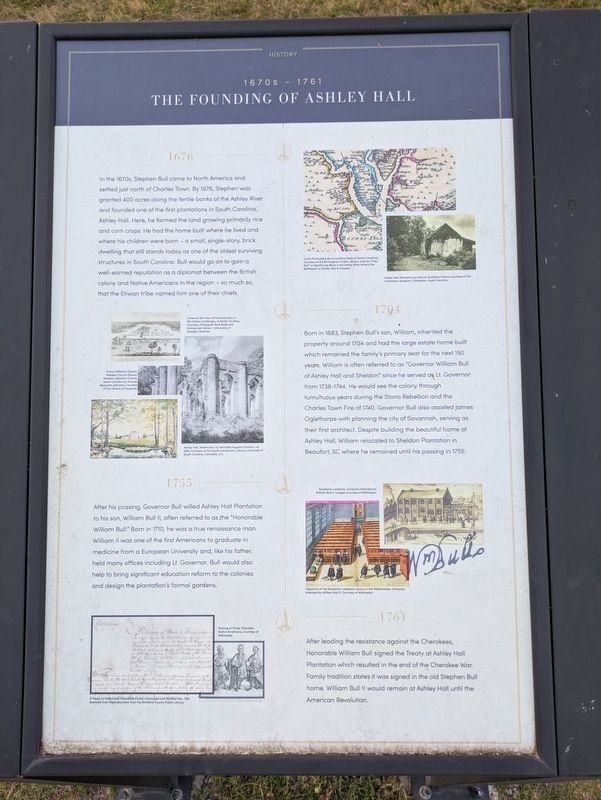
The Founding Of Ashley Hall
1670s–1761
⎯⎯⎯
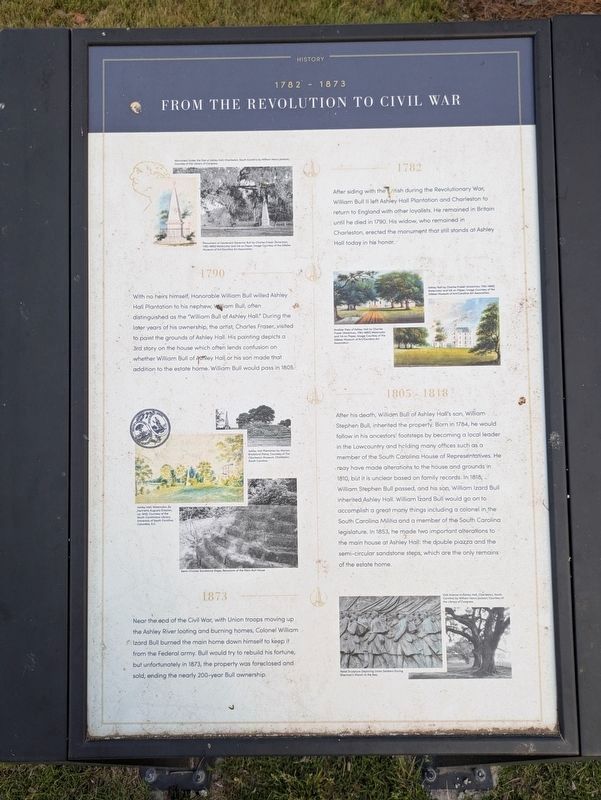
From The Revolution To Civil War
1782-1873
Photographed by Graham Glaab, April 29, 2025
1. The Founding of Ashley Hall Marker
1676
In the 1670s, Stephen Bull came to North America and settled just north of Charles Town. By 1676, Stephen was granted 400 acres along the fertile banks of the Ashley River and founded one of the first plantations in South Carolina, Ashley Hall. Here, he farmed the land growing primarily rice and corn crops. He had the home built where he lived and where his children were born — a small, single-story, brick dwelling that still stands today as one of the oldest surviving structures in South Carolina. Bull would go on to gain a well-earned reputation as a diplomat between the British colony and Native Americans in the region — so much so, that the Etiwan tribe named him one of their chiefs.
1704
Born in 1683, Stephen Bull’s son, William, inherited the property around 1704 and had the large estate home built, which remained the family’s primary seat for the next 150 years. William is often referred to as “Governor William Bull of Ashley Hall and Sheldon” since he served as Lt. Governor from 1738–1744. He would see the colony through tumultuous years during the Stono Rebellion and the Charles Town Fire of 1740. Governor
this page online
1755
After his passing, Governor Bull willed Ashley Hall Plantation to his son, William Bull II, often referred to as “The Honorable William Bull.” Born in 1710, he was a true renaissance man. William II was one of the first Americans to graduate in medicine from a European university and, like his father, held many offices including Lt. Governor. Bull would also help to bring significant education reform to the colonies and design the plantation’s formal gardens.
1761
After leading the resistance against the Cherokees, Honorable William Bull signed the Treaty at Ashley Hall Plantation which resulted in the end of the Cherokee War. Family tradition states it was signed in the old Stephen Bull home. William Bull II would remain at Ashley Hall until the American Revolution.
1782
After siding with the British during the Revolutionary War, William Bull II left Ashley Hall
Photographed by Graham Glaab, April 29, 2025
2. From the Revolution to Civil War Marker
1790
With no heirs himself, Honorable William Bull willed Ashley Hall Plantation to his nephew, William Bull (often distinguished as the “William Bull of Ashley Hall”). During the later years of his ownership, the artist Charles Fraser visited to paint the grounds of Ashley Hall. His painting depicts a 3rd story on the house which often lends confusion on whether William Bull of Ashley Hall or his son made that addition to the estate home. William Bull would pass in 1805.
1805–1818
After his death, William Bull of Ashley Hall’s son, William Stephen Bull, inherited the property. Born in 1784, he would follow in his ancestors’ footsteps by becoming a local leader in the Lowcountry and holding many offices such as a member of the South Carolina House of Representatives. He may have made alterations to the house and grounds in 1810, but it is unclear based on family records. In 1818, William Stephen Bull passed, and his son, William Izard Bull inherited Ashley Hall. William Izard Bull would go on to accomplish a great many things including a colonel in the South Carolina Militia and a member of the South Carolina legislature. In 1853, he made two important alterations to the main house at Ashley Hall: the double piazza and the semi-circular sandstone steps, which are the only remains of the estate home.
1873
Near the end of the Civil War, with Union troops moving up the Ashley River looting and burning homes, Colonel William Izard Bull burned the main home down himself to keep it from the Federal army. Bull would try to rebuild his fortune, but unfortunately in 1873, the property was foreclosed and sold, ending the nearly 200-year Bull ownership.
Topics. This historical marker is listed in these topic lists: Colonial Era • War, US Civil. A significant historical year for this entry is 1676.
Location. 32° 49.393′ N, 80° 1.207′ W. Marker is in Charleston, South Carolina, in Charleston County. It is at the intersection of Ashley Hall Plantation Road and Captiva Row on Ashley Hall Plantation Road. The markers are directly in front of the preserved staircase, which is all that remains of the Bull House. Touch for map. Marker is in this post office area: Charleston SC 29407, United States of America. Touch for directions.

Regionally, this marker is in the Lowcountry. It is also in the American South, specifically in the Deep South, and on the Eastern Seaboard. Globally, it is in the North Atlantic Region, North America, the Western Hemisphere, the Western World, and the Anglosphere. Historically, it finds itself in what was once the territory of the Mississippian Culture, one of the original Thirteen Colonies, one of the Confederate States of America, and the Antebellum South.
Other nearby markers. At least 8 other markers are within 3 miles of this marker, measured as the crow flies: South Carolina Canal & Rail Road Company (approx. 1.9 miles away); a different marker also named St. Andrew’s Parish Church (approx. 2 miles away); Skirmish at St. Andrew’s Parish Church (approx. 2 miles away); Jenkins Orphanage (approx. 2.1 miles away); Dr. Henry Woodward (approx. 2.2 miles away); Charles Towne / Old Town Plantation (approx. 2.2 miles away); “Brave & Happy Settlements” (approx. 2.3 miles away); Site of Old Charles Town (approx. 2.3 miles away). Touch for a list and map of all markers in Charleston.
Another marker is no longer nearby. St. Andrew’s Parish Church (was approx. 2 miles away but has been replaced with another marker now near it).
Credits. This page was last revised on July 20, 2025. It was originally submitted on May 11, 2025, by Graham Glaab of Charleston, South Carolina. This page has been viewed 289 times since then and 57 times this year. Photos: 1, 2. submitted on May 11, 2025, by Graham Glaab of Charleston, South Carolina. • Bernard Fisher was the editor who published this page.
