Carencro in Lafayette Parish, Louisiana — The American South (West South Central)
Lynching In America ⎯⎯⎯ The Lynching of Louis Senegal and Antoine Domingue
—
Community Remembrance Project
—
Photographed by Cajun Scrambler, May 16, 2025
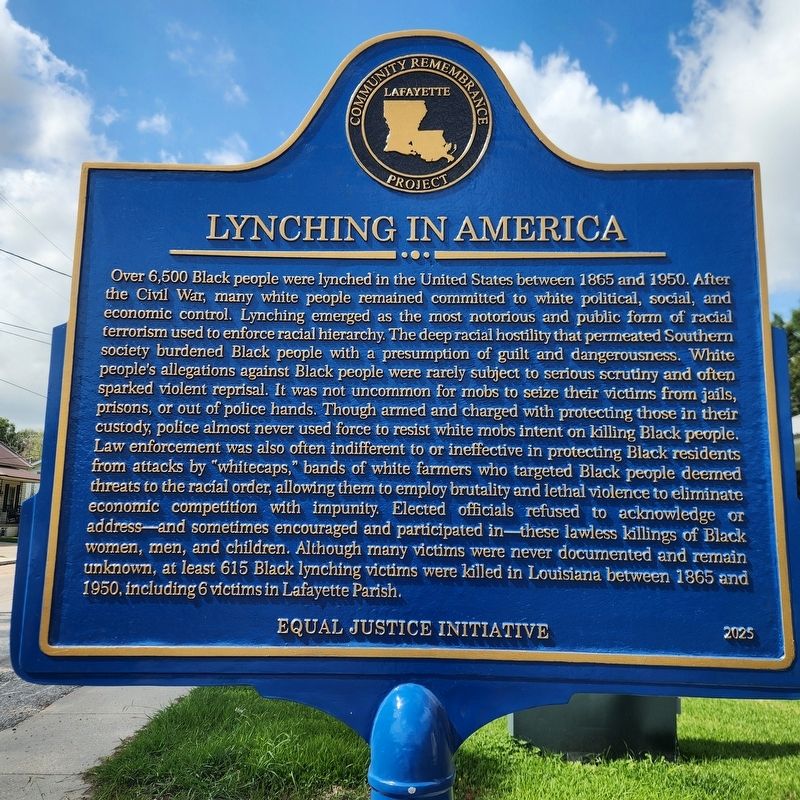
1. Lynching In America/ The Lynching of Louis Senegal and Antoine Domingue side of marker
Inscription.
Lynching in America.
Over 6,500 Black people were lynched in the United States between 1865 and 1950. After the Civil War, many White people remained committed to White political, social, and economic control. Lynching emerged as the most notorious and public form of racial terrorism used to enforce racial hierarchy. The deep racial hostility that permeated Southern society burdened Black people with a presumption of guilt and dangerousness. White people's allegations against Black people were rarely subject to serious scrutiny and often sparked violent reprisal. It was not uncommon for mobs to seize their victims from jails, prisons, or out of police hands. Though armed and charged with protecting those in their custody, police almost never used force to resist White mobs intent on killing Black people. Law enforcement was also often indifferent to or ineffective in protecting Black residents from attacks by "Whitecaps," bands of White farmers who targeted Black people deemed threats to the racial order, allowing them to employ brutality and lethal violence to eliminate economic competition with impunity. Elected officials
Click or scan to see this page online
refused to acknowledge or address and sometimes encouraged and participated in-these lawless killings of Black women, men, and children. Although many victims were never documented and remain unknown, at least 615 Black lynching victims were killed in Louisiana between 1865 and 1950, including 6 victims in Lafayette Parish.
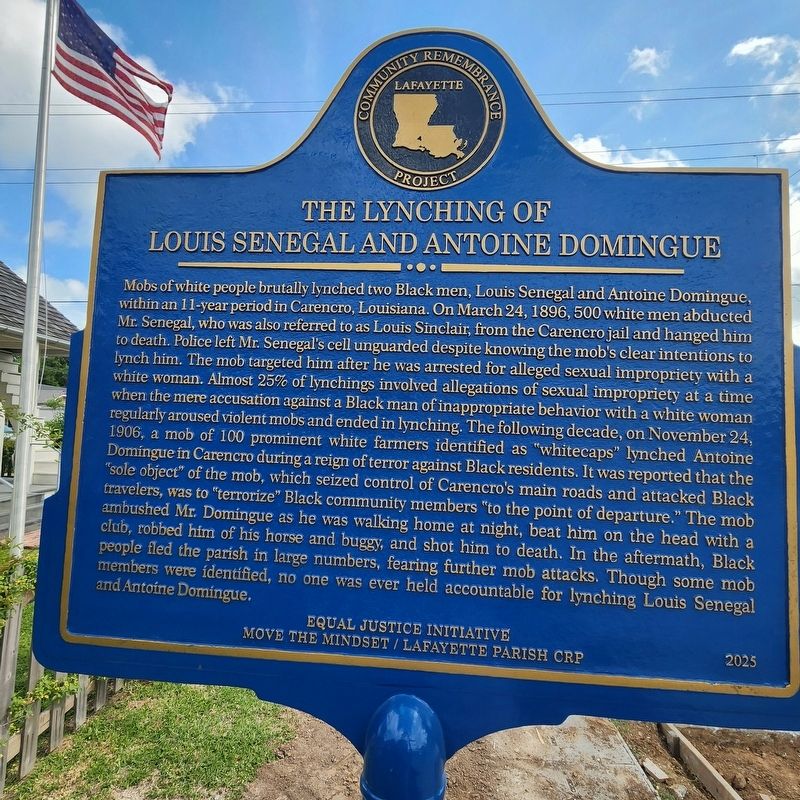
The Lynching of Louis Senegal and Antoine Domingue.
Mobs of White people brutally lynched two Black men, Louis Senegal and Antoine Domingue, within an 11-year period in Carencro, Louisiana. On March 24, 1896, 500 White men abducted Mr. Senegal, who was also referred to as Louis Sinclair, from the Carencro jail and hanged him to death. Police left Mr. Senegal's cell unguarded despite knowing the mob's clear intentions to lynch him. The mob targeted him after he was arrested for alleged sexual impropriety with a White woman. Almost 25% of lynchings involved allegations of sexual impropriety at a time when the mere accusation against a Black man of inappropriate behavior with a White woman regularly aroused violent mobs and ended in lynching. The following decade, on November 24, 1906, a mob of 100 prominent White
Photographed by Cajun Scrambler, May 16, 2025
2. The Lynching of Louis Senegal and Antoine Domingue side of marker
farmers identified as "Whitecaps” lynched Antoine Domingue in Carencro during a reign of terror against Black residents. It was reported that the "sole object” of the mob, which seized control of Carencro's main roads and attacked Black travelers, was to "terrorize” Black community members "to the point of departure.” The mob ambushed Mr. Domingue as he was walking home at night, beat him on the head with a club, robbed him of his horse and buggy, and shot him to death. In the aftermath, Black people fled the parish in large numbers, fearing further mob attacks. Though some mob members were identified, no one was ever held accountable for lynching Louis Senegal and Antoine Domingue.
Erected 2025 by Equal Justice Initiative, Move the Mindset, Lafayette Parish CRP.
Topics and series. This historical marker is listed in these topic lists: African Americans • Civil Rights • Law Enforcement. In addition, it is included in the Lynching in America series list. A significant historical date for this entry is March 24, 1896.
Location. 30° 19.334′ N, 92° 2.764′ W. Marker is in Carencro, Louisiana, in Lafayette Parish. It is on Veterans Drive
Photographed by Cajun Scrambler, May 16, 2025
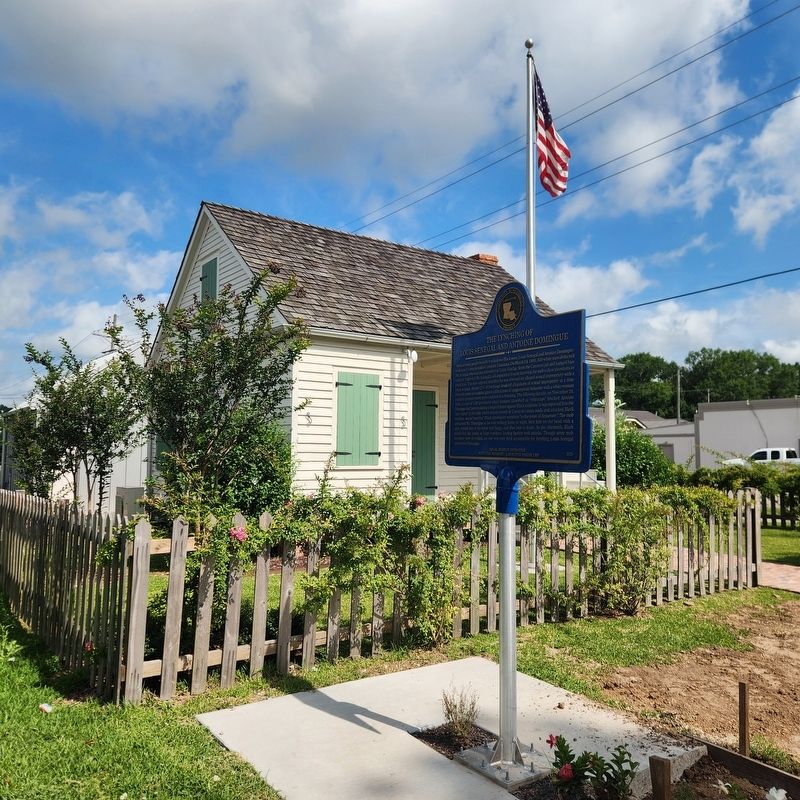
3. Lynching In America / The Lynching of Louis Senegal and Antoine Domingue Marker
near North Church Street. Located in front of the Carencro Visitors Center. Touch for map. Marker is at or near this postal address: 409 Veterans Dr, Carencro LA 70520, United States of America. Touch for directions.
Regionally, this marker is in Louisiana’s Acadiana — Cajun Country. It is also in the American South and specifically in the Deep South. Globally, it is in North America, a Gulf of Mexico state, the Western Hemisphere, the Western World, and the Anglosphere. Historically, it finds itself in what was once New Spain,Acadia, the territory of the Mississippian Culture, the Louisiana Purchase, one of the Confederate States of America, and the Antebellum South.
Credits. This page was last revised on March 14, 2026. It was originally submitted on May 17, 2025, by Cajun Scrambler of Assumption, Louisiana. This page has been viewed 438 times since then and 67 times this year. Photos:1, 2, 3. submitted on May 17, 2025, by Cajun Scrambler of Assumption, Louisiana.