Big Bog State Recreation Area near Waskish in Beltrami County, Minnesota — The American Midwest (Upper Plains)
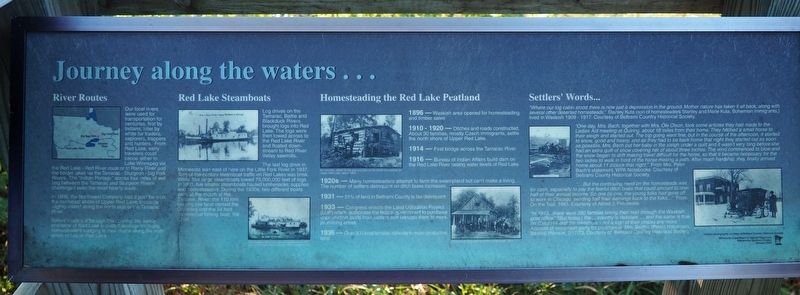
Journey along the waters…
Photographed by McGhiever, August 30, 2021
1. Journey along the waters... Marker
River Routes
Our local rivers were used for transportation for centuries, first by Indians, later by white fur traders, explorers, trappers and hunters. From Red Lake, early travelers could canoe either to Lake Winnepeg via the Red Lake - Red River route or to Rainy River and the border lakes via the Tamarac - Sturgeon - Big Fork Rivers. The "Indian Portage" across four miles of wet bog between the Tamarac and Sturgeon Rivers challenged even the most hearty souls.
In 1806, the Northwest Company had a post here on the northeast shore of Upper Red Lake, probably slightly inland along the north side of the Tamarac River.
Before roads cut through this country, the sandy shoreline of Red Lake provided passage for many homesteaders trudging to their claims along the north shore of Upper Red Lake.
Red Lake Steamboats
Log drives on the Tamarac, Battle and Blackduck Rivers brought logs into Red Lake. The logs were then towed across to the Red Lake River and floated downstream to Red River Valley sawmills.
The last log drive in Minnesota was east of here on the Little Fork River in 1937. Turn-of-the-century steamboat
this page online
Homesteading the Red Lake Peatland
Mr. and Mrs. Albert Smith and son Dan at the Smith homestead on Upper Red Lake, about 1909.
1896—Waskish area opened for homesteading and timber sales
1910 - 1920—Ditches and roads constructed. About 30 families, mostly Czech immigrants, settle the north shore of Upper Red Lake
1914—First bridge across the Tamarac River
1916—Bureau of Indian Affairs build dam on the Red Lake River raising water levels of Red Lake.
1920s—Many homesteaders attempt to farm the swampland but can't make a living. The number of settlers delinquent on ditch taxes increases.
1931—51% of land in Beltrami County is tax delinquent.
1933—Congress enacts the Land Utilization Project (LUP) which authorizes the federal government to purchase unproductive lands from settlers and
Photographed by McGhiever, September 1, 2021
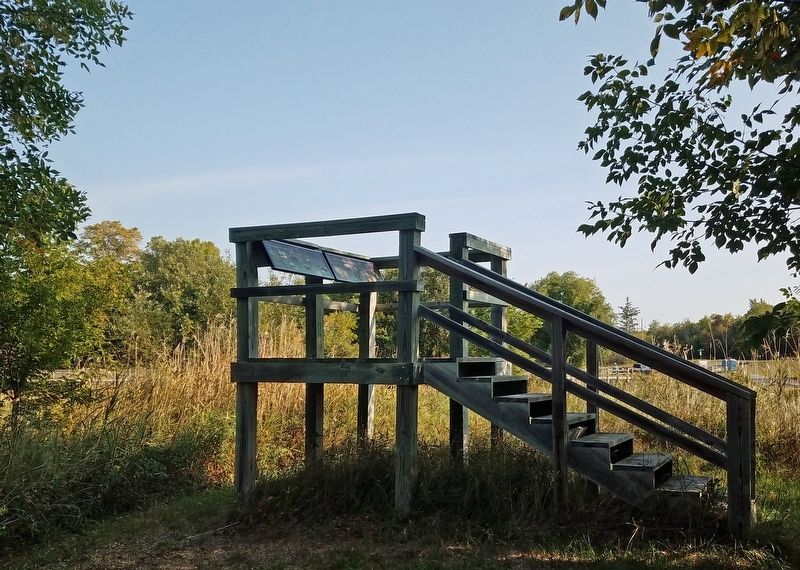
2. Journey along the Waters Marker (left) on the platform at the end of the Old Marina Trail
1936—Over 300 local families relocate to more productive land.
Settlers' Words…
"Where our log cabin stood there is now just a depression in the ground. Mother nature has taken it all back, along with several other deserted homesteads." Stanley Kuta (son of homesteaders Stanley and Marie Kuta, Bohemian immigrants.) lived in Waskish 1909 - 1917. Courtesy of Beltrami County Historical Society.
"One day, Mrs. Bach, together with Mrs. Ole Olson, took some articles they had made to the Ladies Aid meeting at Quiring, about 18 miles from their home. They hitched a small horse to their sleigh and started out. The trip was going fine, but in the course of the afternoon, it started to snow, good and heavy, and as they had to be back home that night they started out as soon as possible. Mrs. Bach put her baby in the sleigh under a quilt and it wasn't very long before she had an extra quilt of snow covering her of about three inches. The wind commenced to blow and the snow began to drift making travel difficult for the horse, so that it became necessary for the two ladies to walk in front of the horse making a path. After much hardship, they finally arrived home about 11 o'clock that night." From Mrs. Peter Bach's statement, WPA Notebooks. Courtesy of Beltrami County Historical Society.
"…But the continuing need on the homesteads was for cash, especially to pay the fearful ditch taxes that could amount to one-half of their annual income. So one by one, the young folks had gone off to work in Chicago, sending half their earnings back to the folks…" From On the Trail, 1981. Courtesy of Alfred J. Pretowske
"In 1913… there were 350 families taking their mail through the Waskish post office." "(But today,) the… country is desolate… and the same is true on (Ditch) 14 and the lakeshore - not a sign of their places any more." Account of retirement party for postmaster Mrs. Bertha (Peter) Halvarson, Bemidji Pioneer, 2/17/73. Courtesy of Beltrami County Historical Society.
Erected 2004 by Minnesota Department of Natural Resources.
Topics. This historical marker is listed in these topic lists: Horticulture & Forestry • Immigration • Settlements & Settlers • Waterways & Vessels. A significant historical year for this entry is 1896.
Location. 48° 10.487′ N, 94° 30.832′ W. Marker is near Waskish, Minnesota, in Beltrami County. It is in the Big Bog State Recreation Area. It can be reached from Waskish Beach Road N.E. west of Minnesota Highway 72, on the right when traveling west. The marker is in the southern unit of Big Bog State Recreation Area (fee area) at the north end of the Old Marina Trail. Touch for map. Marker is at or near this postal address: 55716 Minnesota Highway 72, Waskish MN 56685, United States of America. Touch for directions.

Regionally, this marker is in the Northland. It is also in the American Midwest and in the Corn Belt. Globally, it is in North America, the Great North Woods, the Western Hemisphere, the Western World, and the Anglosphere. Historically, it finds itself in what was once Rupert’s Land, the territory of the Mississippian Culture, the Louisiana Purchase, and the Northwest Territory.
Other nearby markers. At least 8 other markers are within walking distance of this marker: Historic Waskish Hatchery 1941–1979 (here, next to this marker); The Old Waskish Town Site (about 700 feet away, measured in a direct line); Harry Davidson (approx. 0.2 miles away); The Marina (approx. 0.2 miles away); Pure Peatland / A Boring Story (approx. 0.3 miles away); Red Lake is Minnesota's Largest Lake! / Flat Terrain Lets Water Pool (approx. 0.3 miles away); Where There is Smoke / Forests of the Agassiz Lowlands (approx. 0.3 miles away); The Red Lake Walleye Story (approx. 0.3 miles away). Touch for a list and map of all markers in Waskish.
Credits. This page was last revised on May 18, 2025. It was originally submitted on May 18, 2025, by McGhiever of Minneapolis, Minnesota. This page has been viewed 193 times since then and 45 times this year. Photos: 1, 2. submitted on May 18, 2025, by McGhiever of Minneapolis, Minnesota.
