Pound Gap in Letcher County, Kentucky — The American South (East South Central)
The Teardrop Monument
Photographed by J. J. Prats, May 16, 2025
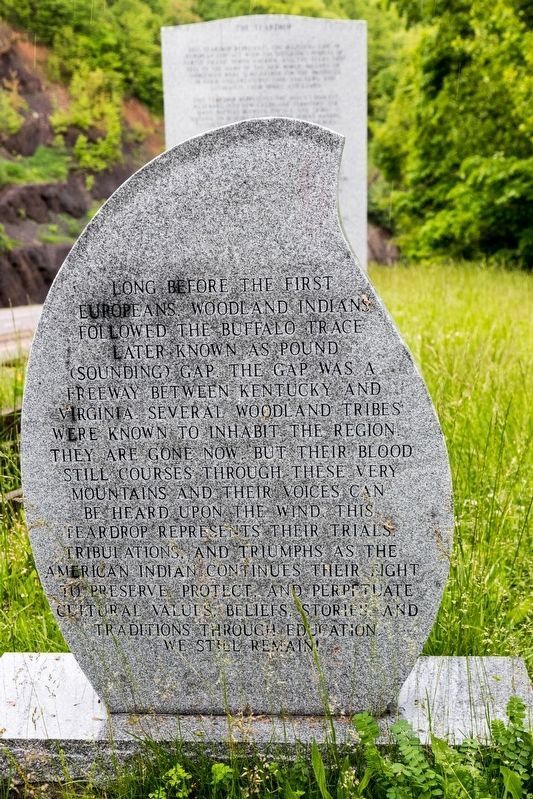
1. The Teardrop Monument, front
Long before the first Europeans, Woodland Indians followed the buffalo trace later known as Pound (Sounding) Gap. The gap was a freeway between Kentucky and Virginia. Several Woodland Tribes were known to inhabit the region. They are gone now but their blood still courses through these very mountains and their voices can be heard upon the wind. This teardrop represents their trials, tribulations, and triumphs as the American Indian continues their fight to preserve, protect, and perpetuate cultural values, beliefs, stories, and traditions through education.
We still remain!
We still remain
Thunderbolt Warriors Society
adjacent granite marker:
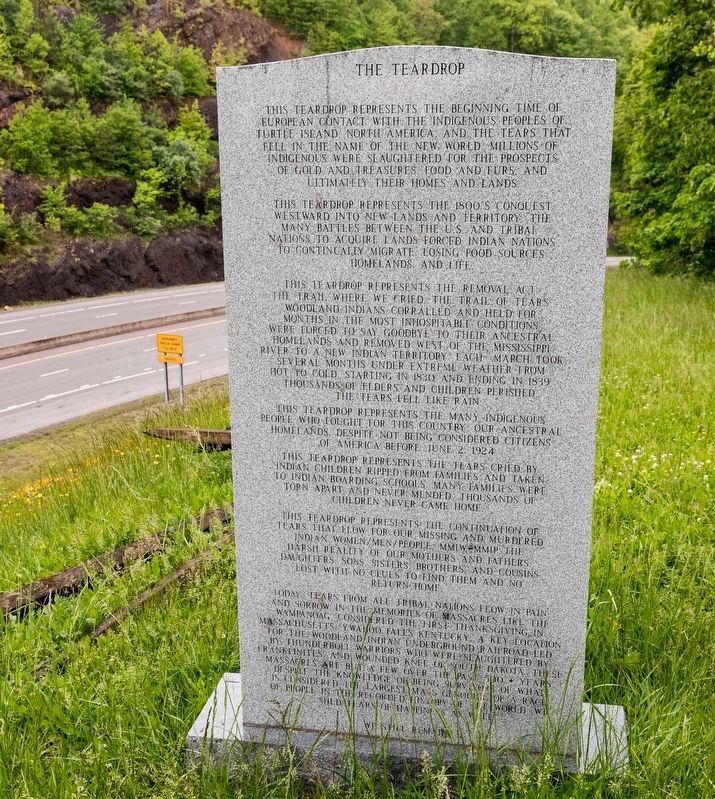
The Teardrop
This teardrop represents the beginning time of European contact with the Indigenous Peoples of Turtle Island, North America, and the tears that fell in the name of the New World. Millions of Indigenous were slaughtered for the prospects of gold and treasures, food and furs, and ultimately their homes and lands.
This teardrop represents the 1800’s conquest westward into new lands and territory. The many battles between the U.S. and Tribal Nations to acquire lands forced Indian Nations to continually migrate, losing food sources, homelands, and life.
This teardrop represents the Removal Act, the trail where we cried, the Trail of Tears. Woodland Indians corralled and held for months in the most inhospitable conditions were forced to say goodbye to their ancestral homelands and removed west of the Mississippi River
this page online
This teardrop represents the many indigenous people who fought for this country, our ancestral homelands, despite not being considered citizens of America before June 2, 1924.
This teardrop represents the tears cried by Indian children ripped from families and taken to Indian boarding schools. Many families were torn apart and never mended. Thousands of children never came home.
This teardrop represents the continuation of tears that flow for our missing and murdered Indian women/men/people, MMIW–MMIP, the harsh reality of our mothers and fathers, daughters, sons, sisters, brothers, and cousins lost with no clues

Photographed by J. J. Prats, May 16, 2025
2. The Teardrop Marker, back
Today tears from all Tribal Nations flow in pain and sorrow in the memories of massacres like The Wampanoag, considered first Thanksgiving in Massachusetts; Ywahoo Falls, Kentucky, a key location for the Woodland Indian underground railroad led by Thunderbolt Warriors who were slaughtered by Franklinites; and Wounded Knee, South Dakota. These massacres are but few over the past 500+ years.
Despite the knowledge of being survivors of what is considered the largest mass genocide of a race of people in the recorded history of world, we shed tears of happiness as well.
We still remain.
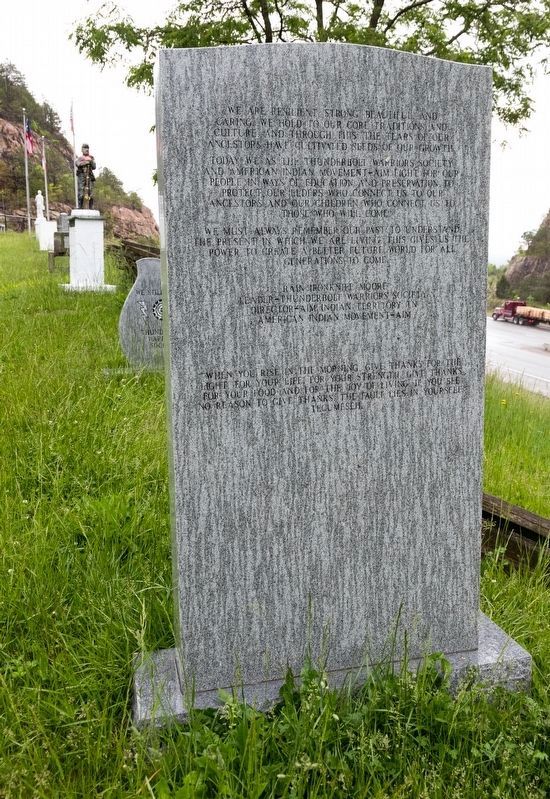
We are resilient, strong, beautiful, and caring. We hold to our core traditions and culture, and through this, the tears of our ancestors, we have cultivated seeds of our growth.
Today we as the Thunderbolt
Photographed by J. J. Prats, May 16, 2025
3. Adjacent Granite Marker, front
We must always remember our past to understand the present in which we are living. This gives the power to create a better future world for all generations to come.
Leader–Thunderbolt Warriors Society
Director–AIM Indian Territory TN
American Indian Movement–AIM
When you rise in the morning, give thanks for the light, for your life, for your strength. Give thanks for your food and for the joy of living. If you see no reason to give thanks, the fault lies in yourself.
—Tecumeseh
Erected 2024 by the Thunderbolt Warriors Society.
Topics and series. This historical marker
Photographed by J. J. Prats, May 16, 2025
4. Adjacent Granite Marker, back
Location. 37° 9.328′ N, 82° 38.031′ W. Marker is in Pound Gap, Kentucky, in Letcher County. It can be reached from the intersection of U.S. 23 and Raven Rock Road (unsigned), on the right when traveling north. It is just inside the Kentucky state line, behind and to the right of the Civil War Memorial. There is a small brown road sign on U.S. 23 northbound pointing to the turn for the Civil War Memorial. Immediately before the turn is the small green Letcher County sign. It is the next right after both signs. If you are traveling southbound, turn around at the gas station and you will immediately see the turn. Parking is available at the memorial, then walk around the left side of the memorial and then behind it to reach this monument. Touch for map. Marker is in this post office area: Jenkins KY 41537, United States of America. Touch for directions.

Regionally, this marker and monument is in Eastern Kentucky and in the Cumberland Plateau. It is also in the American South, specifically in the Upper South, in Appalachia, and specifically in Southern Appalachia. Globally, it is in North America, the Western Hemisphere, the Western World, and the Anglosphere. Historically, it finds itself in what was once the territory of the Mississippian Culture and also the Antebellum South.
Other nearby markers. At least 8 other markers are within walking distance of this marker: Pound Gap Massacre (a few steps from this marker); Brothers Once More (within shouting distance of this marker); Virginians Confederate Memorial (within shouting distance of this marker); The Shepherd of the Mountains (within shouting distance of this marker); Mountain Strong (within shouting distance of this marker); Sept. 11, 2001 Memorial (within shouting distance of this marker); Caudill’s Army (within shouting distance of this marker); More History (within shouting distance of this marker).
Regarding The Teardrop Monument. MMIW (Missing and Murdered Indigenous Women) and MMIP (Missing and Murdered Indigenous Persons)—on the text of this marker—are terms used to put names to the crisis of missing and murdered Indigenous people in North America. MMIP encompasses a broader range of individuals, including women, girls, and two-spirited people while MMIW specifically refers to the tragedy of missing and murdered Indigenous women.
Also see . . . Wikipedia entry for AIM–American Indian Movement. Initial paragraph:
The American Indian Movement (AIM) is an American Indian grassroots movement which was founded in Minneapolis, Minnesota in July 1968, initially centered in urban areas in order to address systemic issues of poverty, discrimination, and police brutality against American Indians. AIM soon widened its focus from urban issues to many Indigenous Tribal issues that American Indian groups have faced due to settler colonialism in the Americas. These issues have included treaty rights, high rates of unemployment, the lack of American Indian subjects in education, and the preservation of Indigenous cultures.(Submitted on May 24, 2025.)
Credits. This page was last revised on October 3, 2025. It was originally submitted on May 24, 2025, by J. J. Prats of Powell, Ohio. This page has been viewed 399 times since then and 81 times this year. It was the Marker of the Week November 9, 2025. Photos: 1, 2, 3, 4. submitted on May 24, 2025, by J. J. Prats of Powell, Ohio.
Editor’s want-list for this marker. A wide shot of the monument and marker, showing them in their surroundings. • Better photographs (these were taken in the rain) • Can you help?
