Reynoldstown in Atlanta in Fulton County, Georgia — The American South (South Atlantic)
Battle of Atlanta
⎯⎯⎯
Fall of Atlanta

Photographed by Mike Shepard, May 23, 2025
1. Battle of Atlanta side of marker
Battle of Atlanta
Battle of Atlanta - 22 July 1864
This land was once a battlefield. Repulsed in his 20 July attack against the Federal forces near Peachtree Creek, commander of Confederate forces General John B. Hood next tried to crush the Federals approaching Atlanta from the east. On the morning of 22 July, Federal troops occupied trenches abandoned by the Confederates the previous evening. The new Federal line ran from Copenhill (northeast of this spot, now the site of the Carter Center) southeast towards what is now Moreland Avenue, then south before turning sharply eastward at the Bald Hill (now the Moreland Avenue interchange with I-20). The new Confederate position occupied a line built the previous summer and fall under the direction of Lemuel Grant. The section in this area ran south near Randolph Street and Boulevard, just west of here. The single track Georgia Railroad, which connected Atlanta to Augusta, ran along the same course as the modern railroad.
After an exhausting 15-hour overnight march from its previous lines north of the city, Lieutenant General William J. Hardee's Confederate Corps opened
this page online
Brown's Division broke through the Federal XV Corps line about where the Inman Park MARTA Station now stands, but the Confederate command structure failed to realize Brown's success, so his troops did not receive enough support to resist a Federal counterattack that pushed back Brown's and Clayton's divisions. This counterattack

Photographed by Mike Shepard, May 23, 2025
2. Fall of Atlanta side of marker
The Confederates retreated across this ground to their original position, again having been unable to turn back the Federal advance. The human toll was high on both sides: 5500 Confederates and 3700 Federals were killed, wounded, or missing. Among the Federal dead was Major General James B. McPherson, the highest ranking Federal officer to die in combat during the war.
Marker content & map by: Georgia Battlefields Association www.georgiabattlefields.org
Marker design & installation by: Atlanta Creative Graphics www.atlantacreativegraphics.com
Marker funding by: Ultima Holdings, developer of Mill Town Lofts www.ultima-atl.com
Fall of Atlanta
Evacuation of Atlanta - 1 September 1864
The land on which you stand shook from explosions on the night of 1 September 1864.
When Federal forces overwhelmed the Confederates at Jonesboro, about 15 miles south of here, the city of Atlanta lost its last rail connection to

Photographed by Mike Shepard, May 23, 2025
3. Battle of Atlanta / Fall of Atlanta Marker
Daylight photo with surroundings in context (Wylie Street and beltline)
Parked on the railroad near... trains loaded with with military supplies. ...move the trains south from the city had... by Federal artillery fire near Rough and... (now just east of the airport) earlier on 1 September. One train had 81 cars, 28 of which were full of ammunition. Confederate officers ordered the train put to the torch, and the resulting explosions shook this area for hours. Windows were broken for miles around.
The burning of the train is depicted in Gone with the Wind, when Rhett Butler is driving a wagon to take Scarlett, Prissy, Melanie,
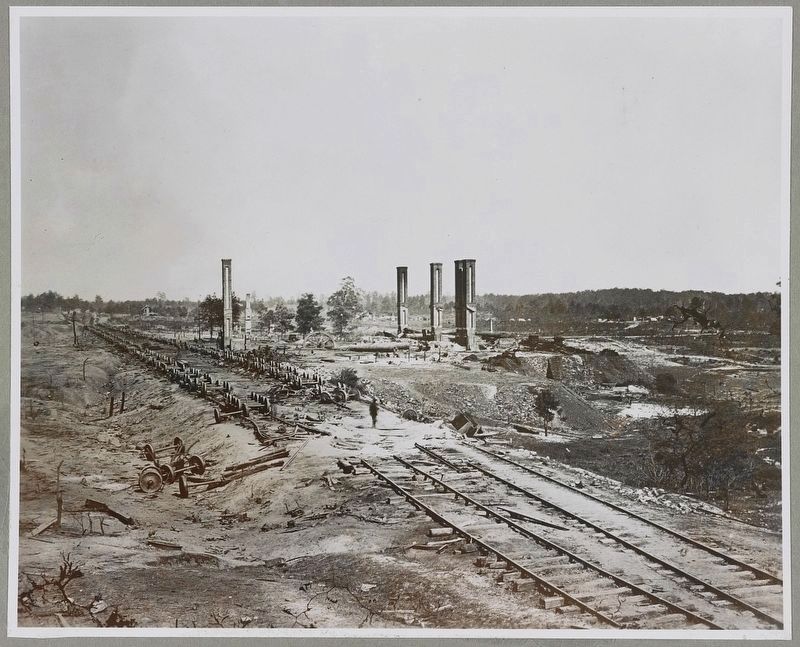
Photographed by George N. Barnard, 1864
4. Destruction of Hood's Ordnance train, Georgia Central Railroad
Library of Congress (LC-DIG-ppmsca-33492)
The aftermath is depicted in one of the most famous photographs of the Civil War. George Barnard was a photographer working under contract to the Federal government. He arrived in Atlanta in September while Federal troops were occupying the city. This photo was taken from just north of the railroad, facing east. It shows the remains of the train, with the cars burned to their trucks (wheels), and the chimneys of the Schofield & Markham Rolling Mill, which was completely blown down and burned. The spot on which you stand would be visible in the left background of the photo.
The rolling mill was an example of Atlanta's value as a military manufacturing and supply center. In the 1880s, the site of the rolling mill became the location of the Fulton Bag & Cotton Mill and today is the site of loft apartments.
Marker content & map by: Georgia Battlefields Association www.georgiabattlefields.org
Marker design & installation by: Atlanta Creative Graphics www.atlantacreativegraphics.com
Marker funding by: Ultima Holdings, developer of Mill Town Lofts www.ultima-atl.com
Erected by Georgia Battlefields Association and Ultima Holdings.
Topics. This historical marker is listed in these topic lists: Railroads & Streetcars • War, US Civil. A significant historical date for this entry is July 22, 1864.
Location. 33° 45.155′ N, 84° 21.67′ W. Marker is in Atlanta, Georgia, in Fulton County. It is in Reynoldstown. It is on Wylie Street Southeast east of Pearl Street Southeast, on the right when traveling east. Touch for map. Marker is at or near this postal address: 791 Wylie St SE, Atlanta GA 30316, United States of America. Touch for directions.

Regionally, this marker is in Georgia’s Piedmont. It is also in the American South and specifically in the Deep South. Globally, it is in North America, the Western Hemisphere, the Western World, and the Anglosphere. Historically, it finds itself in what was once the territory of the Mississippian Culture, one of the original Thirteen Colonies, one of the Confederate States of America, and the Antebellum South.
Other nearby markers. At least 8 other markers are within walking distance of this marker: Brown’s & Clayton’s Divs. (approx. ¼ mile away); Brig. Gen. A. M. Manigault’s Brigade (approx. 0.3 miles away); Springvale Park (approx. 0.4 miles away); Jacob Elsas and the Fulton Bag & Cotton Mills (approx. 0.4 miles away); Baker's Brigade (approx. half a mile away); Neighborhood Transformed (approx. half a mile away); Harper House (approx. half a mile away); Benton’s & Coltart’s Brigades (approx. 0.6 miles away). Touch for a list and map of all markers in Atlanta.
Credits. This page was last revised on May 26, 2025. It was originally submitted on May 24, 2025, by Mike Shepard of Atlanta, Georgia. This page has been viewed 355 times since then and 87 times this year. Photos: 1, 2, 3. submitted on May 24, 2025, by Mike Shepard of Atlanta, Georgia. 4. submitted on May 26, 2025. • Bernard Fisher was the editor who published this page.
