Bernalillo in Sandoval County, New Mexico — The American Mountains (Southwest)
Experimental Archaeology
⎯⎯⎯
Arqueología Experimental
Photographed by James Hulse, April 9, 2025
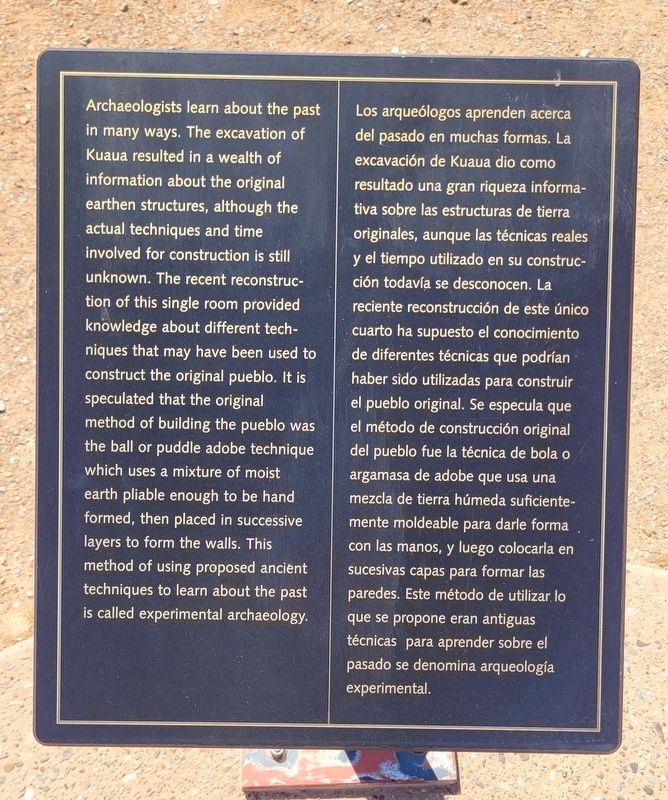
1. Experimental Archaeology / Arqueología Experimental Marker
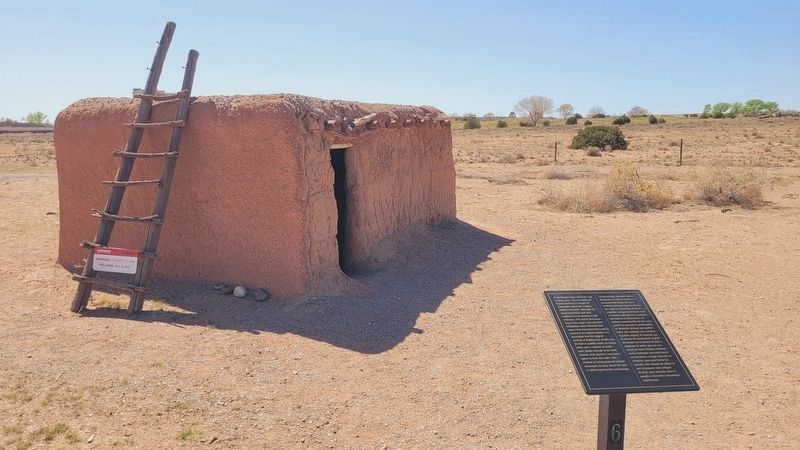
 Archaeologists learn about the past in many ways. The excavation of Kuaua resulted in a wealth of information about the original earthen structures, although the actual techniques and time involved for construction is still unknown. The recent reconstruction of this single room provided knowledge about different techniques that may have been used to construct the original pueblo. It is speculated that the original method of building the pueblo was the ball or puddle adobe technique which uses a mixture of moist earth pliable enough to be hand formed, then placed in successive layers to form the walls. This method of using proposed ancient techniques to learn about the past is called experimental archaeology.
Los arqueólogos aprenden acerca del pasado en muchas formas. La excavación de Kuaua dio como resultado una gran riqueza informativa sobre las estructuras de tierra originales, aunque las técnicas reales y el tiempo utilizado en su construcción todavía se desconocen. La reciente reconstrucción de este único cuarto ha supuesto el conocimiento de diferentes técnicas que podrían haber sido utilizadas
this page online
Topics. This historical marker is listed in these topic lists: Anthropology & Archaeology • Indigenous Peoples and Communities.
Location. 35° 19.792′ N, 106° 33.463′ W. Marker is in Bernalillo, New Mexico, in Sandoval County. It is on Kuaua Road half a mile east of U.S. 550. The marker is located in the Kuaua Ruins (Coronado Historic Site). Touch for map. Marker is at or near this postal address: 485 Kuaua Rd, Bernalillo NM 87004, United States of America. Touch for directions.

Regionally, this marker is in the San Juan Basin and in Greater Albuquerque. It is also in the American Southwest and at the Four Corners. Globally, it is in North America,
Photographed by James Hulse, April 9, 2025
2. The Reconstructed Pueblo and Marker
Other nearby markers. At least 8 other markers are within walking distance of this marker: Pedro de Castañeda (here, next to this marker); Kivas (a few steps from this marker); The Pueblo of Kuau (within shouting distance of this marker); The Plazas / Las Plazas (within shouting distance of this marker); Pueblo (within shouting distance of this marker); Grind the Meal (within shouting distance of this marker); Central Plaza (within shouting distance of this marker); Kuaua (within shouting distance of this marker). Touch for a list and map of all markers in Bernalillo.
More about this marker. There is a small fee to visit the Kuaua Ruins (Coronado Historic Site).
Also see . . .
1. Coronado Historic Site. New Mexico Historic Sites
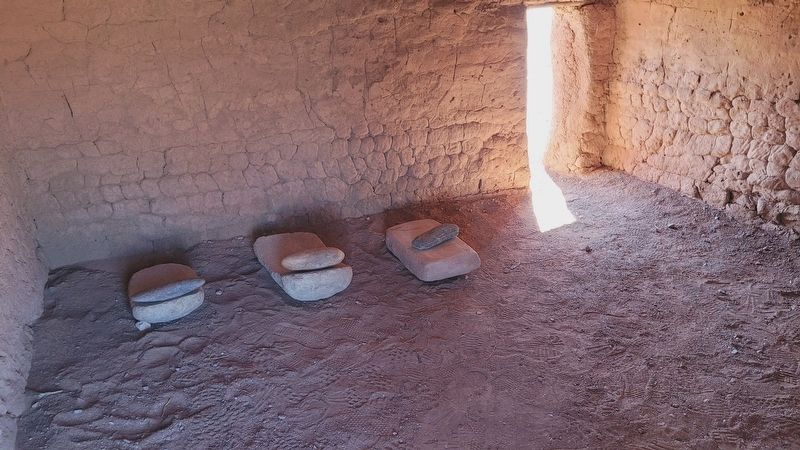
Coronado Historic Site and the ancient Kuaua Pueblo are located just minutes north of Albuquerque (off of I-25, Exit 242) in Bernalillo. In 1540, Francisco Vásquez de Coronado—with 500 soldiers and(Submitted on May 25, 2025, by James Hulse of Medina, Texas.)2,000 Indigenous allies from New Spain—entered the Rio Grande valley somewhere near this site. Coronado was searching for the fabled Seven Cities of Gold.Photographed by James Hulse, April 9, 20253. A Look Inside the Reconstructed Pueblo
2. Experimental archaeology. Wikipedia
Experimental archaeology (also called experiment archaeology) is a field of study which attempts to generate and test archaeological hypotheses, usually by replicating or approximating the feasibility of ancient cultures performing various tasks or feats. It employs a number of methods, techniques, analyses, and approaches, based upon archaeological source material such as ancient structures or artifacts.(Submitted on May 26, 2025, by James Hulse of Medina, Texas.)
Credits. This page was last revised on May 26, 2025. It was originally submitted on May 25, 2025, by James Hulse of Medina, Texas. This page has been viewed 119 times since then and 13 times this year. Photos: 1, 2, 3. submitted on May 26, 2025, by James Hulse of Medina, Texas.
