
Eastern Neck National Wildlife Refuge near Rock Hall in Kent County, Maryland — The American Northeast (Mid-Atlantic)
Tundra Swan Range
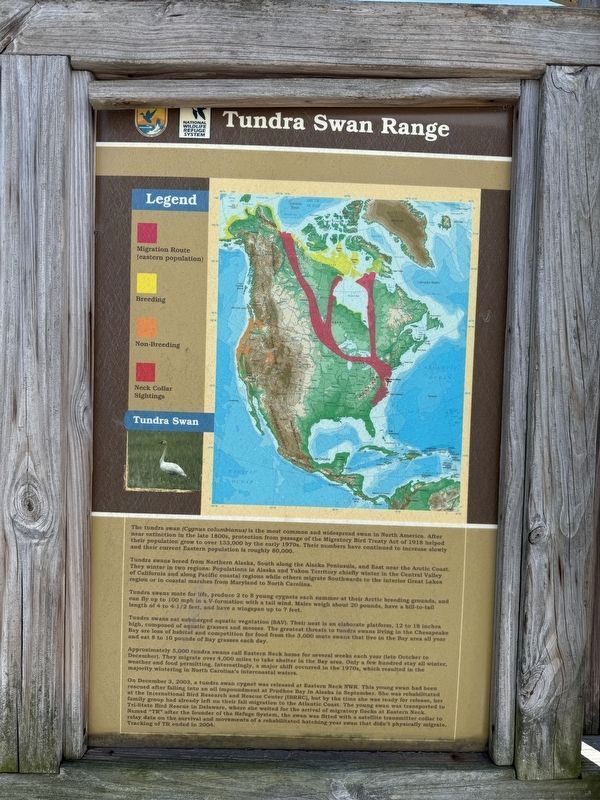
The tundra swan (Cygnus columbianus) is the most common and widespread swan in North America. After near extinction in the late 1800s, protection from passage of the Migratory Bird Treaty Act of 1918 helped their population grow to over 133,000 by the early 1970s. Their numbers have continued to increase slowly and their current Eastern population is roughly 80,000.
Tundra swans breed from Northern Alaska, South along the Alaska Peninsula, and East near the Arctic Coast. They winter in two regions: Populations in Alaska and Yukon Territory chiefly winter in the Central Valley of California and along Pacific Coastal regions while others migrate Southwards to the interior Great Lakes region or in coastal marshes from Maryland to North Carolina.
Tundra swans mate for life, produce 2 to 8 young cygnets each summer at their Arctic breeding grounds, and can fly up to 100 mph in a V-formation with a tail wind. Males weigh about 20 pounds, have a bill-to-tail length of 4 to 4-1/2 feet, and have a wingspan up to 7 feet.
Tundra swans eat submerged aquatic vegetation (SAV). Their nest is an elaborate platform, 12 to 18
this page online
Approximately 5,000 tundra swans call Eastern Neck home for several weeks each year (late October to December). They migrate over 4,000 miles to take shelter in the Bay area. Only a few hundred stay all winter, weather and food permitting. Interestingly, a major shift occurred in the 1970s, which resulted in the majority wintering in North Carolina's intercoastal waters.
On December 3, 2003, a tundra swan cygnet was released at Eastern Neck NWR. This young swan had been rescued after falling into an oil impoundment at Prudhoe Bay in Alaska in September. She was rehabilitated at the International Bird Research and Rescue Center (IBRRC), but by the time she was ready for release, her family group had already left on their fall migration to the Atlantic Coast. The young swan was transported to Tri-State Bird Rescue in Delaware, where she waited for the arrival of
Erected by Fish & Wildlife Service, U.S. Department of the Interior.
Topics. This historical marker is listed in these topic lists: Animals • Environment • Parks & Recreational Areas. A significant historical date for this entry is December 3, 2003.
Location. 39° 3.245′ N, 76° 13.326′ W. Marker is near Rock Hall, Maryland, in Kent County. It is in Eastern Neck National Wildlife Refuge. It is on Eastern Neck Island Road south of Ellendale Farm Drive, on the right when traveling south. Touch for map. Marker is at or near this postal address: 1632 Eastern Neck Island Rd, Rock Hall MD 21661, United States of America. Touch for directions.

Regionally, this marker is on the Eastern Shore. It is also in the American Mid-Atlantic, on the Delmarva Peninsula, in the Tidewater, in the Chesapeake Bay Region, and on the Eastern Seaboard. Globally, it is in the North Atlantic Region, North America, the Western Hemisphere, the Western World, and the Anglosphere. Historically, it finds itself in what was once one of the original Thirteen Colonies and also the Antebellum South.
Other nearby markers. At least 8 other markers are within 6 miles of this marker, measured as the crow flies: In Recognition of Howard E. McIntyre (approx. 0.6 miles away); New Yarmouth (approx. one mile away); Living Shorelines at Eastern Neck National Wildlife Refuge (approx. 1.6 miles away); History of Bogles Wharf (approx. 1.6 miles away); Hunting Waterfowl in the Chesapeake (approx. 2.3 miles away); Chesapeake Waterfowl Hunting / Hunting Skiff (approx. 2.3 miles away); Wickliffe (approx. 2.4 miles away); Bowlingly (approx. 5½ miles away). Touch for a list and map of all markers in Rock Hall.
Other markers no longer nearby. Clever Ruse (was within shouting distance of this marker but has been permanently removed); Long Distance Travelers (was approx. 0.6 miles away but has been permanently removed); Birds of Prey-Hunters in the Sky (was approx. 0.6 miles away but has been permanently removed).
Credits. This page was last revised on May 25, 2025. It was originally submitted on May 25, 2025, by Devry Becker Jones of Washington, District of Columbia. This page has been viewed 130 times since then and 34 times this year. Photos: 1, 2. submitted on May 25, 2025, by Devry Becker Jones of Washington, District of Columbia.
