Chestertown in Kent County, Maryland — The American Northeast (Mid-Atlantic)
Before There Was a Town
📜
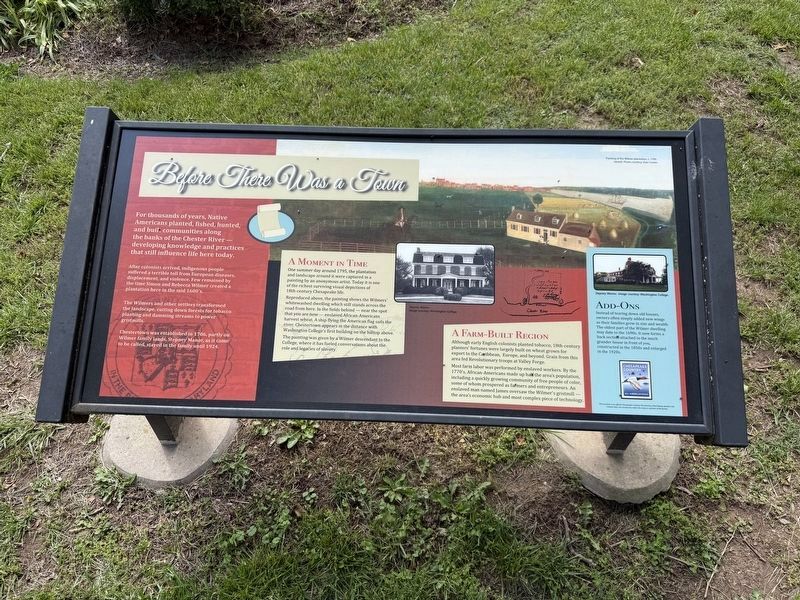
For thousands of years, Native Americans planted, fished, hunted, and built communities along the banks of the Chester River — developing knowledge and practices that still influence life here today.
After colonists arrived, indigenous people suffered a terrible toll from European diseases, displacement, and violence. Few remained by the time Simon and Rebecca Wilmer created a plantation here in the mid 1600's.
The Wilmers and other settlers transformed the landscape, cutting down forests for tobacco planting and damming streams to power gristmills.
Chestertown was established in 1706, partly on Wilmer family lands. Stepney Manor, as it came to be called, stayed in the family until 1924.
A Moment in Time
One summer day around 1795, the plantation and landscape around it were captured in a painting by an anonymous artist. Today it is one of the richest surviving visual depictions of 18th-century Chesapeake life.
Reproduced above, the painting shows the Wilmers' whitewashed dwelling which stands across the road from here. In the fields behind — near the spot that you are now — enslaved African-Americans harvest
this page online
The painting was given by a Wilmer descendant to the College, where it has fueled conversations about the role and legacies of slavery.
A Farm-Built Region
Although early English colonists planted tobacco, 18th-century planters' fortunes were largely built on wheat grown for export to the Caribbean, Europe, and beyond. Grains from this area fed Revolutionary troops at Valley Forge.
Most farm labor was performed by enslaved workers. By the 1770's, African-Americans made up half the area's population including a quickly growing community of free people of color, some of whom prospered as farmers and entrepreneurs. An enslaved man named James oversaw the Wilmer's gristmill — the area's economic hub and most complex piece of technology.
Add-Ons
Instead of tearing down old houses, owners often simply added new wings as their families grew in size and wealth. The oldest part of the Wilmer dwelling may date to the 1690s. It now forms a back section attached to the much grander
Topics. This historical marker is listed in these topic lists: African Americans • Agriculture • Indigenous Peoples and Communities • Settlements & Settlers. A significant historical year for this entry is 1706.
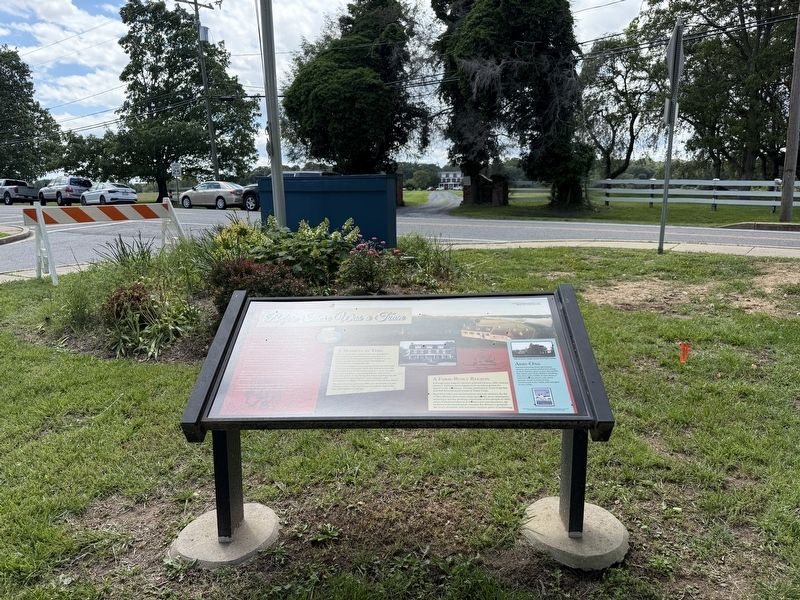
Location. 39° 12.351′ N, 76° 4.028′ W. Marker is in Chestertown, Maryland, in Kent County. It is on South Cross Street (Maryland Route 289) south of Cannon Street, on the right when traveling north. Touch for map. Marker is at or near this postal address: 406 S Cross St, Chestertown MD 21620, United States of America. Touch for directions.

Regionally, this marker is on the Eastern Shore. It is also in the American Mid-Atlantic, on the Delmarva Peninsula, in the Tidewater, in the Chesapeake Bay Region, and on the Eastern Seaboard. Globally, it is in the North Atlantic Region, North America, the Western Hemisphere, the Western World, and the Anglosphere. Historically, it finds itself in what was once one of the original Thirteen Colonies and also the Antebellum South.
Other nearby markers. At least 8 other markers are within walking distance of this marker: Philip G. Wilmer Park Urban Greening Project (within shouting distance of this marker); Charles Sumner Post #25, G.A.R. (about 500 feet away, measured in a direct line); Philip G. Wilmer Park (about 600 feet away); Worrell’s Tavern (about 600 feet away); U.S. Marines Memorial (about 700 feet away); Wilmer Park Living Shoreline (about 700 feet away); We honor them here (approx. 0.2 miles away); Chestertown Vol. Fire Co. (approx. 0.2 miles away). Touch for a list and map of all markers in Chestertown.
Other markers no longer nearby. Charles Sumner Post, G.A.R. (was about 500 feet away but has been replaced with another marker now near it); Kent County News (was about 800 feet away but has been confirmed missing).
Credits. This page was last revised on May 26, 2025. It was originally submitted on May 26, 2025, by Devry Becker Jones of Washington, District of Columbia. This page has been viewed 188 times since then and 32 times this year. Photos: 1, 2. submitted on May 26, 2025, by Devry Becker Jones of Washington, District of Columbia.
