Bernalillo in Sandoval County, New Mexico — The American Mountains (Southwest)
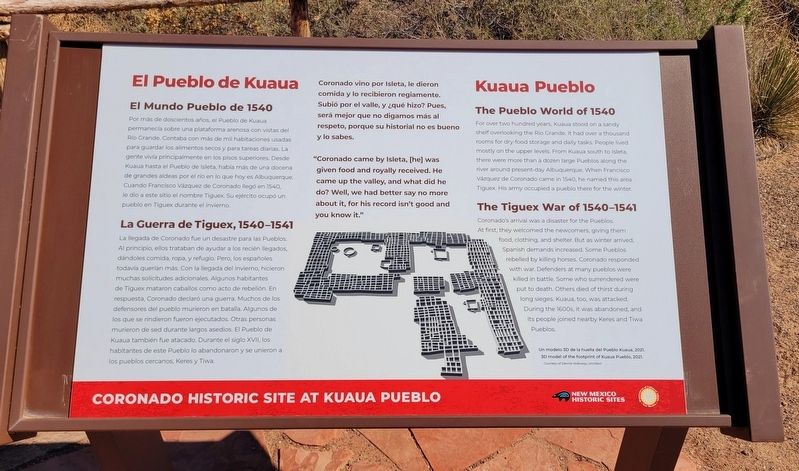
El Pueblo de Kuaua
⎯⎯⎯
Kuaua Pueblo
Photographed by James Hulse, April 9, 2025
1. El Pueblo de Kuaua / Kuaua Pueblo Marker

El Mundo Pueblo de 1540
Por más de doscientos años, el Pueblo de Kuaua permanecía sobre una plataforma arenosa con vistas del Rio Grande. Contaba con más de mil habitaciones usadas para guardar los alimentos secos y para tareas diarias. La gente vivía principalmente en los pisos superiores. Desde Kuaua hasta el Pueblo de Isleta, había más de una docena de grandes aldeas por el río en lo que hoy es Albuquerque. Cuando Francisco Vázquez de Coronado llegó en 1540, le dio a este sitio el nombre Tiguex. Su ejército ocupó un pueblo en Tiguex durante el invierno.
La Guerra de Tiguex, 1540-1541
La llegada de Coronado fue un desastre para las Pueblos. Al principio, ellos trataban de ayudar a los recién llegados, dándoles comida, ropa, y refugio. Pero, los españoles todavía querían más. Con la llegada del invierno, hicieron muchas solicitudes adicionales. Algunos habitantes de Tiguex mataron caballos como acto de rebelión. En respuesta, Coronado declaró una guerra. Muchos de los defensores del pueblo murieron en batalla. Algunos de los que se rindieron fueron ejecutados. Otras personas murieron de sed durante
this page online
Coronado vino por Isleta, le dieron comida y lo recibieron regiamente. Subió por el valle, y ¿qué hizo? Pues, será mejor que no digamos más al respeto, porque su historial no es bueno y lo sabes.
Subtítulos
(Foto #1) Un modelo 3D de la huella del Pueblo Kuaua, 2021.
The Pueblo World of 1540
For over two hundred years, Kuaua stood on a sandy shelf overlooking the Rio Grande. It had over a thousand rooms for dry-food storage and daily tasks. People lived mostly on the upper levels. From Kuaua south to Isleta, there were more than a dozen large Pueblos along the river around present-day Albuquerque. When Francisco Vázquez de Coronado came in 1540, he named this area Tiguex. His army occupied a pueblo there for the winter.
The Tiguex War of 1540-1541
Coronado's arrival was a disaster for the Pueblos. At first, they welcomed the newcomers, giving them food, clothing, and shelter. But as winter arrived, Spanish demands increased. Some Pueblos

Photographed by James Hulse, April 9, 2025
2. The Kuaua Pueblo Marker
The Rio Grande River and Sandia Mountains are located behind the marker.
"Coronado came by Isleta, [he] was given food and royally received. He came up the valley, and what did he do? Well, we had better say no more about it, for his record isn't good and you know it."
Captions
(Photo #1) 3D model of the footprint of Kuaua Pueblo, 2021. Courtesy of Dennis Holloway, architect
Erected by Coronado Historic Site Kuaua Pueblo and New Mexico Historic Sites.
Topics. This historical marker is listed in these topic lists: Anthropology & Archaeology • Indigenous Peoples and Communities • Settlements & Settlers. A significant historical year for this entry is 1540.
Location. 35° 19.785′ N, 106° 33.398′ W. Marker is in Bernalillo, New Mexico, in Sandoval County. It is on Kuaua Road half a mile east of U.S. 550. The marker is located in the Kuaua Ruins (Coronado Historic Site). Touch for map. Marker

Photographed by James Hulse, April 9, 2025
3. Kuaua Pueblo Marker (top right)

Regionally, this marker is in the San Juan Basin and in Greater Albuquerque. It is also in the American Southwest and at the Four Corners. Globally, it is in North America, the Western Hemisphere, the Western World, and the Anglosphere. Historically, it finds itself in what was once New Spain, the territory of the Ancestral Puebloans, and the Republic of Texas.
Other nearby markers. At least 8 other markers are within walking distance of this marker: Was Coronado Ever at Kuaua? (a few steps from this marker); The Siege of Kuaua (a few steps from this marker); Agricultura Pueblo / Pueblo Agriculture (a few steps from this marker); Francisco Vasquez de Coronado (a few steps from this marker); Cultivos y animales nativas / Native Crops and Animals (a few steps from this marker); Recursos del desierto / Desert Resources (a few steps from this marker); Las Montañas / The Mountains (a few steps from this marker); El Bosque / The Bosque (within shouting distance of this marker). Touch for a list and map of all markers in Bernalillo.
More about this marker. There is a small fee to visit the Kuaua Ruins (Coronado Historic Site).
Also see . . .
1. Coronado Historic Site. New Mexico Historic Sites
Coronado Historic Site and the ancient Kuaua Pueblo are located just minutes north of Albuquerque (off of I-25, Exit 242) in Bernalillo. In 1540, Francisco Vásquez de Coronado—with 500 soldiers and 2,000 Indigenous allies from New Spain—entered the Rio Grande valley somewhere near this site. Coronado was searching for the fabled Seven Cities of Gold.(Submitted on May 26, 2025, by James Hulse of Medina, Texas.)
2. The Tiguex War. National Park Service, U.S. Department of the Interior
In 1540, the indigenous Tiguex (tee-wish) lived in villages along the Rio Grande River. Some of their ancestors had lived there for thousands of years. They resided in multi-storied towns of up to a thousand people made of adobe, stone, and timber. Like most Native Americans of the Southwest, they raised several varieties of corn, along with squash, beans and other crops. They wove fine cotton cloth. They were generally peaceful, though warfare was not unknown between the Tiguex and the other tribes in the area. The Tiguex, now known as the Tewa, still live in this area, in the Ohkay Owingeh, Nambe, Pojoaque, San Ildefonso, Santa Clara and Tequque Pueblos, vibrant towns that cherish their past, present and future roles in New Mexican culture.(Submitted on May 27, 2025, by James Hulse of Medina, Texas.)
Credits. This page was last revised on May 27, 2025. It was originally submitted on May 26, 2025, by James Hulse of Medina, Texas. This page has been viewed 113 times since then and 11 times this year. Photos: 1, 2, 3. submitted on May 27, 2025, by James Hulse of Medina, Texas.
