Marker Logo
THE HISTORICAL
MARKER DATABASE
“Bite-Size Bits of Local, National, and Global History”
Appalachia in Wise County, Virginia — The American South (Mid-Atlantic)
 

The Lynching of Dave Hurst
⎯⎯⎯
Lynching in America

Community Remembrance Project
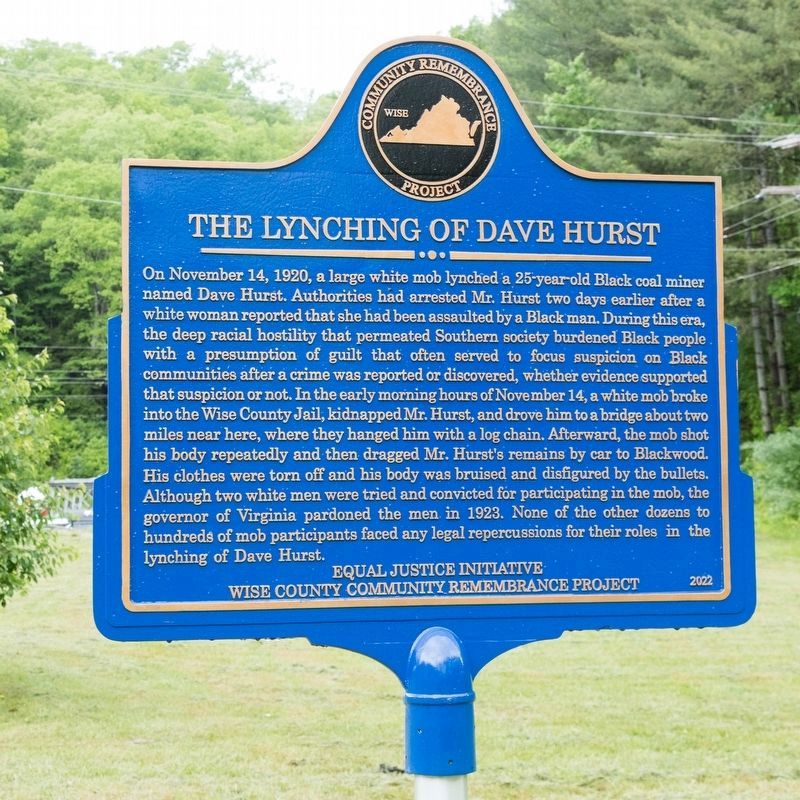
 
 
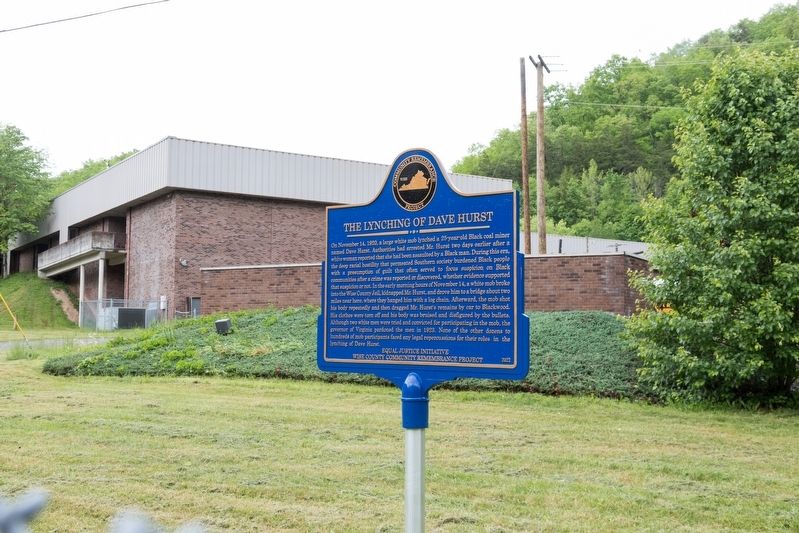
The Lynching of Dave Hurst Marker, side one image. Click for full size.
Photographed by J. J. Prats, May 16, 2025
1. The Lynching of Dave Hurst Marker, side one
Inscription.
The Lynching of Dave Hurst
On November 14, 1920, a large white mob lynched a 25-year-old Black coal miner named Dave Hurst. Authorities had arrested Mr. Hurst two days earlier after a white woman reported that she had been assaulted by a Black man. During this era, the deep racial hostility that permeated Southern society burdened Black people with a presumption of guilt that often served to focus suspicion on Black communities after a crime was reported or discovered, whether evidence supported that suspicion or not. In the early morning hours of November 14, a white mob broke into the Wise County Jail, kidnapped Mr. Hurst, and drove him to a bridge about two miles near here, where they hanged him with a log chain. Afterward, the mob shot his body repeatedly and then dragged Mr. Hurst's remains by car to Blackwood. His clothes were torn off and his body was bruised and disfigured by the bullets. Although two white men were tried and convicted for participating in the mob, the governor of Virginia pardoned the men in 1923. None of the other dozens to hundreds of mob participants faced any legal repercussions for their
Paid Advertisement
Click or scan to see
this page online
roles in the lynching of Dave Hurst.

Lynching in America
Between 1865 and 1950, thousands of African Americans were victims of mob violence and lynching across the United States. Following the Civil War, fierce resistance to equal rights for African Americans and an ideology of white supremacy led to fatal violence against Black women, men, and children. Lynching emerged as the most public and notorious form of racial terrorism, intended to intimidate Black people and reinforce racial hierarchy and segregation. Many African Americans were lynched for exercising economic freedoms, perceived violations of social customs, and accusations of crimes. Accusations against Black men by white women regularly aroused mob violence and lynching. A white person's allegation against a Black person was rarely subject to scrutiny and often sparked violent reprisal, even when there was no evidence tying the accused to any offense. Although many victims of racial terror lynching will never be known, over 84 racial terror lynchings have been documented in Virginia including at least three victims in Wise County.
 
Erected 2024 by the Equal Justice
The Lynching of Dave Hurst / Lynching in America Marker image. Click for full size.
Photographed by J. J. Prats, May 16, 2025
2. The Lynching of Dave Hurst / Lynching in America Marker
Initiative and the Wise County Community Remembrance Project.
 
Topics and series. This historical marker is listed in these topic lists: African AmericansCivil RightsLaw Enforcement. In addition, it is included in the Lynching in America series list. A significant historical date for this entry is November 14, 1920.
 
Location. 36° 55.485′ N, 82° 44.689′ W. Marker is in Appalachia, Virginia, in Wise County. It is on Kent Junction Road. Touch for map. Marker is at or near this postal address: 3965 Kent Junction Rd, Appalachia VA 24216, United States of America. Touch for directions.

Regionally, this marker is in Southwest Virginia. It is also in the American South, specifically in the Upper South, in Appalachia, and specifically in Southern Appalachia. Globally, it is in North America, the Western Hemisphere, the Western World, and the Anglosphere. Historically, it finds itself in what was once the original Cherokee Nation, the territory of the Mississippian Culture, one of the original Thirteen Colonies, one of the Confederate States of America, and the Antebellum South.

Other nearby markers. At least 8 other markers
Paid Advertisement
are within 5 miles of this marker, measured as the crow flies: Appalachia (approx. 2.4 miles away); Appalachia High School (approx. 2.8 miles away); Appalachia: A Legacy of Railroading (approx. 3 miles away); Kelly View School (approx. 3 miles away); In Memory of Johnny Cubine (approx. 3 miles away); The Bee Rock Troll (approx. 3 miles away); Trail Head (approx. 3 miles away); Origins of Big Stone Gap (approx. 4.2 miles away). Touch for a list and map of all markers in Appalachia.
 
Additional commentary.
1. Marker stolen & replaced years later.
Two weeks after its initial installation the marker was stolen on November 11, 2022. On February 9th 2024 a replacement marker was installed.
    — Submitted April 22, 2026, by Mark Hilton of Montgomery, Alabama.
 
 
Credits. This page was last revised on May 3, 2026. It was originally submitted on May 25, 2025, by J. J. Prats of Powell, Ohio. This page has been viewed 250 times since then and 34 times this year. Last updated on May 27, 2025, by Gianluca De Fazio of Harrisonburg, Virginia. Photos:   1, 2. submitted on May 25, 2025, by J. J. Prats of Powell, Ohio. • Devry Becker Jones was the editor who published this page.
 
Editor’s want-list for this marker. A photo of the other side of the marker (the marker is behind a fence on private property so permission to enter will be required) • • Can you help?

m=273690

CeraNet Cloud Computing sponsors the Historical Marker Database.
This website earns income from purchases you make after using our links to Amazon.com. We appreciate your support.
Paid Advertisement
Sep. 9, 2026