Newboro in Leeds and Grenville United Counties, Ontario — Central Canada (North America)
Sappers and Miners
⎯⎯⎯
Sapeurs et mineurs
Photographed by Cosmos Mariner, May 29, 2024
1. Sappers and Miners / Sapeurs et mineurs Marker

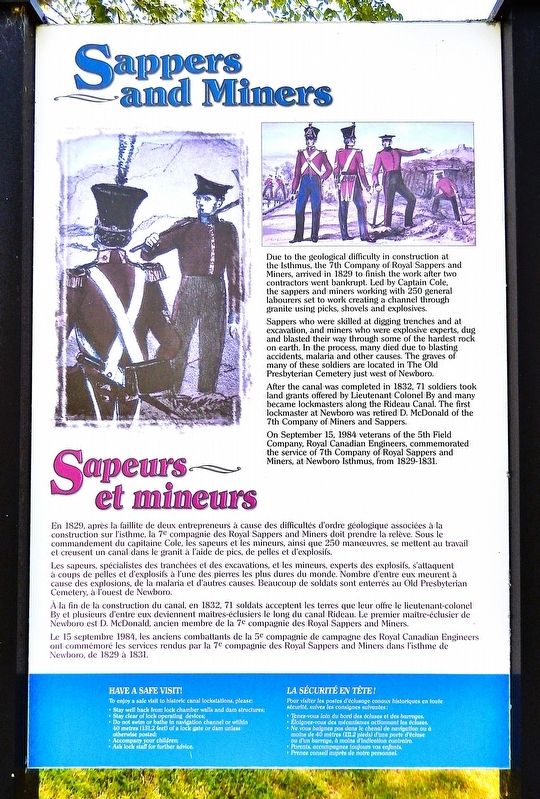
Sappers who were skilled at digging trenches and at excavation, and miners who were explosive experts, dug and blasted their way through some of the hardest rock on earth. In the process, many died due to blasting accidents, malaria and other causes. The graves of many of these soldiers are located in The Old Presbyterian Cemetery just west of Newboro.
After the canal was completed in 1832, 71 soldiers took land grants offered by Lieutenant Colonel By and many became lockmasters along the Rideau Canal. The first lockmaster at Newboro was retired D. McDonald of the 7th Company of Miners and Sappers.
On September 15, 1984 veterans of the 5th Field Company, Royal Canadian Engineers, commemorated the service of 7th Company of Royal Sappers and Miners, at Newboro Isthmus, from 1829-1831.
Les sapeurs, spécialistes des tranchées et des excavations, et les mineurs, experts des explosifs, s'attaquent à coups de pelles et d'explosifs à l'une des pierres les plus dures du monde. Nombre d'entre eux meurent à cause des explosions, de la malaria et d'autres causes.
this page online
À la fin de la construction du canal, en 1832, 71 soldats acceptent les terres que leur offre le lieutenant-colonel By et plusieurs d'entre eux deviennent maîtres-éclusiers le long du canal Rideau. Le premier maître-éclusier de Newboro est D. McDonald, ancien membre de la 7e compagnie des Royal Sappers and Miners.
Le 15 septembre 1984, les anciens combattants de la 5e compagnie de campagne des Royal Canadian Engineers ont commémoré les services rendus par la 7e compagnie des Royal Sappers and Miners dans l'isthme de Newboro, de 1829 à 1831.
Topics. This historical marker is listed in these topic lists: Cemeteries & Burial Sites • Waterways & Vessels. A significant historical year for this entry is 1829.
Location. 44° 38.795′ N, 76° 19.239′ W. Marker is in Newboro, Ontario, in Leeds and Grenville United Counties. It can be reached from Lock Road 0.4 kilometers south of County Road 42. The marker is located at the Newboro Lock 36 Rideau Canal National Historic Site. Touch for map. Marker is at or near this postal address: 10 Blockhouse Lane, Newboro
Photographed by Cosmos Mariner, May 29, 2024
2. Sappers and Miners / Sapeurs et mineurs Marker
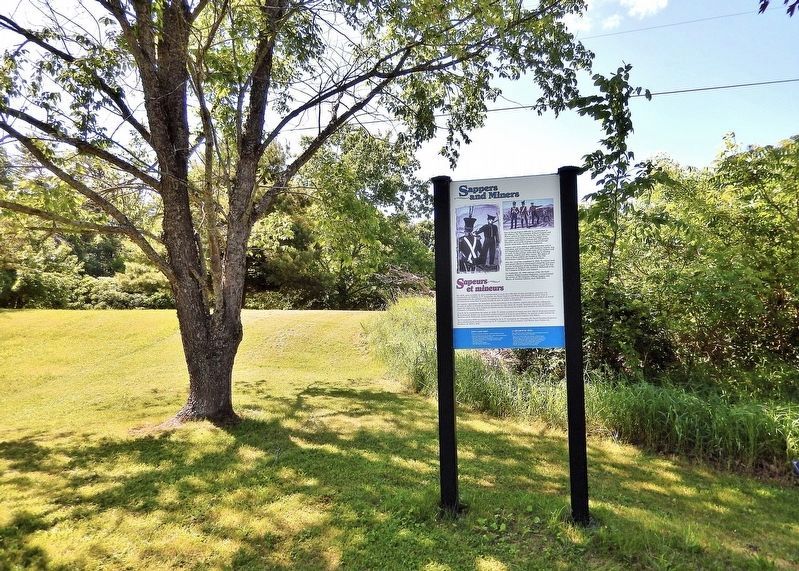
The marker is located along the walking trail between the Newboro Municipal Harbour parking lot and Rideau Canal Lock 36.

Regionally, this marker is in Eastern Ontario and specifically in Southeastern Ontario. It is also in Central Canada. Globally, it is in North America, the Western Hemisphere, the Western World, and the Anglosphere. Historically, it finds itself in what was once a British colony, the Viceroyalty of New France, the Haudenosaunee (Iroquois) Confederacy, and Rupert’s Land.
Other nearby markers. At least 8 other markers are within 6 kilometers of this marker, measured as the crow flies: The Royal Sappers and Miners (approx. 0.6 kilometers away); St. Mary's Anglican Church (approx. 0.7 kilometers away); Blanche A. Thompson Leggett (approx. 5 kilometers away); Crosby Methodist Church Bell (approx. 5 kilometers away); The Methodist New Connection Church (approx. 5 kilometers away); Blockhaus de Narrows Blockhouse (approx. 6.6 kilometers away); Narrows (approx. 6.6 kilometers away); Rivers, Lakes and Locks / Rivières, Lacs et Écluses (approx. 6.6 kilometers away). Touch for a list and map of all markers in Newboro.
Related markers. Click here for a list of markers that are related to this marker. The Royal Sappers and Miners
Also see . . . The Royal Sappers and Miners Cemetery.
(by Don Cooke, 4/9/2016) Excerpt: The construction on the cut at the Isthmus between Mud (later Newboro) Lake and Rideau Lake was one of frustration and death. Malaria had a devastating impact on the work especially in August 1830, when many labourers, as well as women, children and soldiers, died from the disease. Two contractors tried but found it next to impossible, using hammer and iron bar, to cut through the Precambrian granite rock that formed the Isthmus. As a result, this was the only section of the canal, outside of Bytown, that was built under direct military supervision. The 7th and 15th Companies of the Royal Sappers and Miners had arrived at Bytown (Ottawa) on June 1, 1827. Fifty-seven men of the 7th Company, along with approximately 250 labourers were moved to the Isthmus in 1829.(Submitted on May 27, 2025, by Cosmos Mariner of Cape Canaveral, Florida.)The unit was commanded by Captain Savage with three Lieutenants to assist him; Briscoe, Bentamin and Simon. There were two Royal Engineers assigned to the Isthmus, Captain Cole and Captain Gale, who solved the problem of cutting through the hard rock by building a dam and lock at the narrowest point on Rideau Lake (the Narrows). This created “Upper” Rideau Lake, adding five feet of depth to allow flooding the rock in the cut thereby avoiding additional excavation.
Credits. This page was last revised on May 27, 2025. It was originally submitted on May 27, 2025, by Cosmos Mariner of Cape Canaveral, Florida. This page has been viewed 123 times since then and 24 times this year. Photos: 1, 2. submitted on May 27, 2025, by Cosmos Mariner of Cape Canaveral, Florida.
