Brentwood in Williamson County, Tennessee — The American South (East South Central)
Archaeological Expedition
Photographed by Darren Jefferson Clay, May 26, 2025
1. Archaeological Expedition Marker
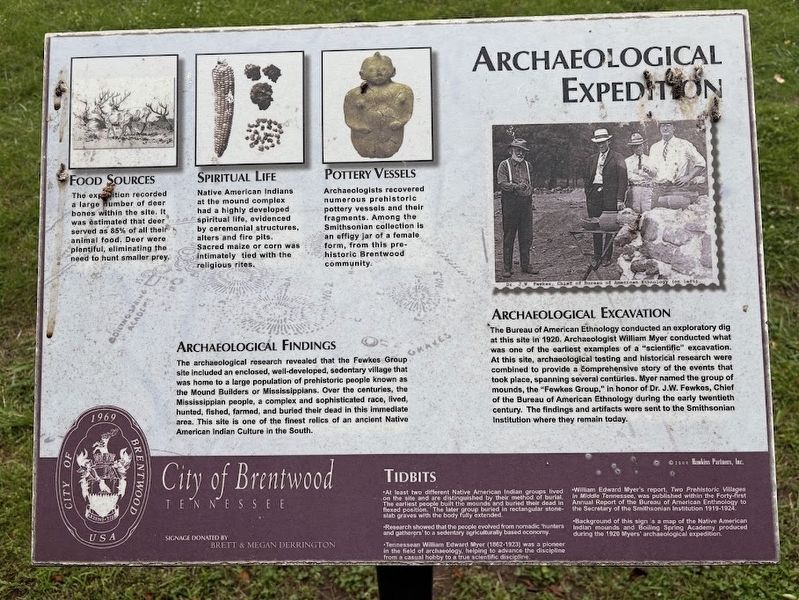
The Bureau of American Ethnology conducted an exploratory dig at this site in 1920. Archaeologist William Myer conducted what was one of the earliest examples of a "scientific" excavation. At this site, archaeological testing and historical research were combined to provide a comprehensive story of the events that took place, spanning several centuries. Myer named the group of mounds, the "Fewkes Group," in honor of Dr. J.W. Fewkes, Chief of the Bureau of American Ethnology during the early twentieth century. The findings and artifacts were sent to the Smithsonian Institution where they remain today.
Archaeological Findings
The archaeological research revealed that the Fewkes Group site included an enclosed, well-developed, sedentary village that was home to a large population of prehistoric people known as the Mound Builders or Mississippians. Over the centuries, the Mississippian people, a complex and sophisticated race, lived, hunted, fished, farmed, and buried their dead in this immediate area. This site is one of the finest relics of an ancient Native American Indian Culture in the
this page online
Food Sources
The expedition recorded a large number of deer bones within the site. It was estimated that deer served as 85% of all their animal food. Deer were plentiful, eliminating the need to hunt smaller prey.
Spiritual Life
Native American Indians at the mound complex had a highly developed spiritual life, evidenced by ceremonial structures, alters and fire pits. Sacred maize or corn was intimately tied with the religious rites.
Pottery Vessels
Archaeologists recovered numerous prehistoric pottery vessels and their fragments. Among the Smithsonian collection is an effigy jar of a female form, from this pre-historic Brentwood community.
Tidbits
• At least two different Native American Indian groups lived on the site and are distinguished by their method of burial. The earliest people built the mounds and buried their dead in flexed position. The later group buried in rectangular stone-slab graves with the body fully extended.
• Research showed that the people evolved from nomadic 'hunters and gatherers' to a sedentary agriculturally based economy.
• Tennessean William Edward Myer (1862-1923) was a pioneer in the field of archaeology, helping to advance the discipline from a casual hobby to a true scientific discipline.
• William Edward Myer's report, Two Prehistoric Villages in Middle Tennessee, was published within the Forty-first Annual Report of the Bureau of American Ethnology to the Secretary of the Smithsonian Institution 1919-1924.
• Background of this sign is a map of the Native American Indian mounds and Boiling Spring Academy produced during the 1920 Myers' archaeological expedition.
Erected by City
Photographed by Darren Jefferson Clay, May 26, 2025
2. Archaeological Expedition Marker
Topics. This historical marker is listed in these topic lists: Cemeteries & Burial Sites • Indigenous Peoples and Communities.
Location. 35° 58.019′ N, 86° 46.642′ W. Marker is in Brentwood, Tennessee, in Williamson County. It can be reached from Moores Lane (Tennessee Route 441) west of Wilson Pike ( Route 252), on the right when traveling east. Touch for map. Marker is at or near this postal address: 8400 Moores Ln, Brentwood TN 37027, United States of America. Touch for directions.

Regionally, this marker is in Middle Tennessee and in Greater Nashville. It is also in the American South and specifically in the Upper South. Globally, it is in North America, the Western Hemisphere, the Western World, and the Anglosphere. Historically, it finds itself in what was once the territory of the Mississippian Culture, one of the Confederate States of America, and the Antebellum South.
Other nearby markers. At least 8 other markers are within 2 miles of this marker, measured as the crow flies: Prehistoric Native American Indian Town (within shouting distance of this marker); The Boiling Spring Site (within shouting distance of this marker); Primm Historic Park (within shouting distance of this marker); Boiling Spring Academy (about 300 feet away, measured in a direct line); Forge Seat (approx. 0.7 miles away); Andrew Crockett 1745-1821 (approx. 0.7 miles away); Cool Springs House (approx. one mile away); Knox-Crockett House (approx. 1.2 miles away). Touch for a list and map of all markers in Brentwood.
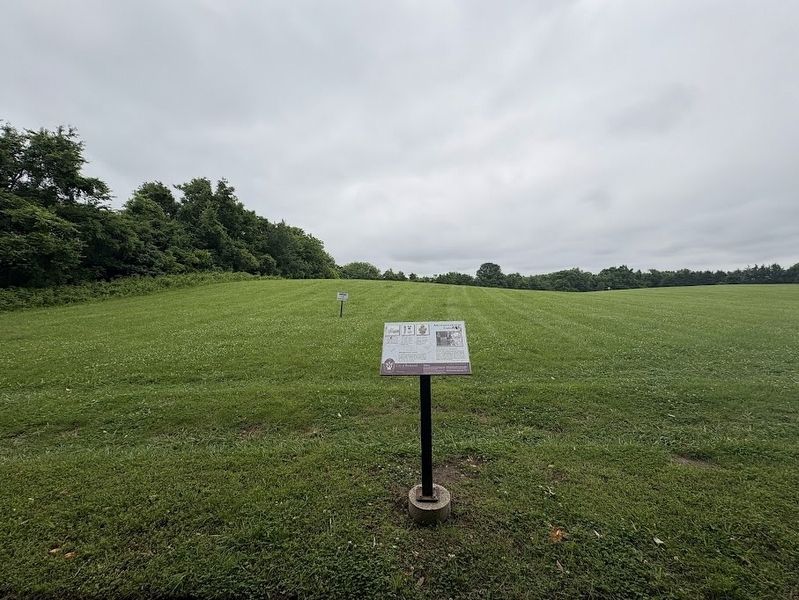
More about this marker. Maker is located in Primm Park, off of Moores Lane
Credits. This page was last revised on May 28, 2025. It was originally submitted on May 27, 2025, by Darren Jefferson Clay of Duluth, Georgia. This page has been viewed 249 times since then and 64 times this year. Photos: 1, 2. submitted on May 27, 2025, by Darren Jefferson Clay of Duluth, Georgia. • James Hulse was the editor who published this page.
