Liberty in Clay County, Missouri — The American Midwest (Upper Plains)
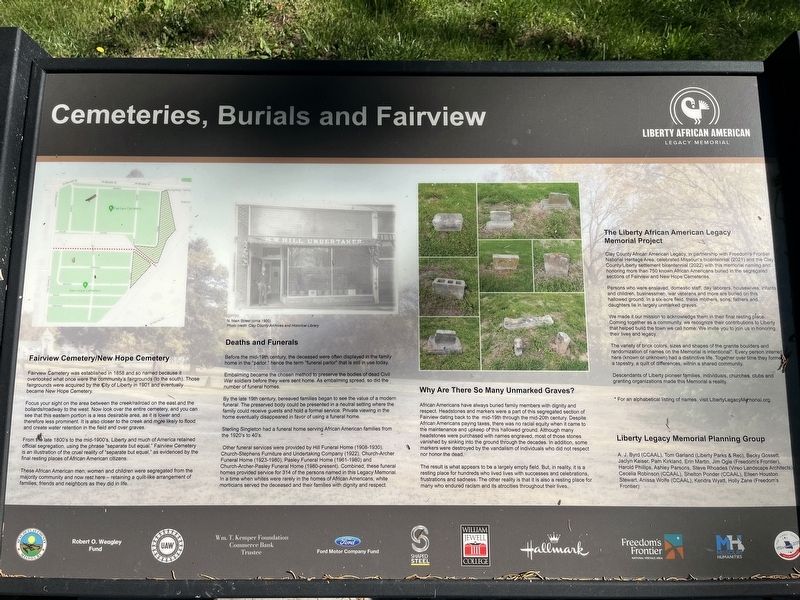
Cemeteries, Burials and Fairview
Liberty African American Legacy Memorial
Photographed by Erika Brant
1. Liberty African American Legacy Memorial Marker
Fairview Cemetery/New Hope Cemetery
Fairview Cemetery was established in 1858 and so named because it overlooked what once were the community’s fairgrounds (to the south). Those fairgrounds were acquired by the City of Liberty in 1901 and eventually became New Hope Cemetery.
Focus your sight on the area between the creek/railroad on the east and the bollards/roadway to the west. Now look over the entire cemetery, and you can see that this eastern portion is a less desirable area, as it is lower and therefore less prominent. It is also closer to the creek and more likely to flood and create water retention in the field and over graves.
From the late 1800’s to the mid-1900’s, Liberty and much of America retained official segregation, using he phrase “separate but equal.” Fairview Cemetery is an illustration of the cruel reality of “separate but equal,” as evidenced by the final resting places of African American citizens. These African American men, women and children were segregated from the majority community and now rest here – retaining a quilt-like arrangement of families, friends and neighbors as they did in
this page online
Deaths and Funerals
Before the mid-19th century, the deceased were often displayed in the family home in the “parlor” hence the term “funeral parlor” that is still in use today.
Embalming became the chosen method to preserve the bodies of dead Civil War soldiers before they were sent home. As embalming spread, so did the number of funeral homes.
By the late 19th century, bereaved families became to see the value of a modern funeral. The preserved body could be presented in a neutral setting where the family could receive guests and hold a formal service. Private viewing in the home eventually disappeared in favor of using a funeral home.
Sterling Singleton had a funeral home serving African American families from the 1920’s to 40’s. Other funeral services were provided by Hill Funeral Home (1908-1930), Church-Stephens Furniture and Undertaking Company (1922), Church-Archer Funeral Home (1923-1980), Pasley Funeral Home (1961-1980) and Church-Archer Pasley Funeral Home (1980-present). Combined, these funeral homes provided service for 314 of the persons named in this Legacy Memorial In a time when whites were rarely
Photographed by Erika Brant
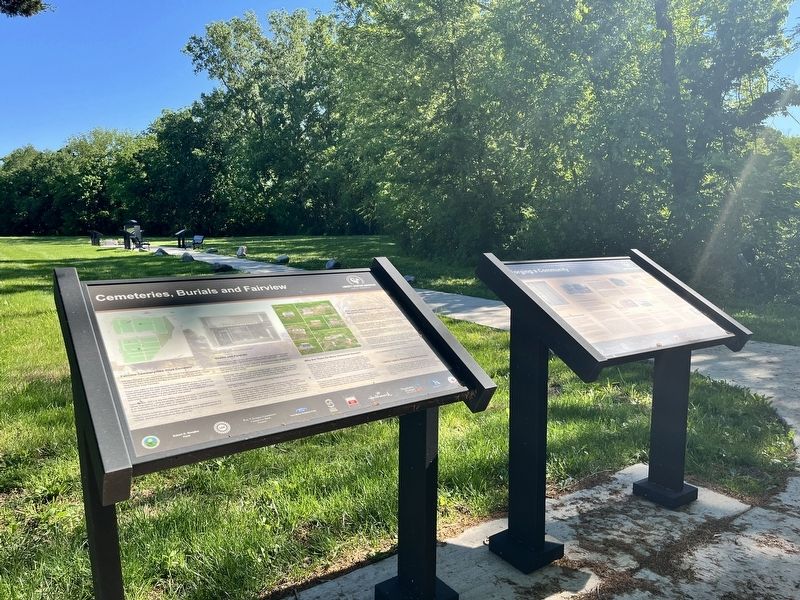
2. Liberty African American Legacy Memorial
Why are there so many unmarked graves?
African Americans have always buried family members with dignity and respect. Headstones and markers were a part of this segregated section of Fairview dating back to the mid-19th throughout the mid-20th century. Despite African Americans paying taxes, there was no racial equity when it came to the maintenance and upkeep of this hallowed ground. Although many headstones were purchased with names engraved, most of those stones vanished by sinking into the ground through the decades. In addition, some markers were destroyed by the vandalism of individuals who did not respect or honor the dead.
The result is what appears to be a largely empty field. But, in reality, it is a resting place for hundreds who lived lives with successes and celebrations, frustrations and sadness. The other reality is that it is also a resting place for many who endured racism and its atrocities throughout their lives.
The Liberty African American Legacy Memorial Project
Clay County African American
Photographed by Erika Brant
3. Liberty African American Legacy Memorial
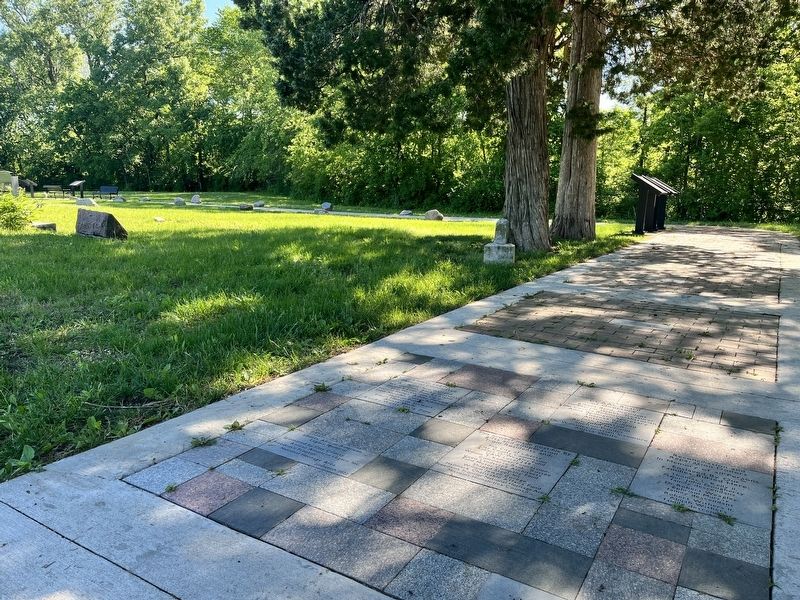
Persons who were enslaved, domestic staff, day laborers, housewives, infants and children, businessmen, war veterans and more are buried on this hallowed ground. In a six-acre field, these mothers, sons, fathers and daughters lie in largely unmarked graves.
We made it our mission to acknowledge them in their final resting place. Coming together as a community, we recognize their contributions to Liberty that helped build the town we call home. We invite you to join us in honoring their lives and legacy.
The variety of brick colors, sizes and shapes of the granite boulders and the randomization of the names on the Memorial is intentional*. Every person interred here (known or unknown) had a distinctive life. Together over time they formed a tapestry, a quilt of differences, within a shared community.
Descendants of Liberty pioneer families, individuals, churches, clubs and granting organizations made this Memorial a reality.
*For an alphabetical listing of names, visit LibertyLegacyMemorial.org
Liberty Legacy Memorial Planning Group
A.J. Byrd (CCAAL), Tom Garland (Liberty Parks & Rec), Becky Gossett, Jaclyn Kaiser, Pam Kirkland, Erin Martin, Jim Ogle (Freedom’s Frontier), Harold Phillips, Ashley Parsons, Steve Rhoades (Vireo Landscape Architects), Cecelia Robinson (CCAAL), Shelton Ponder (CCAAL), Eileen Houston Stewart, Anissa Wolfe (CCAAL), Kendra Wyatt, Holly Zane (Freedom’s Frontier)
Erected 2022 by Clay County African American Legacy, Inc. (Marker Number 1.)
Topics. This historical marker is listed in these topic lists: African Americans • Cemeteries & Burial Sites • Charity & Public Work • Civil Rights. A significant historical year for this entry is 1858.
Location. 39° 14.49′ N, 94° 25.352′ W. Marker is in Liberty, Missouri, in Clay County. It is on West Shrader Street west of Gallatin Street, on the right when traveling east. Touch for map. Marker is in this post office area: Liberty MO 64068, United States of America. Touch for directions.

Regionally, this marker is in the Missouri River Corridor and in Greater Kansas City. It is also in the American Midwest, in the Lewis & Clark Corridor, and in the Corn Belt. Globally, it is in North America, the Western Hemisphere, the Western World, and the Anglosphere. Historically, it finds itself in what was once the territory of the Mississippian Culture, the Louisiana Purchase, and the Antebellum South.
Other nearby markers. At least 8 other markers are within walking distance of this marker: Forging a Community (here, next to this marker); Business Owners (within shouting distance of this marker); Veterans (within shouting distance of this marker); Reconstruction, Great Migration and Civil Rights Eras (within shouting distance of this marker); Teachers and Educators (within shouting distance of this marker); Antebellum Era (within shouting distance of this marker); Pioneer Families (within shouting distance of this marker); Col. John Thornton (about 400 feet away, measured in a direct line). Touch for a list and map of all markers in Liberty.
Credits. This page was last revised on May 28, 2025. It was originally submitted on May 28, 2025, by Erika Brant of Liberty, Missouri. This page has been viewed 157 times since then and 42 times this year. Photos: 1, 2, 3. submitted on May 28, 2025, by Erika Brant of Liberty, Missouri. • Devry Becker Jones was the editor who published this page.
