Barrie in Simcoe County, Ontario — Central Canada (North America)
The East End — 1900s
| — | Barrie Waterfront Heritage Trail | — |
Photographed by Cosmos Mariner, June 5, 2024
1. The East End — 1900s Marker
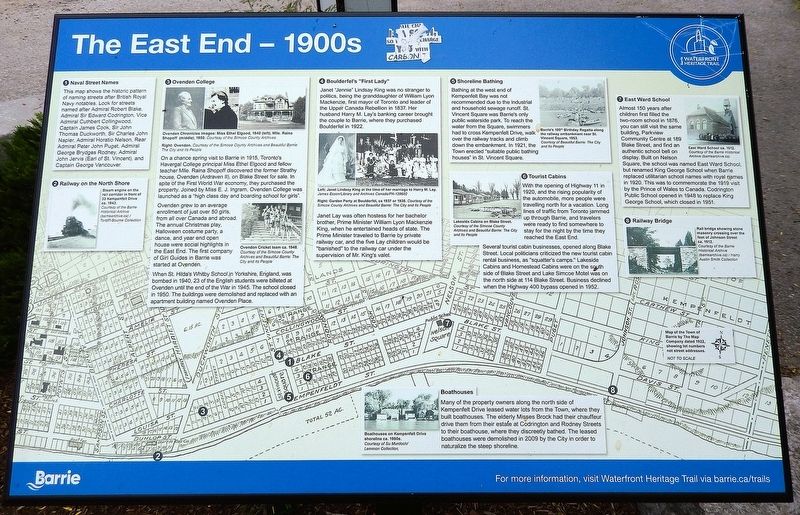
1 — Naval Street Names
This map shows the historic pattern of naming streets after British Royal Navy notables. Look for streets named after Admiral Robert Blake, Admiral Sir Edward Codrington, Vice Admiral Cuthbert Collingwood, Captain James Cook, Sir John Thomas Duckworth, Sir Charles John Napier, Admiral Horatio Nelson, Rear Admiral Peter John Puget, Admiral George Brydges Rodney, Admiral John Jervis (Earl of St. Vincent), and Captain George Vancouver.
3 — Ovenden College
On a chance spring visit to Barrie in 1915, Toronto's Havergal College principal Miss Ethel Elgood and fellow teacher Mlle. Raina Shopoff discovered the former Strathy house, Ovenden (Ardraven II), on Blake Street for sale. In spite of the First World War economy, they purchased the property. Joined by Miss E. J. Ingram, Ovenden College was launched as a “high class day and boarding school for girls”.
Ovenden grew to an average enrollment of just over 50 girls, from all over Canada and abroad. The annual Christmas play, Halloween costume party, a dance, and year end open house were social highlights in the East End. The first company of Girl Guides in
this page online
When St. Hilda's Whitby School in Yorkshire, England, was bombed in 1940, 23 of the English students were billeted at Ovenden until the end of the War in 1945. The school closed in 1950. The buildings were demolished and replaced with an apartment building named Ovenden Place.
4 — Boulderfers “First Lady”
Janet “Jennie” Lindsay King was no stranger to politics, being the granddaughter of William Lyon Mackenzie, first mayor of Toronto and leader of the Upper Canada Rebellion in 1837. Her husband Harry M. Lay's banking career brought the couple to Barrie, where they purchased Boulderfel in 1922.
Janet Lay was often hostess for her bachelor brother, Prime Minister William Lyon Mackenzie King, when he entertained heads of state. The Prime Minister traveled to Barrie by private railway car, and the five Lay children would be “banished” to the railway car under the supervision of Mr. King's valet.
5 — Shoreline Bathing
Bathing at the west end of Kempenfelt Bay was not recommended due to the industrial and household sewage runoff. St. Vincent Square was Barnes only public waterside park. To reach the water from
Photographed by Cosmos Mariner, June 5, 2024
2. The East End — 1900s Marker
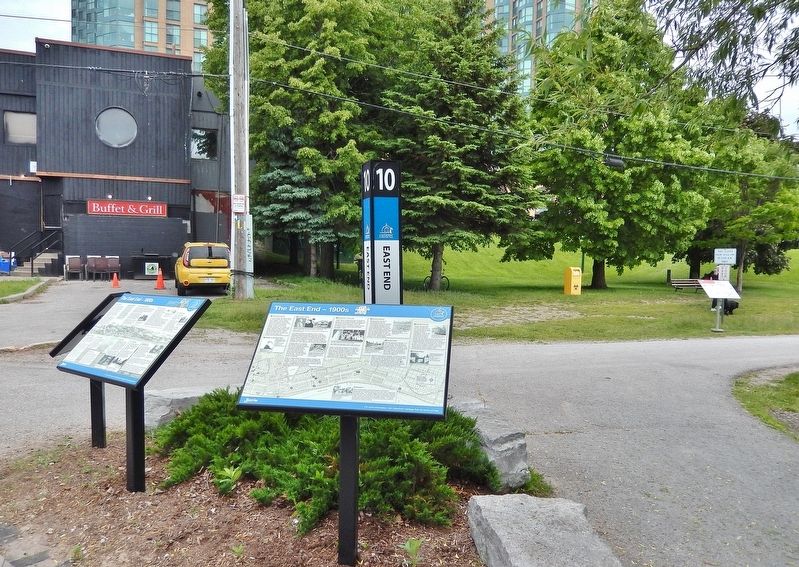
Looking north from the Heritage Park parking lot. The Barrie North Shore Trail (former rail line) and Sam Cancilla Park are in the right background. There are two related interpretive panels on the left.
6 — Tourist Cabins
With the opening of Highway 11 in 1920, and the rising popularity of the automobile, more people were travelling north for a vacation. Long lines of traffic from Toronto jammed up through Barrie, and travelers were ready to find somewhere to stay for the night by the time they reached the East End.
Several tourist cabin businesses opened along Blake Street. Local politicians criticized the new tourist cabin rental business, as “squatter's camps.” Lakeside Cabins and Homestead Cabins were on the south side of Blake Street and Lake Simcoe Motel was on the north side at 114 Blake Street. Business declined when the Highway 400 bypass opened in 1952.
7 — East Ward School
Almost 150 years after children first filled the two-room school in 1876, you can still visit the same building, Parkview Community Centre at 189 Blake Street, and find an authentic school bell on display. Built on Nelson Square, the school was named East Ward School, but renamed King George School when Barrie replaced utilitarian school names with royal names in 1920. This was to commemorate the 1919 visit by the Prince of Wales to Canada. Codrington Public School opened in 1948 to replace King George School, which closed in 1951.
Boathouses
Many of the property owners along the north side of Kempenfelt Drive leased water lots from the Town, where they built boathouses. The elderly Misses Brock had their chauffeur drive them from their estate at Codrington and Rodney Streets to their boathouse, where they discreetly bathed. The leased boathouses were demolished in 2009 by the City in order to naturalize the steep shoreline.
[photo and image captions]
• [marker background image] Map of the Town of Barrie by The Map Company, 1922
• Steam engine on rail corridor in front of 33 Kempenfelt Drive, circa 1943
• Miss Ethel Elgood, 1940
• Mlle. Raina Shopoff, 1950
• Ovenden
• Ovenden Cricket Team, circa 1948
• Janet Lindsey King at the time of her marriage to Harry M. Lay
• Garden Party at Boulderfel, circa 1937-1938
• Barrie’s 100th Birthday Regatta along the railway embankment near St. Vincent Square, 1953
• Lakeside Cabins on Blake Street
• East Ward School, circa 1912
• Rail bridge showing stone masonry crossing over the foot of Johnson Street, circa 1912
• Boathouse on Kempenfelt Drive shoreline, circa 1960s
Erected by Barrie Waterfront Heritage Trail.
Topics. This historical marker is listed in these topic lists: Education • Industry & Commerce • Parks & Recreational Areas • Roads & Vehicles.
Location. 44° 23.327′ N, 79° 41.088′ W. Marker is in Barrie, Ontario, in Simcoe County. It is at the intersection of Simcoe Street and Mulcaster Street on Simcoe Street. The marker is on the Barrie Waterfront Heritage Trail at Station #10 (East End), on the east side of Heritage Park. Touch for map. Marker is at or near this postal address: 9 Lakeshore Drive, Barrie ON L4M 3L9, Canada. Touch for directions.

Regionally, this marker is in Central Ontario Cottage Country and specifically in Georgian Bay Country. It is also in Central Canada. Globally, it is in North America, on the Great Lakes, in the Western Hemisphere, in the Western World, and in the Anglosphere. Historically, it finds itself in what was once a British colony, the Viceroyalty of New France, the Haudenosaunee (Iroquois) Confederacy, and Rupert’s Land.
Other nearby markers. At least 8 other markers are within walking distance of this marker: The East End — 1800s (here, next to this marker); Lakeview Dairy (here, next to this marker); Market Hall (about 180 meters away, measured in a direct line); Andrew Frederick Hunter (about 180 meters away); Wharfs & Boatworks (about 180 meters away); County Town (about 180 meters away); Lost Buildings (about 180 meters away); Railway Watercraft (about 180 meters away). Touch for a list and map of all markers in Barrie.
Related markers. Click here for a list of markers that are related to this marker. Barrie Waterfront Heritage Trail Station #10 — East End
Credits. This page was last revised on May 29, 2025. It was originally submitted on May 28, 2025, by Cosmos Mariner of Cape Canaveral, Florida. This page has been viewed 178 times since then and 39 times this year. Photos: 1, 2. submitted on May 29, 2025, by Cosmos Mariner of Cape Canaveral, Florida.
