Crieve Hall in Nashville in Davidson County, Tennessee — The American South (East South Central)
Travellers Rest
Hood's Campaign
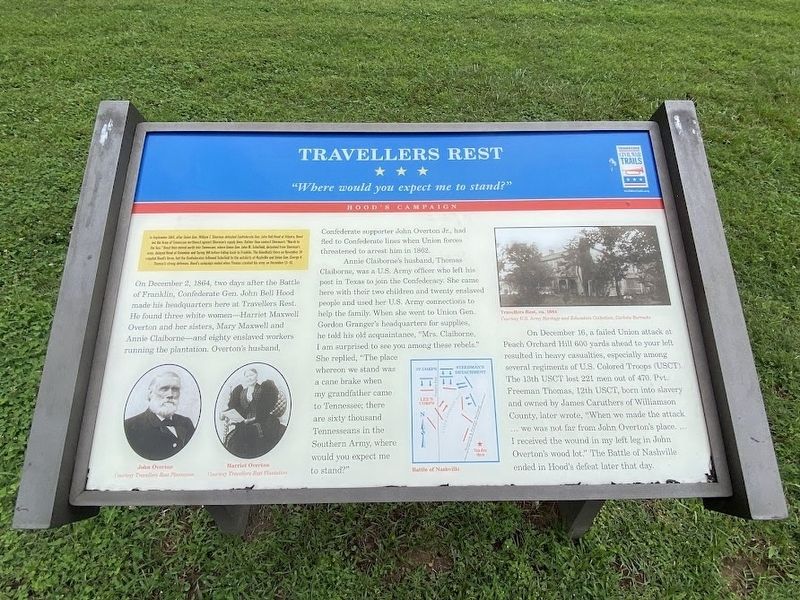
Photographed by Darren Jefferson Clay, June 1, 2024
1. Travellers Rest Marker
In September 1864, after Union Gen. William T. Sherman defeated Confederate Gen. John Bell Hood at Atlanta, Hood led the Army of Tennessee northwest against Sherman's supply lines. Rather than contest Sherman's "March to the Sea", Hood then moved north into Tennessee, where Union Gen. John M. Schofield, detached from Sherman's army, delayed Hood at Columbia and Spring Hill before falling back to Franklin. The bloodbath there on November 30 crippled Hood's force, but the Confederates followed Schofield to the outskirts of Nashville and Union Gen. George H. Thomas's strong defenses. Hood's campaign ended when Thomas crushed his army on December 15-16.
On December 2, 1864, two days after the Battle of Franklin, Confederate Gen. John Bell Hood made his headquarters here at Travellers Rest. He found three white women-Harriet Maxwell Overton and her sisters, Mary Maxwell and Annie Claiborne-and eighty enslaved workers running the plantation. Overton's husband, Confederate supporter John Overton Jr., had fled to Confederate lines when Union forces threatened to arrest him in 1862.
Annie Claiborne's husband, Thomas Claiborne,
this page online
On December 16, a failed Union attack at Peach Orchard Hill 600 yards ahead to your left resulted in heavy casualties, especially among several regiments of U.S. Colored Troops (USCT). The 13th USCT lost 221 men out of 470. Pvt. Freeman Thomas, 12th USCT, born into slavery and owned by James Caruthers of Williamson County, later wrote, "When we made the attack .. we was not far from John Overton's place. I received the wound in my left leg in John Overton's wood lot." The Battle of Nashville ended in Hood's defeat later that day.
Erected by Tennessee Civil War Trails.
Topics and series.
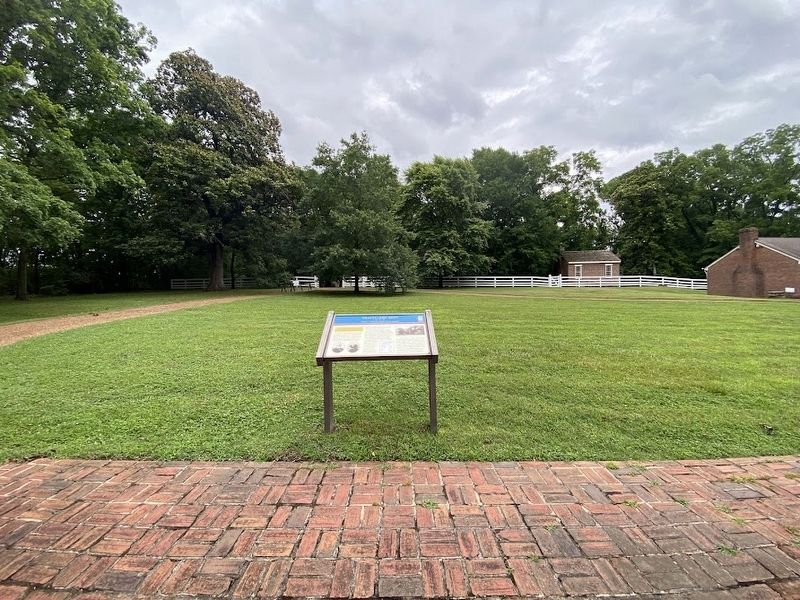
Photographed by Darren Jefferson Clay, June 1, 2024
2. Travellers Rest Marker
Location. 36° 4.578′ N, 86° 45.886′ W. Marker is in Nashville, Tennessee, in Davidson County. It is in Crieve Hall. It can be reached from Farrell Parkway west of Regent Drive. Touch for map. Marker is at or near this postal address: 636 Farrell Pkwy, Nashville TN 37220, United States of America. Touch for directions.

Regionally, this marker is in Middle Tennessee. It is also in the American South and specifically in the Upper South. Globally, it is in North America, the Western Hemisphere, the Western World, and the Anglosphere. Historically, it finds itself in what was once the territory of the Mississippian Culture, one of the Confederate States of America, and the Antebellum South.
Other nearby markers. At least 8 other markers are within walking distance of this marker: From Enslavement to Freedom (a few steps from this marker); Earliest Residents of Travellers Rest (within shouting distance of this marker); Battle of Nashville / Peach Orchard Hill (within shouting distance of this marker); Historic Travellers Rest Herb Garden (about 500 feet away, measured in a direct line); Herb Garden (about 500 feet away); Smokehouse (about 500 feet away); Arabian Horses (about 500 feet away); a different marker also named Travellers' Rest (approx. 0.2 miles away). Touch for a list and map of all markers in Nashville.
Another marker is no longer nearby. Travellers Rest (has been replaced with this marker).
Credits. This page was last revised on August 13, 2025. It was originally submitted on June 2, 2024, by Darren Jefferson Clay of Duluth, Georgia. This page has been viewed 421 times since then and 49 times this year. Last updated on May 29, 2025, by Mike McKeown of Baltimore, Maryland. Photos: 1, 2. submitted on June 2, 2024, by Darren Jefferson Clay of Duluth, Georgia. • Devry Becker Jones was the editor who published this page.
