Minesing in Simcoe County, Ontario — Central Canada (North America)
Batteaux
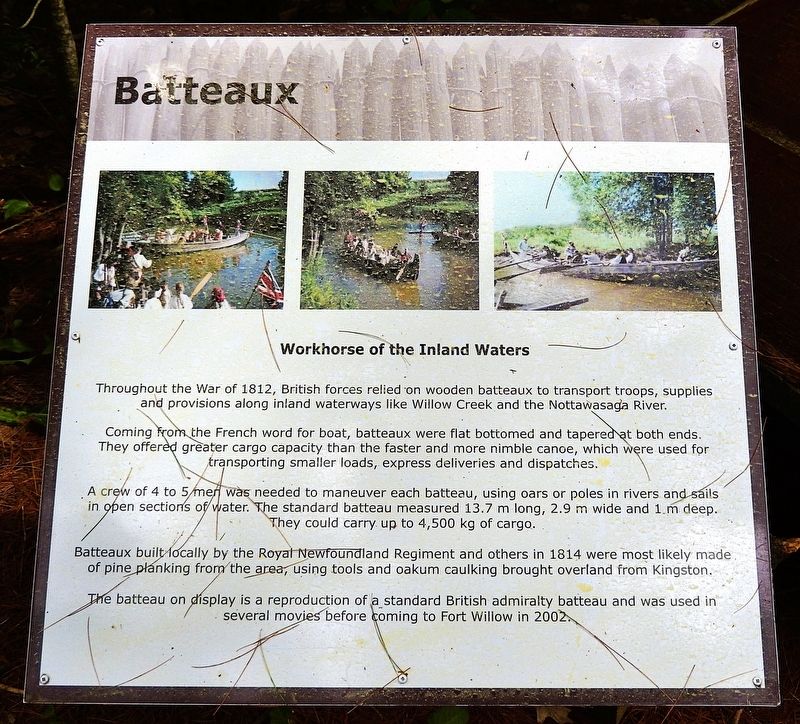
Workhorse of the Inland Waters
Photographed by Cosmos Mariner, June 6, 2024
1. Batteaux Marker
Throughout the War of 1812, British forces relied on wooden batteaux to transport troops, supplies and provisions along inland waterways like Willow Creek and the Nottawasaga River.
Coming from the French word for boat, batteaux were flat bottomed and tapered at both ends. They offered greater cargo capacity than the faster and more nimble canoe, which were used for transporting smaller loads, express deliveries and dispatches.
A crew of 4 to 5 men was needed to maneuver each batteau, using oars or poles in rivers and sails in open sections of water. The standard batteau measured 13.7 m long, 2.9 m wide and 1 m deep. They could carry up to 4,500 kg of cargo.
Batteaux built locally by the Royal Newfoundland Regiment and others in 1814 were most likely made of pine planking from the area, using tools and oakum caulking brought overland from Kingston.
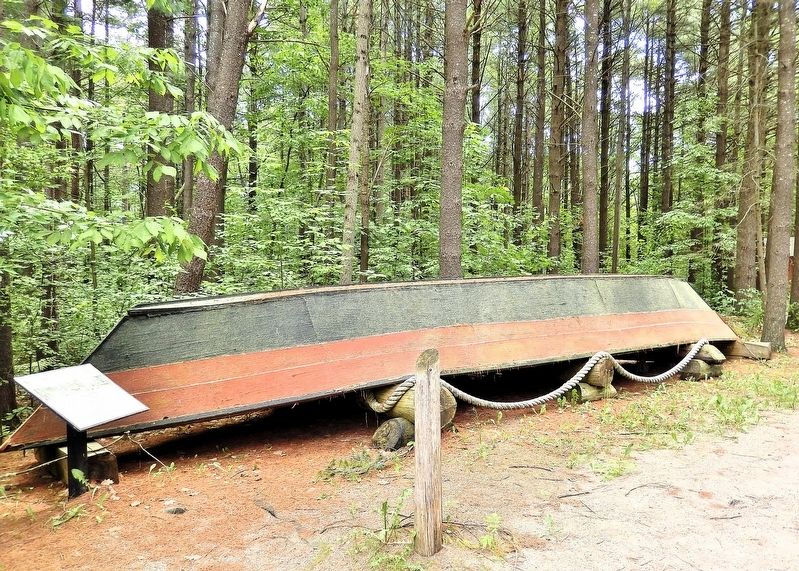
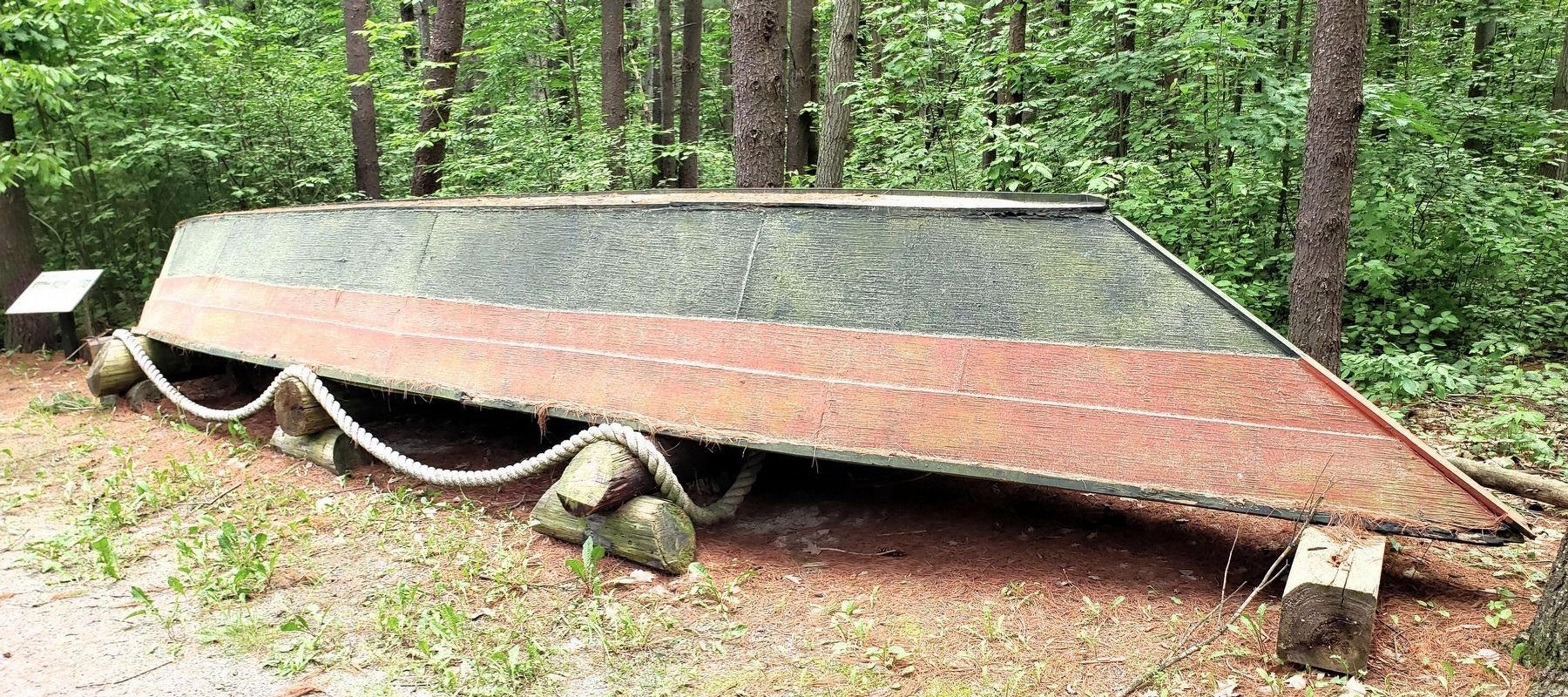
The batteau on display is a reproduction of a standard British admiralty batteau and was used in several movies before coming to Fort Willow in 2002.
Topics. This historical marker is listed in these topic lists: Colonial Era • War of 1812 • Waterways & Vessels. A significant historical year for this entry is 1812.
Location. 44° 23.712′ N,
this page online

Regionally, this marker is in Central Ontario Cottage Country and specifically in Georgian Bay Country. It is also in Central Canada. Globally, it is in North America, on the Great Lakes, in the Western Hemisphere, in the Western World, and in the Anglosphere. Historically, it finds itself in what was once a British colony, the Viceroyalty of New France, the Haudenosaunee (Iroquois) Confederacy, and Rupert’s Land.
Other nearby markers. At least 8 other markers are within walking distance of this marker: Nine Mile Portage and Willow Depot / Portage Nine Mile et Dépôt Willow (a few steps from this marker); Willow Creek Depot (a few steps from this marker); The Post War Years (a few steps from
Photographed by Cosmos Mariner, June 6, 2024
2. Batteaux Marker
Related markers. Click here for a list of markers that are related to this marker. Historic Fort Willow
Also see . . . Bateau (Wikipedia).
Excerpt: A shallow-draft, flat-bottomed boat which was used extensively across North America, especially in the colonial period and in the fur trade. The French explorers of North America used bateaux as well as the native canoes. The boats' shallow draft worked well in rivers while its flat bottom profile allowed heavy loading of cargoes and provided stability. The smallest batteau required only one crewman, while larger ones, reaching up to 58 feet (17.68 meters) in length, required up to five. The largest batteaux could carry two to ten tons of cargo. Batteaux could mount a small sail although the flat bottom was not optimal for sailing.(Submitted on June 4, 2025, by Cosmos Mariner of Cape Canaveral, Florida.)In military records, it is seen that the boats were propelled primarily by oars with one oar being used at the stern as a rudder.Photographed by Cosmos Mariner, June 6, 20243. Batteau Exhibit
Credits. This page was last revised on June 7, 2025. It was originally submitted on June 3, 2025, by Cosmos Mariner of Cape Canaveral, Florida. This page has been viewed 121 times since then and 19 times this year. Photos: 1, 2, 3. submitted on June 4, 2025, by Cosmos Mariner of Cape Canaveral, Florida.
