Astra in Quinte West in Hastings County, Ontario — Central Canada (North America)
CP-107 Argus
Canadair
Photographed by William Fischer, Jr., May 12, 2025
1. CP-107 Argus Marker

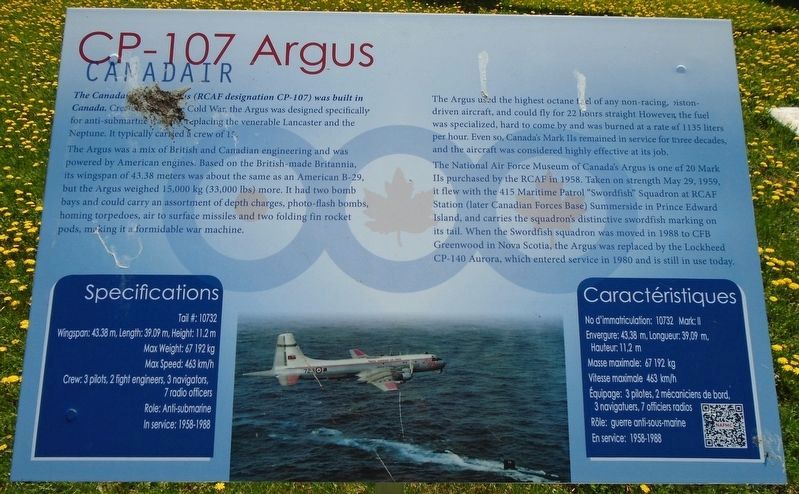
The Canadair [CL-28?] Argus (RCAF designation CP-107) was built in Canada. Created [during the?] Cold War, the Argus was designed specifically replacing the venerable Lancaster and the Neptune. It typically carried a crew of 15.
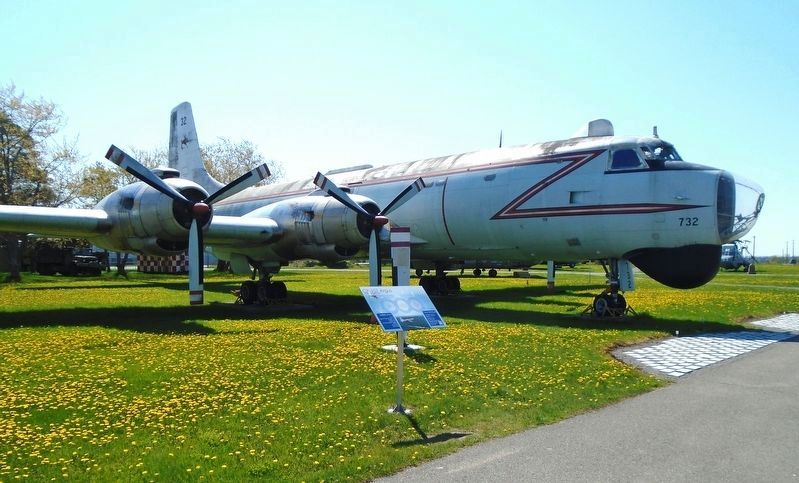
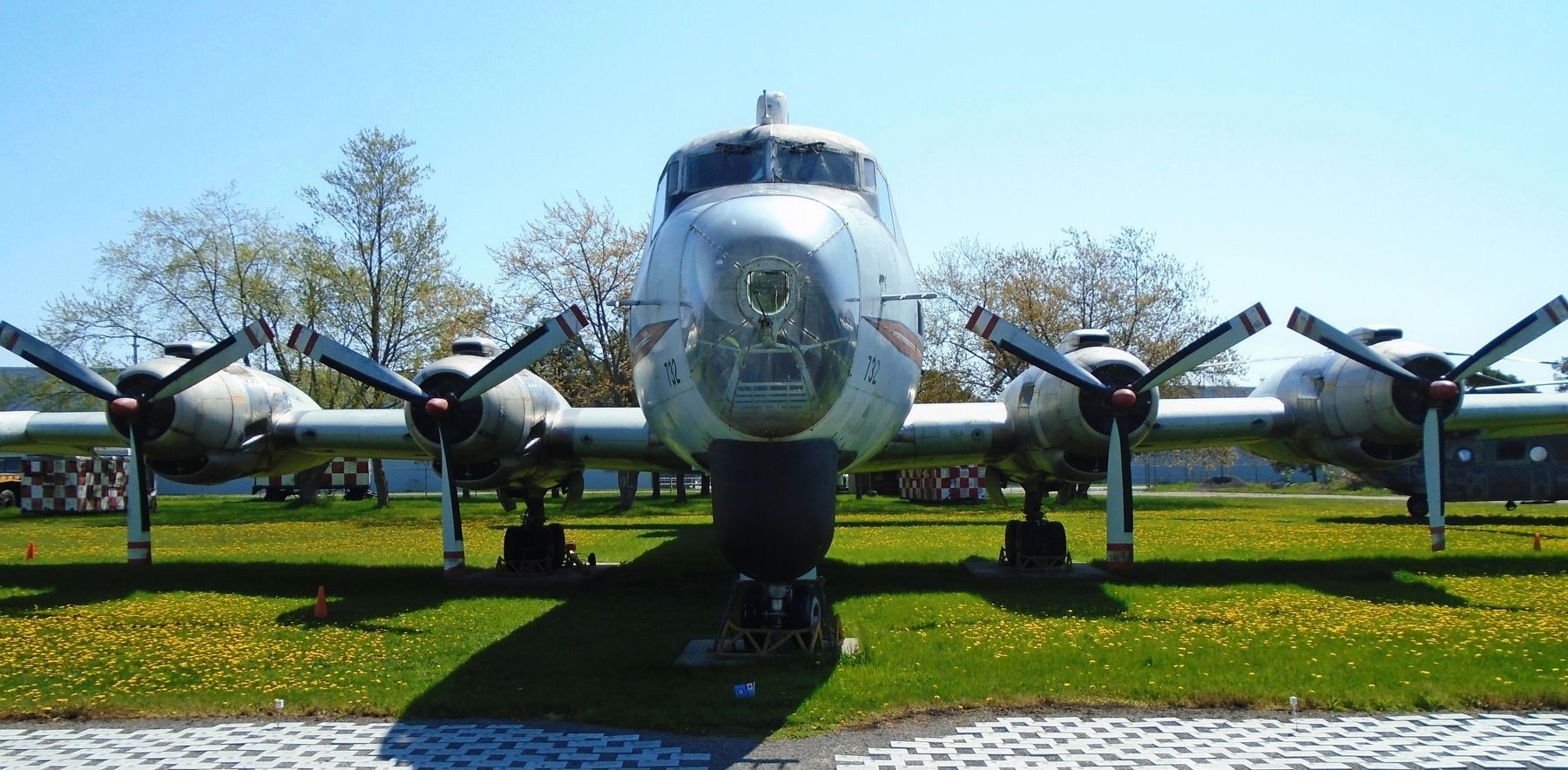
The Argus was a mix of British and Canadian engineering and was powered by American engines. Based on the British-made Britannia, its wingspan of 43.38 meters was about the same as an American B-29, but the Argus weighed 15,000 kg (33,000 lbs) more. It had two bomb bays and could carry an assortment of depth charges, photo-flash bombs, homing torpedoes, air to surface missiles and two folding fin rocket pods, making it a formidable war machine.
The Argus used the highest octane fuel of any non-racing, piston-driven aircraft, and could fly for 22 hours straight. However the fuel was specialized, hard to come by and was burned at a rate of 1135 liters per hour. Even so, Canada's Mark Ils remained in service for three decades, and the aircraft was considered highly effective at its job.
The National Air Force Museum of Canada's Argus is one of 20 Mark Ils purchased by the RCAF
this page online
Specifications
Tail #: 10732
Wingspan: 43.38 m, Length: 39.09 m, Height: 11.2m
Max Weight: 67 192 kg
Max Speed: 463 km/h
Crew: 3 pilots, 2 f[l]ight engineers, 3 navigators,
7 radio officers
Role: Anti-submarine
In service: 1958-1988
No d'immatriculation: 10732 Mark: II
Envergure: 43,38 m, Longueur: 39,09 m,
Hauteur: 11,2 m
Masse maximale: 67 192 kg
Vitesse maximale 463 km/h
Équipage: 3 pilotes, 2 mécaniciens de bord,
3 navigatuers, 7 officiers radios
Rôle: guerre anti-sous-marine
En service: 1958-1988
Erected by National Air Force Museum of Canada.
Topics. This memorial is listed in these topic lists: Air & Space • Patriots & Patriotism •
Photographed by William Fischer, Jr., May 12, 2025
2. CP-107 Argus and Marker
Location. 44° 6.864′ N, 77° 32.971′ W. Memorial is in Quinte West, Ontario, in Hastings County. It is in Astra. It can be reached from Hastings 21. Marker and aircraft are in the National Air Force Museum of Canada's Memorial Air Park. Touch for map. Memorial is at or near this postal address: 220 RCAF Road, Quinte West ON K0K 3V0, Canada. Touch for directions.

Regionally, this memorial is in Eastern Ontario and specifically in Southeastern Ontario. It is also in Central Canada. Globally, it is in North America, on the Great Lakes, in the Western Hemisphere, in the Western World, and in the Anglosphere. Historically, it finds itself in what was once a British colony, the Viceroyalty of New France, the Haudenosaunee (Iroquois) Confederacy, and Rupert’s Land.
Other nearby markers. At least 8 other markers are within walking distance of this marker: Non-Destructive Testing/
Photographed by William Fischer, Jr., May 12, 2025
3. CP-107 Argus
More about this memorial. Admission required, and the outdoor Air Park is closed during inclement weather.
Also see . . .
1. Nightmare Fuel For Soviet Submarines; the story of the Canadair CP-107 Argus (YouTube). (Submitted on June 6, 2025, by William Fischer, Jr. of Reynoldsburg, Ohio.)
2. National Air Force Museum of Canada. (Submitted on June 6, 2025, by William Fischer, Jr. of Reynoldsburg, Ohio.)
Credits. This page was last revised on June 6, 2025. It was originally submitted on June 6, 2025, by William Fischer, Jr. of Reynoldsburg, Ohio. This page has been viewed 129 times since then and 19 times this year. Photos: 1, 2, 3. submitted on June 6, 2025, by William Fischer, Jr. of Reynoldsburg, Ohio.
