Wasaga Beach in Simcoe County, Ontario — Central Canada (North America)
Schooner Town as a Naval Establishment
Photographed by Cosmos Mariner, June 6, 2024
1. Schooner Town as a Naval Establishment Marker
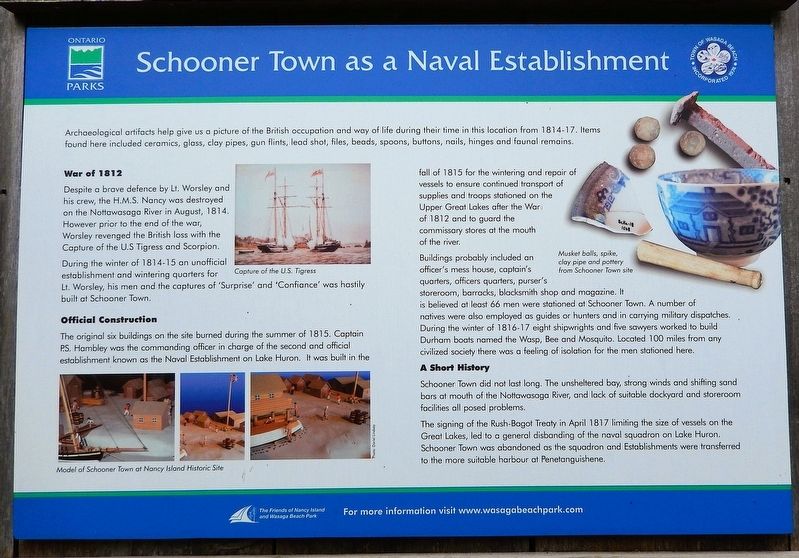
Archaeological artifacts help give us a picture of the British occupation and way of life during their time in this location from 1814-17. Items found here included ceramics, glass, clay pipes, gun flints, lead shot, files, beads, spoons, buttons, nails, hinges and faunal remains.
War of 1812
Despite a brave defence by Lt. Worsley and his crew, the H.M.S. Nancy was destroyed on the Nottawasaga River in August, 1814. However prior to the end of the war, Worsley revenged the British loss with the Capture of the U.S Tigress and Scorpion.
During the winter of 1814-15 an unofficial establishment and wintering quarters for Lt. Worsley, his men and the captures of ‘Surprise’ and ‘Confiance’ was hastily built at Schooner Town.
Official Construction
The original six buildings on the site burned during the summer of 1815. Captain P.S. Hambley was the commanding officer in charge of the second and official establishment known as the Naval Establishment on Lake Huron. It was built in the fall of 1815 for the wintering and repair of vessels to ensure continued transport of supplies and troops stationed on the Upper Great Lakes after the
this page online
Buildings probably included an officer's mess house, captain's quarters, officers quarters, purser's storeroom, barracks, blacksmith shop and magazine. It is believed at least 66 men were stationed at Schooner Town. A number of natives were also employed as guides or hunters and in carrying military dispatches. During the winter of 1816-17 eight shipwrights and five sawyers worked to build Durham boats named the Wasp, Bee and Mosquito. Located 100 miles from any civilized society there was a feeling of isolation for the men stationed here.
A Short History
Schooner Town did not last long. The unsheltered bay, strong winds and shifting sand bars at mouth of the Nottawasaga River, and lack of suitable dockyard and storeroom facilities all posed problems.
The signing of the Rush-Bagot Treaty in April 1817 limiting the size of vessels on the Great Lakes, led to a general disbanding of the naval squadron on Lake Huron. Schooner Town was abandoned as the squadron and Establishments were transferred to the more suitable harbour at Penetanguishene.
[photo captions]
• Capture
Photographed by Cosmos Mariner, June 6, 2024
2. Schooner Town as a Naval Establishment Marker
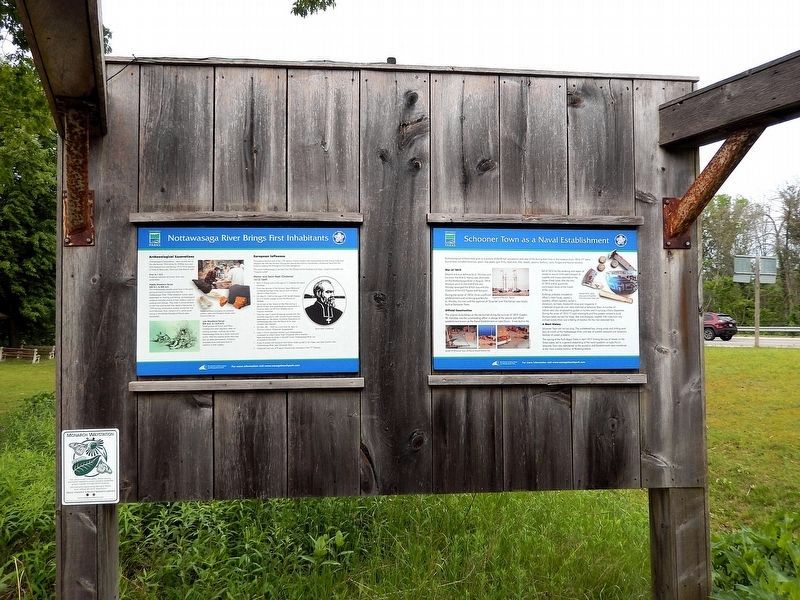
This is the rightmost of two markers mounted on the back side of a large wooden Wasaga Beach sign. River Road West can be seen in the right background.
• Model of Schooner Town at Nancy Island Historic Site
• Musket balls, spike, clay pipe and pottery from Schooner Town site
Erected by The Friends of Nancy Island and Wasaga Beach Park.
Topics. This historical marker is listed in these topic lists: Anthropology & Archaeology • Settlements & Settlers • War of 1812 • Waterways & Vessels. A significant historical month for this entry is August 1814.
Location. 44° 29.42′ N, 80° 2.856′ W. Marker is in Wasaga Beach, Ontario, in Simcoe County. It can be reached from Oxbow Park Drive just south of River Road West (County Road 92), on the right when traveling south. The marker is located at the north end of the Sunset Court cul-de-sac in Schoonertown Parkette. Touch for map. Marker is at or near this postal address: 28 Sunset Court, Wasaga Beach ON L9Z 2A9, Canada. Touch for directions.

Regionally, this marker is in Central Ontario Cottage Country and specifically in Georgian Bay Country. It is also in Central Canada. Globally, it is in North America, on the Great Lakes, in the Western Hemisphere, in the Western World, and in the Anglosphere. Historically,
Photographed by Cosmos Mariner, June 6, 2024
3. Wasaga Beach Sign
Looking east; River Road West is in the left background. The marker is mounted on the back side of this sign at the Schooner Town Heritage Site.
Other nearby markers. At least 8 other markers are within 13 kilometers of this marker, measured as the crow flies: Schooner Town (here, next to this marker); Nottawasaga River Brings First Inhabitants (here, next to this marker); The Muirhead Cabin (approx. 4.2 kilometers away); Stayner (formerly Nottawasaga Station) (approx. 8.4 kilometers away); The Founding of Stayner (approx. 8.7 kilometers away); Shannon's Bridge (approx. 12.2 kilometers away); Edenvale Park (approx. 12.4 kilometers away); Glengarry Landing / Le débarquement du « Glengarry » (approx. 12.4 kilometers away). Touch for a list and map of all markers in Wasaga Beach.
Related markers. Click here for a list of markers that are related to this marker. Schooner Town
Also see . . . Wasaga Beach (Wikipedia).
Excerpt: In 1812 the United States declared war on Great Britain and invaded Upper Canada on several occasions. Wasaga Beach became a strategic location at the mouth of the Nottawasaga River leading to Fort Willow and the Nine Mile Portage which was part of the supply line for British forces in the War of 1812 to Fort Michilimackinac and points to the north and west. The Royal Navy schooner HMS Nancy was scuttled in the Nottawasaga River to prevent the Americans from capturing her and her stores.(Submitted on June 9, 2025, by Cosmos Mariner of Cape Canaveral, Florida.)
Credits. This page was last revised on June 9, 2025. It was originally submitted on June 8, 2025, by Cosmos Mariner of Cape Canaveral, Florida. This page has been viewed 163 times since then and 30 times this year. Photos: 1. submitted on June 8, 2025, by Cosmos Mariner of Cape Canaveral, Florida. 2, 3. submitted on June 9, 2025, by Cosmos Mariner of Cape Canaveral, Florida.
