Barrie in Simcoe County, Ontario — Central Canada (North America)
Fenian Raids
1866
| — | Barrie Waterfront Heritage Trail | — |
Photographed by Cosmos Mariner, June 5, 2024
1. Fenian Raids Marker
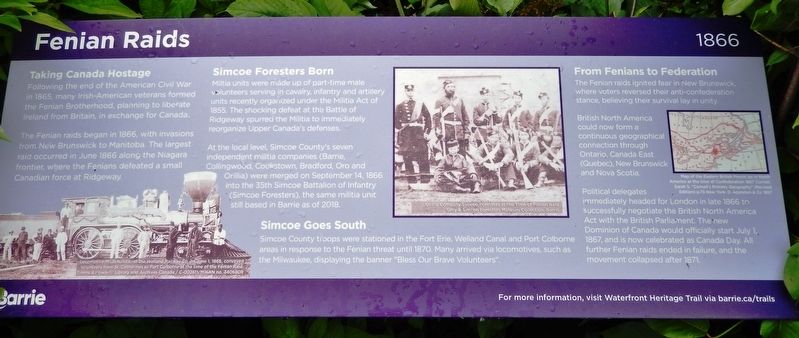
Taking Canada Hostage
Following the end of the American Civil War in 1865, many Irish-American veterans formed the Fenian Brotherhood, planning to liberate Ireland from Britain, in exchange for Canada.
The Fenian raids began in 1866, with invasions from New Brunswick to Manitoba. The largest raid occurred in June 1866 along the Niagara frontier, were the Fenians defeated a small Canadian force at Ridgeway.
Simcoe Foresters Born
Militia units were made up of part-time male volunteers serving in cavalry, infantry and artillery units recently organized under the Militia Act of 1855. The shocking defeat at the Battle of Ridgeway spurred the Militia to immediately reorganize Upper Canada's defenses.
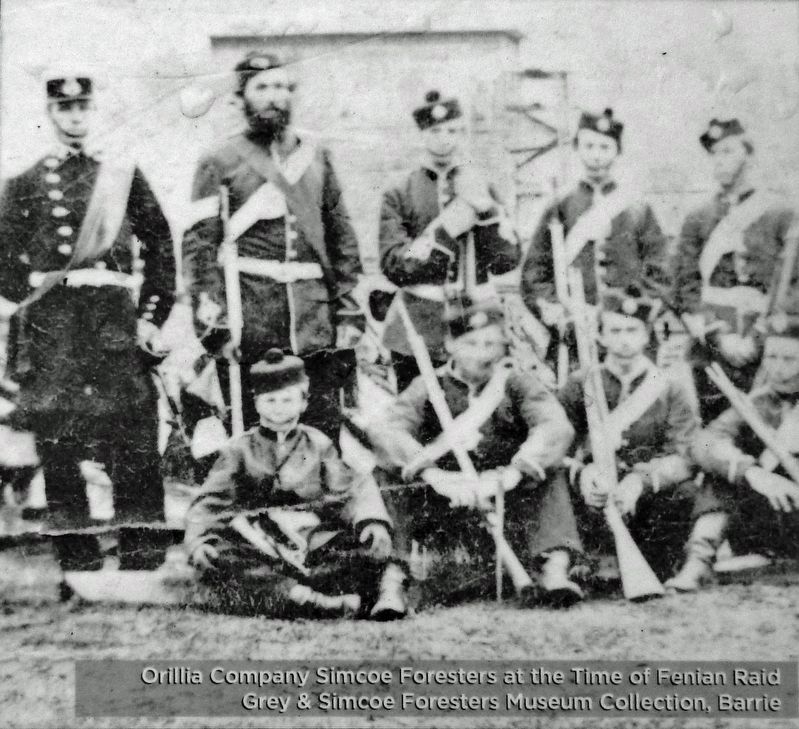
At the local level, Simcoe County's seven independent militia companies (Barrie, Collingwood, Cookstown, Bradford, Oro and Orillia) were merged on September 14, 1866 into the 35th Simcoe Battalion of Infantry (Simcoe Foresters), the same militia unit still based in Barrie as of 2018.
Simcoe Goes South
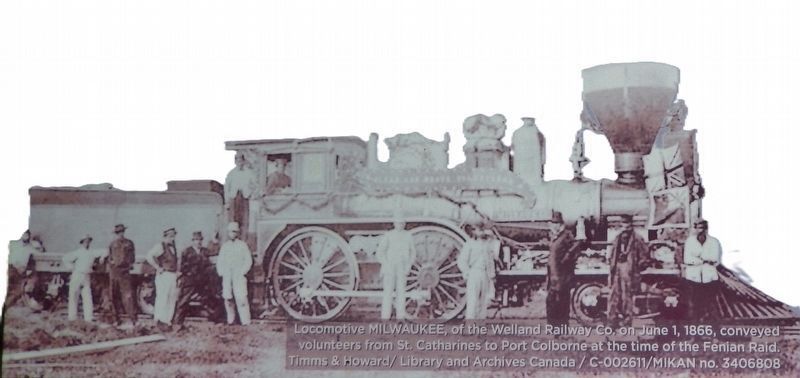
Simcoe County troops were stationed in the Fort Erie, Welland Canal and Port Colborne areas in response to the Fenian threat until 1870.
this page online
From Fenians to Federation
The Fenian raids ignited fear in New Brunswick, where voters reversed their anti-confederation stance, believing their survival lay in unity.
British North America could now form a continuous geographical connection through Ontario, Canada East (Quebec), New Brunswick and Nova Scotia.
Political delegates immediately headed for London in late 1866 to successfully negotiate the British North America Act with the British Parliament. The new Dominion of Canada would officially start July 1, 1867, and is now celebrated as Canada Day. All further Fenian raids ended in failure, and the movement collapsed after 1871.
Erected by Barrie Waterfront Heritage Trail.
Topics. This historical marker is listed in these topic lists: Immigration • Wars, Non-US. A significant historical year for this entry is 1866.
Location. 44° 22.433′ N, 79° 40.674′ W. Marker is in Barrie, Ontario, in Simcoe County. It can be reached from Lakeshore Drive 0.9 kilometers west of Minet's Point Road, on the right when traveling west.
Timms & Howard/Library and Archives Canada/C-002611/MIKAN no. 3406808
2. Marker detail: Locomotive MILWAUKEE, Welland Railway Co., June 1, 1866
Conveyed volunteers from St. Catharines to Port Colborne at the time of the Fenian Raid.

Regionally, this marker is in Central Ontario Cottage Country and specifically in Georgian Bay Country. It is also in Central Canada. Globally, it is in North America, on the Great Lakes, in the Western Hemisphere, in the Western World, and in the Anglosphere. Historically, it finds itself in what was once a British colony, the Viceroyalty of New France, the Haudenosaunee (Iroquois) Confederacy, and Rupert’s Land.
Other nearby markers. At least 8 other markers are within walking distance of this marker: Northwest Rebellion (here, next to this marker); South African War (a few steps from this marker); Trench Warfare (within shouting distance of this marker); Canadian Victoria Cross Recipients / Bénéficiaires de la Croix Victoria canadien (within shouting distance of this marker); Vimy Oaks (within shouting distance of this marker); Tulips (within shouting distance of this marker);
Grey & Simcoe Foresters Museum Collection, Barrie
3. Marker detail: Orillia Company Simcoe Foresters at the time of the Fenian Raid
Related markers. Click here for a list of markers that are related to this marker. Military Heritage Park
Also see . . . Fenian raids (Wikipedia).
Excerpt: The Fenian raids were a series of incursions carried out by the Fenian Brotherhood, an Irish republican organization based in the United States, on military fortifications, customs posts and other targets in Canada (then part of British North America) in 1866, and again from 1870 to 1871. A number of separate incursions by the Fenian Brotherhood into Canada were undertaken to bring pressure on the British government to withdraw from Ireland, although none of these raids achieved their aims.(Submitted on June 13, 2025, by Cosmos Mariner of Cape Canaveral, Florida.)
In Canada, the incursions divided its burgeoning Irish-Canadian population, many of whom were torn between loyalty to their new home and sympathy for the aims of the Fenians.
While authorities in the United States arrested the men and confiscated the arms of the Fenian Brotherhood, there was speculationthat some in the U.S. government ignored the preparations undertaken by the Fenians due to anger over British assistance to the Confederacy during the American Civil War. The Fenian raids were one of the factors that led to Canadian Confederation, as the provinces united to face the threat of invasions.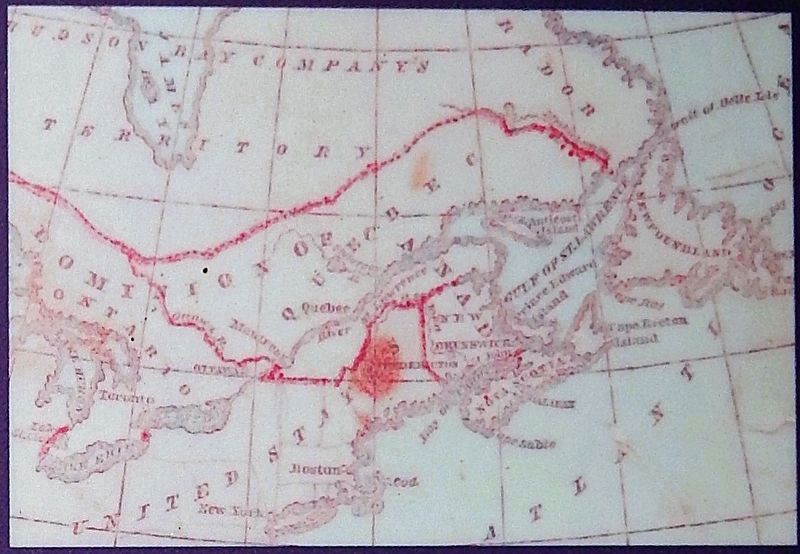 4. Marker detail: Map of the Eastern British Provinces in North AmericaAt the time of Confederation in 1867, Cornell, Sarah S. “Cornell’s Primary Geography” (Revised Edition) p.73 New York, D. Appleton & Co. 1867
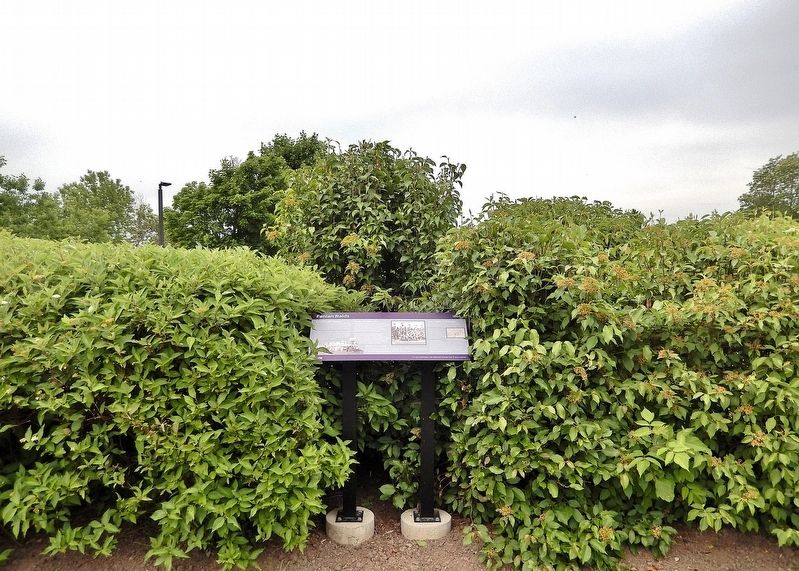
Photographed by Cosmos Mariner, June 5, 2024
5. Fenian Raids Marker
Credits. This page was last revised on June 21, 2025. It was originally submitted on June 9, 2025, by Cosmos Mariner of Cape Canaveral, Florida. This page has been viewed 217 times since then and 76 times this year. Photos: 1, 2, 3, 4, 5. submitted on June 13, 2025, by Cosmos Mariner of Cape Canaveral, Florida.
