Winona in Shannon County, Missouri — The American Midwest (Upper Plains)
The Ancient Ozarks
Rocky Falls
| — | Ozark National Scenic Riverway | — |
Photographed by Craig Doda, April 7, 2019
1. The Ancient Ozarks Marker
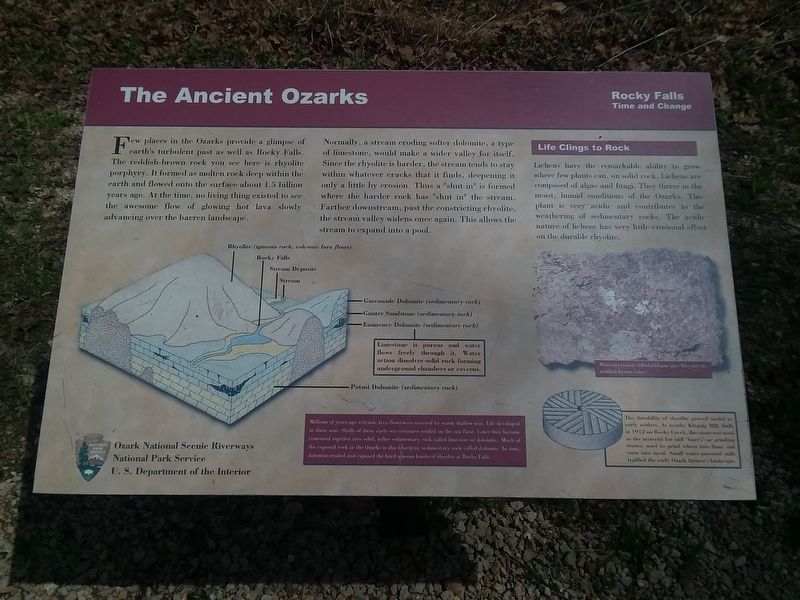
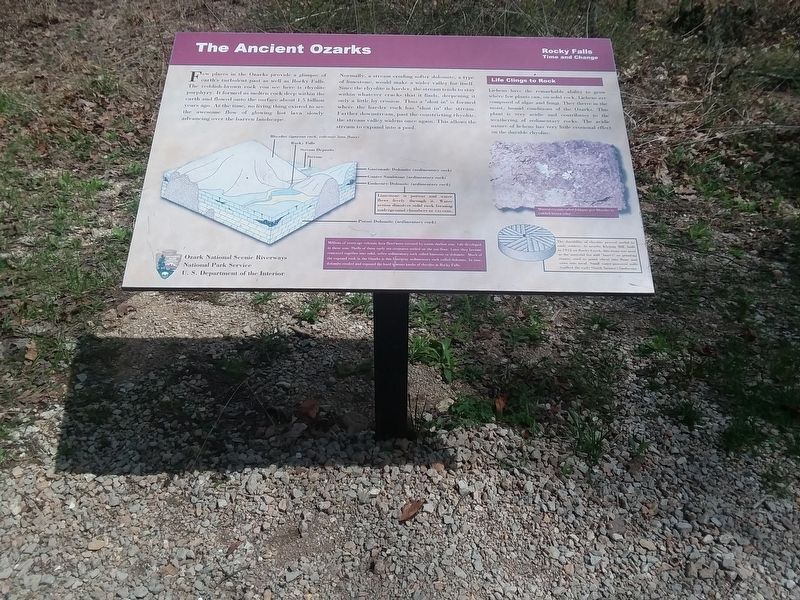
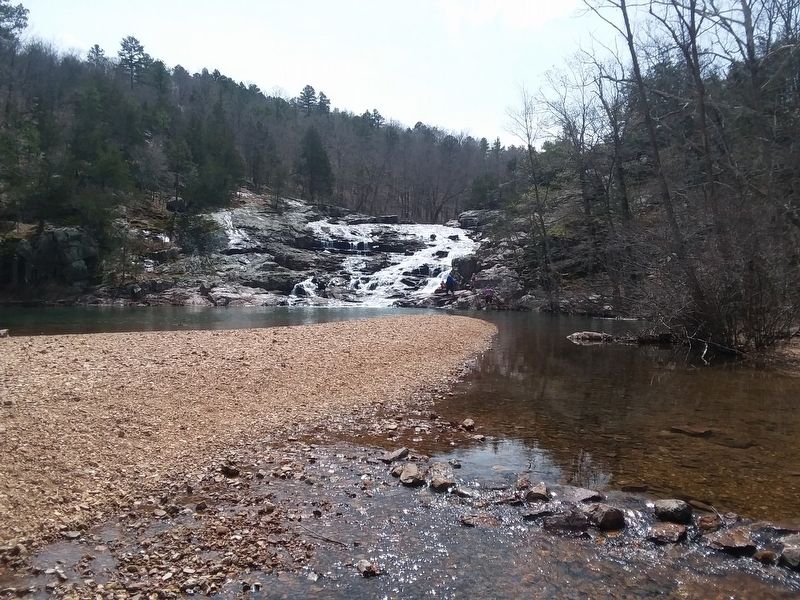
Few places in the Ozarks provide a glimpse of earth's turbulent past as well as Rocky Falls. The reddish-brown rock you see here is rhyolite porphyry. It formed as molten rock deep within the earth and flowed onto the surface about 1.5 billion years ago. At the time, no living thing existed to see the awesome flow of glowing hot lava slowly advancing over the barren landscape.
Normally, a stream eroding softer dolomite, a type of limestone, would make a wider valley for itself. Since the rhyolite is harder, the stream tends to stay within whatever cracks that it finds, deepening it only a little by erosion. Thus a "shut in" is formed where the harder rock has "shut in” the stream. Farther downstream, past the constricting rhyolite, the stream valley widens once again. This allows the stream to expand into a pool.
Life Clings to Rock
Lichens have the remarkabble ability to grow where the harder rock has "shut in" the stream. composed of algae and fungi. They thrive in the moist. humid conditions of the Ozarks. This plant is very acidic and contributes to the weathering of sedimentary rocks. The acidic nature of
this page online
Millions of years ago volcanic lava flows were covered by warm shallow seas. Life developed in these seas, Shells of these early sea creatures settled on the sea floor. Later they became cemented together into solid, softer sedimentary rock called limestone or dolomite Much of the exposed rock in the Ozarks is this blue/grey sedimentary rock called dolomite In time, dolomite eroded and exposed the hard igneous knobs of rhyolite at Rocky Falls.
The durability of rhyolite proved useful to early settlers, At nearby Klepzig Mill. Built in 1912 on Rocky Creek, this stone was used as the material for mill "burr's" or grinding stones, used to grind wheat into flour and corn into meal. Small water-powered mills typified the early Ozark farmer's landscape.
Erected by National Park Service, U.S. Department of the Interior.
Topics. This historical marker is listed in these topic lists: Anthropology & Archaeology • Industry & Commerce • Natural Features. A significant historical year for this entry is 1912.
Location. Marker has been reported missing. It was located near 37° 5.683′ N,
Photographed by Craig Doda, April 7, 2019
2. The Ancient Ozarks Marker

Regionally, this marker was in Southeast Missouri. It was also in the American Ozarks, in the Lewis & Clark Corridor, and in the Corn Belt. Globally, it was in North America, the Western Hemisphere, the Western World, and the Anglosphere. Historically, it found itself in what was once the territory of the Mississippian Culture, the Louisiana Purchase, and the Antebellum South.
Other nearby markers. At least 3 other markers are within 13 miles of this location, measured as the crow flies: Eminence (approx. 9 miles away); Carter County Veterans Memorial (approx. 12.8 miles away); Van Buren (approx. 12.8 miles away).
Also see . . . Rocky Falls. (Submitted on December 10, 2020, by Craig Doda of Napoleon, Ohio.)
Photographed by Craig Doda, April 7, 2019
3. Rocky Falls
Credits. This page was last revised on June 17, 2025. It was originally submitted on December 10, 2020, by Craig Doda of Napoleon, Ohio. This page has been viewed 592 times since then and 50 times this year. Last updated on June 10, 2025, by Edward Troxel of Creal Springs, Illinois. Photos: 1, 2, 3. submitted on December 10, 2020, by Craig Doda of Napoleon, Ohio. • Devry Becker Jones was the editor who published this page.
