Workington in Cumberland, England, United Kingdom — Northwestern Europe (the British Isles)
The Helena Thompson Museum
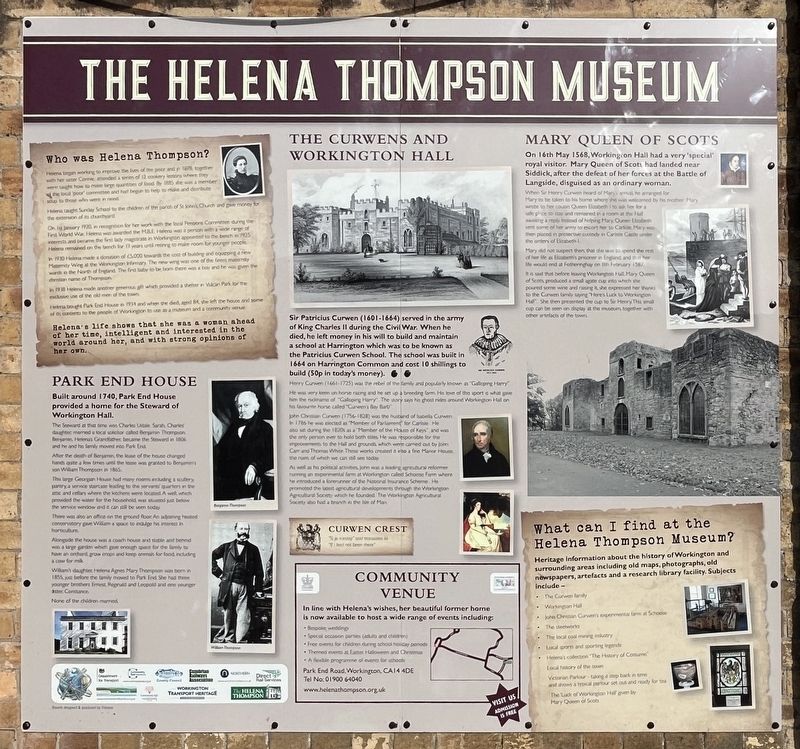
Photographed by Ray Gurganus, April 11, 2025
1. The Helena Thompson Museum Marker
Who Was Helena Thompson?
Helena began working to improve the lives of the poor and in 1879, together with her sister Connie, attended a series of 12 cookery lessons where they were taught how to make large quantities of food. By 1885 she was a member of the local 'poor' committee and had begun to help make and distribute soup to those who were in need.
Helena taught Sunday School to the children of the parish of St John's Church and gave money for the extension of its churchyard.
On 1st January 1920, in recognition for her work with the local Pensions Committee during the First World War, Helena was awarded the M.B.E. Helena was a person with a wide range of interests and became the first lady magistrate in Workington appointed to the bench in 1925. Helena remained on the bench for 13 years until retiring to make room for younger people.
In 1930 Helena made a donation of £5,000 toward the cost of building and equipping a new Maternity Wing at the Workington Infirmary. The new wing was one of the finest maternity wards in the North of England. The first baby to be born there was a boy and he was given the Christian
this page online
In 1938 Helena made another generous gift which provided a shelter in Vulcan Park for the exclusive use of the old men of the town.
Helena bought Park End House in 1934 and when she died, aged 84, she left the house and some of its contents to the people of Workington to use as a museum and a community venue.
Helena's life shows that she was a woman ahead of her time, intelligent and interested in the world around her, and with strong opinions of her own.
Park End House
Built around 1740, Park End House provided a home for the Steward of Workington Hall.
The Steward at that time was Charles Udale. Sarah, Charles' daughter, married a local solicitor called Benjamin Thompson. Benjamin, Helena's grandfather, became the Steward in 1806 and he and his family moved into Park End.
After the death of Benjamin, the lease of the house changed hands quite a few times until the lease was granted to Benjamin's son William Thompson in 1865.
The large Georgian House had many rooms including a scullery, pantry, a service staircase leading to the servant's quarters in the attic and cellars where the kitchens were

The Helena Thompson Museum
2. Helena Thompson
There was also an office on the ground floor. An adjoining heated conservatory gave William a space to indulge his interest in horticulture.
Alongside the house was a coach house and stable and behind was a large garden which gave enough space for the family to have an orchard, grow crops and keep animals for food, including a cow for milk.
William's daughter, Helena Agnes Mary Thompson was born in 1855, just before the family moved to Park end. She had three younger brothers Enrest, Reginald, and Leopold and one younger sister, Constance.
None of the children married.
The Curwens and Workington Hall
Sir Patricius Curwen (1601-1664) served in the army of King Charles II during the Civil War. When he died, he left money in his will to build and maintain a school at Harrington which was to be known as the Patricius Curwen School. The school was built in 1664 on Harrington Common and cost 10 shillings to build (50p in today's money).
Henry Curwen (1661-1725) was the rebel of the family and popularly known as "Galloping Harry".
He was very keen on horse racing and he set up a breeding farm. His love of the sport is what gave him the nickname of "Galloping Harry". The story says his ghost rides around Workington Hall on his favourite horse called "Curwen's Bay Barb".
John Christian Curwen (1756-1828) was the husband of Isabella Curwen. In 1786 he was elected as a Member of Parliament for Carlisle. He also sat during the 1820s as a Member of the House of Keys, and was the only person to ever hold both titles. He was responsible for the improvements to the Hall and grounds, which were carried out by John Carr and Thomas White. These works created it into a fine manor house, the ruins of which we can still see today.
As well as his political activities, John was a leading agricultural reformer running an experimental farm at Workington called Schoose Farm where he introduced a forerunner of the National Insurance Scheme. He promoted the latest agricultural developments through the Workington Agricultural Society which he founded. The Workington Agricultural Society also had a branch in the Isle of Man.
Mary Queen of Scots
On 16th May 1568, Workington Hall had a very 'special' royal visitor. Mary Queen of Scots had landed near Siddick, after the defeat of her forces at the Battle of Langside, disguised as an ordinary woman.
When Sir Henry Curwen heard of Mary's arrival, he arranged for Mary to be taken to his home where she was welcomed by his mother. Mary wrote to her cousin Queen Elizabeth I to ask her for a safe place to stay and remained in a room at the Hall awaiting a reply. Instead of helping Mary, Queen Elizabeth sent some of her army to escort her to Carlisle. Mary was then placed in protective custody in Carlisle Castle under the orders of Elizabeth I.
Mary did not suspect that she would spend the rest of her life as ELizabeth's prisoner in England, and that her life would end at Fotheringhay on 8th February 1587.
It is said that before leaving Workington Hall, Mary Queen of Scots produced a small agate cup into which she poured some wine and raising it, she expressed her thanks to the Curwen family saying "Here's Luck to Workington Hall". She then presented the cup to Sir Henry. This small cup can be seen on display at the museum, together with other artifacts of the town.
Erected by Cumbria County Council.
Topics. This historical marker is listed in these topic lists: Charity & Public Work • Science & Medicine • Women.
Location. 54° 38.719′ N, 3° 33.517′ W. Marker is in Workington, England, in Cumberland. It can be reached from Falcon Street. On the platform at Workington Station. Touch for map. Marker is at or near this postal address: 3 Falcon Street, Workington, England CA14 2XD, United Kingdom. Touch for directions.

Regionally, this marker is in North West England. Globally, it is on the Atlantic Ocean, in the North Atlantic Region, in Europe, in Atlantic Europe, on one of the British Isles, in the Western World, and in the Anglosphere. Historically, it finds itself in what was once the Roman Empire.
Other nearby markers. At least 8 other markers are within walking distance of this marker: A History of Workington Station (here, next to this marker); Remembering World War I (here, next to this marker); Remembering World War II (here, next to this marker); The Rails Which Circled the World (within shouting distance of this marker); James Alexander Smith (within shouting distance of this marker); Workington Station (within shouting distance of this marker); a different marker also named The Rails Which Circled the World (within shouting distance of this marker); Shipping Throughout the Years (within shouting distance of this marker). Touch for a list and map of all markers in Workington.
Credits. This page was last revised on June 25, 2025. It was originally submitted on June 12, 2025, by Ray Gurganus of Washington, District of Columbia. This page has been viewed 94 times since then and 18 times this year. Photos: 1, 2. submitted on June 12, 2025, by Ray Gurganus of Washington, District of Columbia. • Andrew Ruppenstein was the editor who published this page.
