Downtown in Frederick in Frederick County, Maryland — The American Northeast (Mid-Atlantic)
The National Road
The Road that Built the Nation
| — | The Historic National Road - The Road That Built The Nation | — |
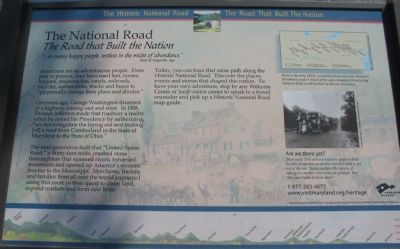
Photographed by Craig Swain, September 3, 2007
1. The National Road Marker
“… so many happy people, restless in the midst of abundance.” —Alexis de Tocqueville, 1840.
Americans are an adventurous people. From past to present, they have used feet, horses, wagons, stagecoaches, canals, railroads, bicycles, automobiles, trucks and buses to “perpetually change their plans and abodes.”
Centuries ago, George Washington dreamed of a highway joining east and west. In 1806, Thomas Jefferson made that roadway a reality when he risked his Presidency by authorizing, “an Act to regulate the laying out and making [of] a road from Cumberland in the State of Maryland to the State of Ohio.”
The next generation built that “United States Road,” a thirty-foot wide, crushed stone thoroughfare that spanned rivers, traversed mountains and opened up America’s western frontier to the Mississippi. Merchants, traders and families from all over the world journeyed along this route in their quest to claim land, expand markets and form new lives.
Today, you can trace that same path along the Historic National Road. Discover the places, events and stories that shaped this nation. To have your own adventure,
this page online
(sidebar)
Are we there yet?
These early 20th century travelers speak to all of us who at one time or another couldn't wait to get out of the car. Today, we have the luxury of taking our modern interstates for granted. But who can's relate to these faces?
Erected by America's Byways.
Topics and series. This historical marker is listed in this topic list: Roads & Vehicles. In addition, it is included in the Former U.S. Presidents: #03 Thomas Jefferson, and the The Historic National Road series lists. A significant historical year for this entry is 1840.
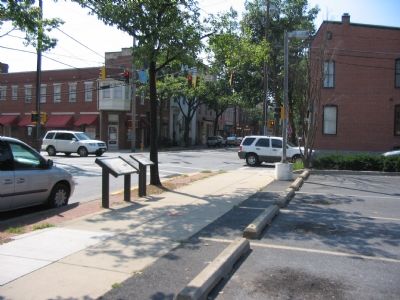
Location. This marker has been replaced by another marker nearby. It was located near 39° 24.844′ N, 77° 24.449′ W. Marker was in Frederick, Maryland, in Frederick County. It was in Downtown. It was at the intersection of East Patrick Street (State Highway 144) and Carroll Street on East Patrick Street. Located in front of the downtown Frederick post office. Touch for map. Marker was at or near this postal address: 201 East Patrick Street, Frederick
Photographed by Craig Swain, September 3, 2007
2. The National Road Marker

Regionally, this marker was in the Washington Metropolitan Area and in Central Maryland. It was also in the American Mid-Atlantic. Globally, it was in North America, the Western Hemisphere, the Western World, and the Anglosphere. Historically, it found itself in what was once one of the original Thirteen Colonies and also the Antebellum South.
Other nearby markers. At least 8 other markers are within walking distance of this location: Frederick (about 400 feet away, measured in a direct line); The Stinky Stuff (about 500 feet away); One Vast Hospital (about 500 feet away); Tanneries (about 500 feet away); 1862 Antietam Campaign (about 500 feet away); Hospitals in Frederick (about 500 feet away); The Rotary Club of Frederick (about 500 feet away); The Story of Community Bridge (about 500 feet away). Touch for a list and map of all markers in Frederick.
Other markers no longer nearby. The National Road (was here, next to this marker but has been confirmed missing); a different marker also named Frederick (was about 500 feet away but has been replaced with another
Photographed by Craig Swain, September 3, 2007
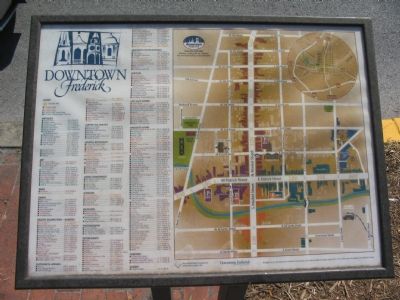
3. Downtown Frederick
Next to the marker is a map of downtown Frederick, pointing out historical sites, restaurants, and other areas of interest. Similar maps are placed around town and next to other historical markers for handy reference.
More about this marker. The marker displays a picture of a family standing beside an early 20th Century car along the National Road. Captioned: “Are we there yet? These early 20th century travelers speak to all of us who at one time or another couldn’t wait to get out of the car. Today, we have the luxury of taking our modern interstates for granted. But who can’t relate to those faces?”
The marker also has a map showing the general path of the National Road from Baltimore to St. Louis. And uses the background “The National Road at Fairview Inn,” which is standard for this marker series. An elevation diagram of the national road is displayed on the bottom of the marker's face.
Regarding The National Road. This is a
circa 1920
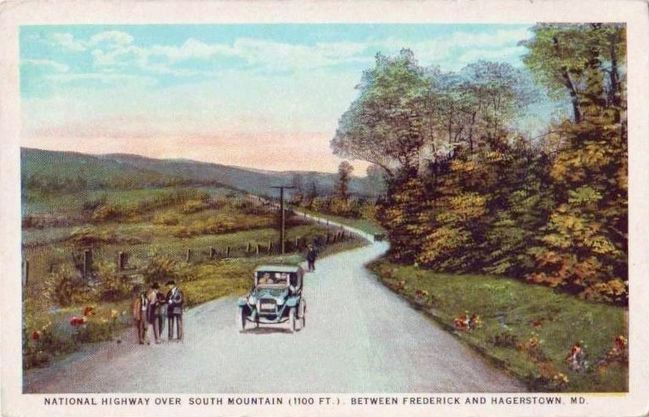
4. National Highway Over South Mountain (1100 ft.) Between Frederick and Hagerstown, Md.
Related marker. Click here for another marker that is related to this marker. This marker has been replaced with the linked marker. There are differences in subtitles.
Also see . . . Historic National Road Scenic Byway. Maryland Office of Tourism website entry (Submitted on March 22, 2022, by Larry Gertner of New York, New York.)
Credits. This page was last revised on June 30, 2024. It was originally submitted on September 29, 2007, by Craig Swain of Leesburg, Virginia. This page has been viewed 2,274 times since then and 48 times this year. Photos: 1, 2, 3. submitted on September 29, 2007, by Craig Swain of Leesburg, Virginia. 4. submitted on November 12, 2015. • J. J. Prats was the editor who published this page.
