Near Richmond in Henrico County, Virginia — The American South (Mid-Atlantic)
Battle of Glendale
Inaction on the Charles City Road
Photographed by Bernard Fisher, June 13, 2025
1. Battle Of Glendale Marker
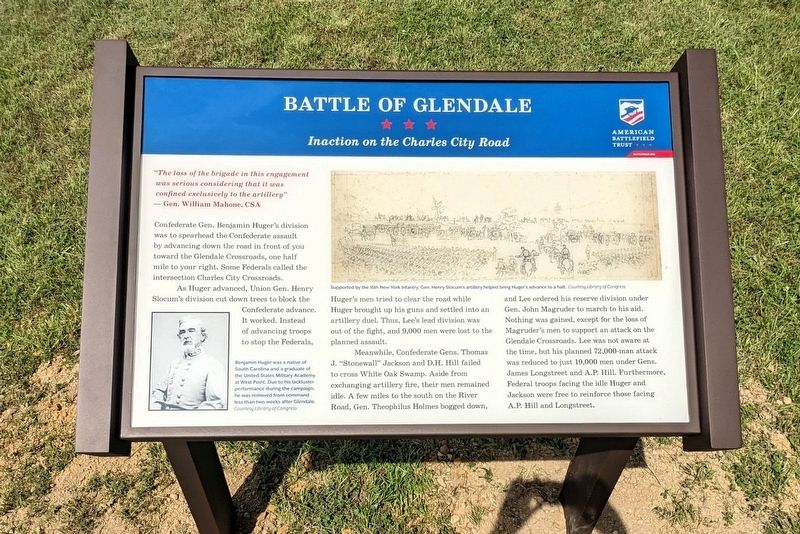
"The loss of the brigade in this engagement was serious considering that it was confined exclusively to the artillery"
- Gen. William Mahone, CSA
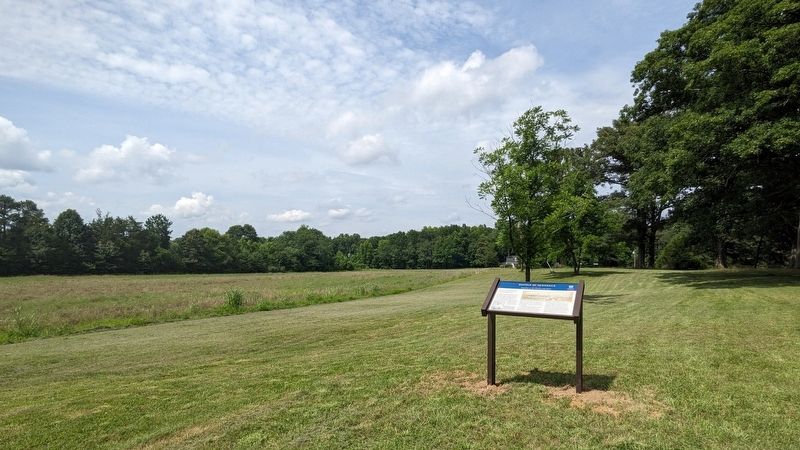
Confederate Gen. Benjamin Huger's division was to spearhead the Confederate assault by advancing down the road in front of you toward the Glendale Crossroads, one half mile to your right. Some Federals called the intersection Charles City Crossroads.
As Huger advanced, Union Gen. Henry Slocum's division cut down trees to block the Confederate advance. It worked. Instead of advancing troops to stop the Federals, Huger's men tried to clear the road while Huger brought up his guns and settled into an artillery duel. Thus, Lee's lead division was out of the fight, and 9,000 men were lost to the planned assault.
Meanwhile, Confederate Gens. Thomas J. "Stonewall" Jackson and D.H. Hill failed to cross White Oak Swamp. Aside from exchanging artillery fire, their men remained idle. A few miles to the south on the River Road, Gen. Theophilus Holmes bogged down, and Lee ordered his reserve division under Gen. John Magruder to march to his aid. Nothing was gained, except for
this page online
(captions)
Benjamin Huger was a native of South Carolina and a graduate of the United States Military Academy at West Point. Due to his lackluster performance during the campaign, he was removed from command less than two weeks after Glendale. Courtesy Library of Congress
Supported by the 16th New York Infantry, Gen. Henry Slocum's artillery helped bring Huger's advance to a halt. Courtesy Library of Congress
Erected 2025 by American Battlefield Trust.
Topics. This historical marker is listed in this topic list: War, US Civil. A significant historical date for this entry is June 30, 1862.
Location. 37° 26.918′ N, 77° 14.449′ W. Marker is near Richmond, Virginia, in Henrico County. It is on Charles City Road 0.4 miles north of Darbytown Road, on the left when traveling north. Touch for map. Marker
Photographed by Bernard Fisher, June 13, 2025
2. Battle Of Glendale Marker

Regionally, this marker is in the Piedmont and in Central Virginia. It is also in the American South, specifically in the Upper South, and on the Eastern Seaboard. Globally, it is in the North Atlantic Region, North America, the Western Hemisphere, the Western World, and the Anglosphere. Historically, it finds itself in what was once the territory of the Mississippian Culture, one of the original Thirteen Colonies, one of the Confederate States of America, and the Antebellum South.
Other nearby markers. At least 8 other markers are within walking distance of this marker: A different marker also named Battle of Glendale (about 300 feet away, measured in a direct line); a different marker also named Battle of Glendale (about 300 feet away); Seven Days Battles (about 800 feet away); Frazier's Farm (about 800 feet away); a different marker also named Frazier's Farm (approx. 0.2 miles away); Pvt. Benjamin B. Levy (approx. 0.2 miles away); a different marker also named Seven Days’ Battles (approx. 0.4
Photographed by Bernard Fisher, June 13, 2025
3. American Battlefield Trust (entrance sign)
Also see . . . Glendale (Frazier's Farm). American Battlefield Trust (ABT) (Submitted on June 14, 2025.)
Credits. This page was last revised on July 24, 2025. It was originally submitted on June 14, 2025, by Bernard Fisher of Richmond, Virginia. This page has been viewed 249 times since then and 44 times this year. Photos: 1, 2, 3. submitted on June 14, 2025, by Bernard Fisher of Richmond, Virginia.
