Near Richmond in Henrico County, Virginia — The American South (Mid-Atlantic)
Battle of Glendale
Lee's Plan

Photographed by Bernard Fisher, June 13, 2025
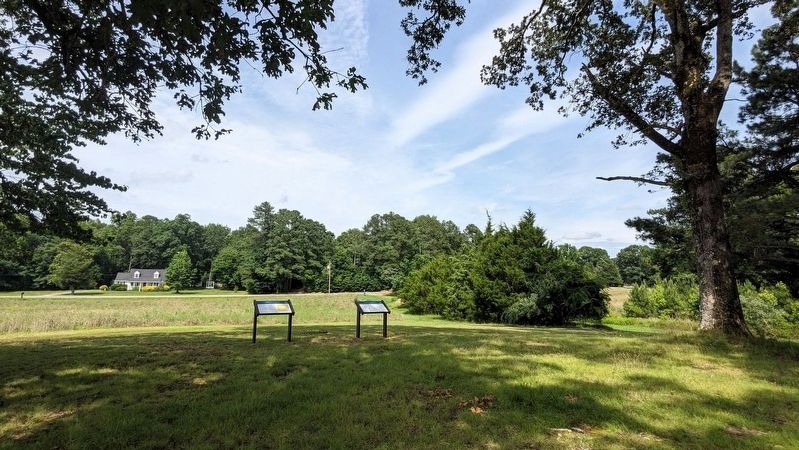
1. Battle Of Glendale Marker
"It was a critical day … General Lee … was to see his splendid prize slip through his hands"
- Gen. D.H. Hill, CSA
On June 30, 1862, Confederate Gen. Robert E. Lee had one of his greatest opportunities. Gen. George McClellan's massive Union Army of the Potomac was in retreat towards the James River, and if Lee's army could execute a concerted strike, he could seriously damage the Federals. Lee planned for Gen. Benjamin Huger to lead his 9,000-man division down the Charles City Road, directly in front of you, from left to right and strike at Glendale. With the support of Gens. James Longstreet's and A.P. Hill's 19,000 men on the Long Bridge Road, they could cut off the Federal retreat. Gens. Thomas J. "Stonewall" Jackson's and D.H. Hill's 25,000 men would advance across White Oak Swamp (two miles to the northeast), and the Confederates could crush the Federals caught between them. Lee also directed Gen. Theophilus Holmes to move down the New Market Road (modern Route 5) with 6,500 men to harass enemy troops that made it past the intersection and possibly even seize Malvern Hill. Gen. John B. Magruder's 12,000-man
this page online
McClellan was not on the field, having gone to the James River to search for a good site for his army's new base. He left no one in overall command. His units were scattered. Divisions of the various corps were not contiguous with each other. It was a recipe for Union disaster.
(captions)
Gen. Robert E. Lee assumed command of Confederate forces defending Richmond in early June 1862. Rather than endure a siege, Lee initiated a series of engagements known as the Seven Days' Battles at the end of the month and steadily drove Union troops back to the James River. Courtesy Library of Congress
Exhausted from recent fighting, Federal troops assumed a position around the Glendale Crossroads to await the Confederate onslaught. Lee hoped to maneuver from different directions in a coordinated effort to attack the Union infantry.
Erected 2025 by American Battlefield Trust.
Topics. This historical marker is listed in this topic list: War, US Civil. A significant historical date for this entry is June 30, 1862.
Location. 37° 26.95′ N, 77° 14.405′ W. Marker is near Richmond, Virginia, in Henrico
Photographed by Bernard Fisher, June 13, 2025
2. Battle Of Glendale Markers

Regionally, this marker is in the Piedmont and in Central Virginia. It is also in the American South, specifically in the Upper South, and on the Eastern Seaboard. Globally, it is in the North Atlantic Region, North America, the Western Hemisphere, the Western World, and the Anglosphere. Historically, it finds itself in what was once the territory of the Mississippian Culture, one of the original Thirteen Colonies, one of the Confederate States of America, and the Antebellum South.
Other nearby markers. At least 8 other markers are within walking distance of this marker: A different marker also named Battle of Glendale (here, next to this marker); a different marker also named Battle of Glendale (about 300 feet away, measured in a direct line); Frazier's Farm (about 600 feet away); Seven Days Battles (approx. 0.2 miles away); a different marker also named Frazier's Farm
Photographed by Bernard Fisher, June 13, 2025
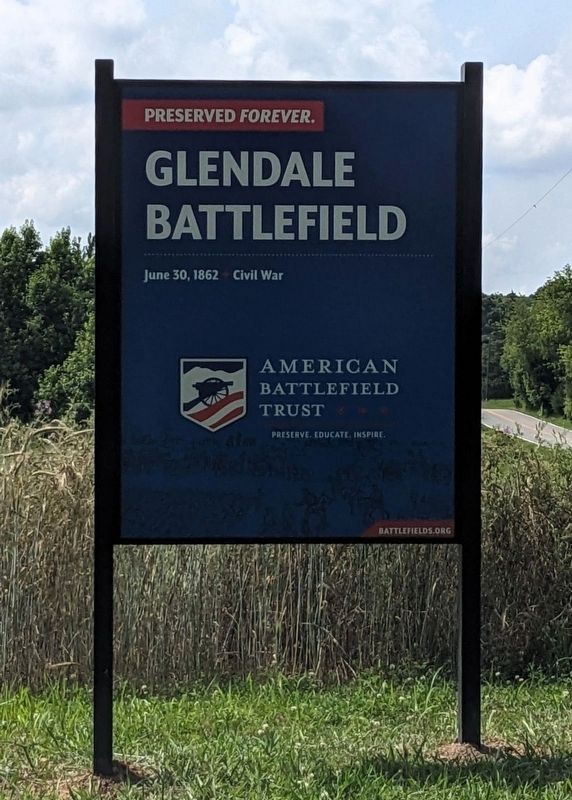
3. American Battlefield Trust (entrance sign)
Also see . . . Glendale (Frazier's Farm). American Battlefield Trust (ABT) (Submitted on June 14, 2025.)
Credits. This page was last revised on July 24, 2025. It was originally submitted on June 14, 2025, by Bernard Fisher of Richmond, Virginia. This page has been viewed 252 times since then and 49 times this year. Photos: 1, 2, 3. submitted on June 14, 2025, by Bernard Fisher of Richmond, Virginia.
