Northwest in Virginia Beach, Virginia — The American South (Mid-Atlantic)
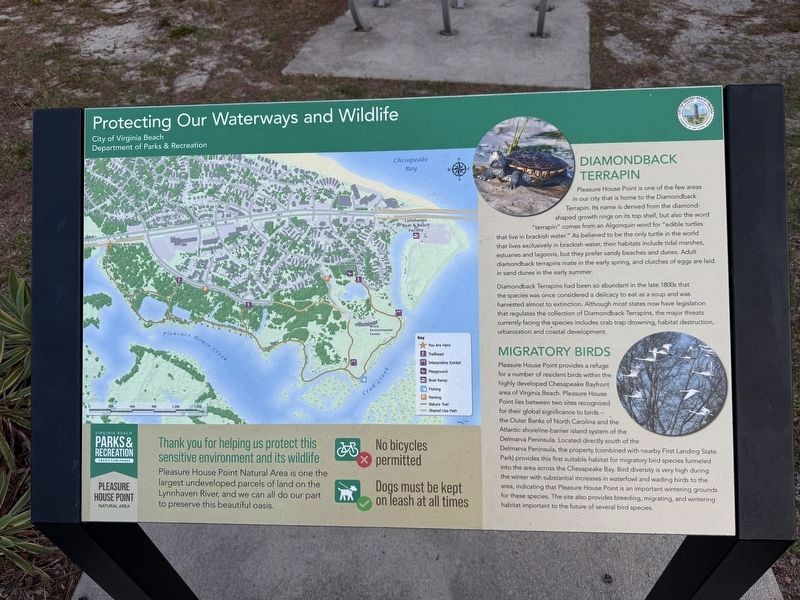
Protecting Our Waterways and Wildlife
City of Virginia Beach Department of Parks & Recreation
| — | Pleasure House Point Natural Area | — |
Photographed by Devry Becker Jones (CC0), June 11, 2025
1. Protecting Our Waterways and Wildlife Marker
Diamondback Terrapin
Pleasure House Point is one of the few areas in our city that is home to the Diamondback Terrapin. Its name is derived from the diamond-shaped growth rings on its top shell, but also the word "terrapin" comes from an Algonquin word for "edible turtles that live in brackish water." As believed to be the only turtle in the world that lives exclusively in brackish water, their habitats include tidal marshes, estuaries and lagoons, but they prefer sandy beaches and dunes. Adult diamondback terrapins mate in the early spring, and clutches of eggs are laid in sand dunes in the early summer.
Diamondback Terrapins had been so abundant in the late 1800s that the species was once considered a delicacy to eat as a soup and was harvested almost to extinction. Although most states now have legislation that regulates the collection of Diamondback Terrapins, the major threats currently faces the species include crab trap drowning, habitat destruction, urbanization and coastal development.
Migratory Birds
Pleasure House Point provides a refuge for a number of resident birds within the highly developed Chesapeake
this page online
Thank you for helping us protect this sensitive environment and its wildlife
Pleasure House Point Natural Area is one of the largest undeveloped parcels of land on the Lynnhaven River, and we can all do our part to preserve this beautiful oasis.
Erected by City of Virginia Beach Department of Parks & Recreation.
Topics. This historical marker is listed
Photographed by Devry Becker Jones (CC0), June 11, 2025
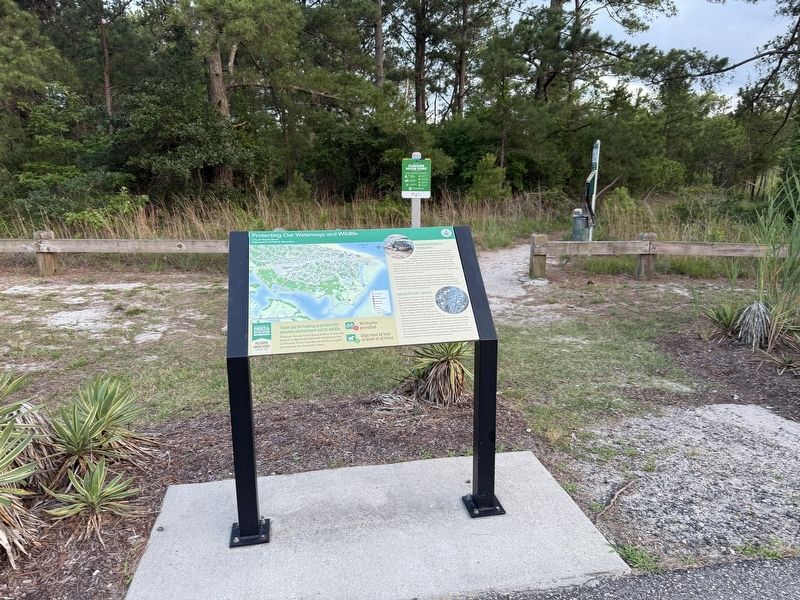
2. Protecting Our Waterways and Wildlife Marker
Location. 36° 54.421′ N, 76° 6.547′ W. Marker is in Virginia Beach, Virginia. It is in Northwest. It is on Woodlawn Avenue (U.S. 60) west of Marlin Bay Drive, on the right when traveling east. Touch for map. Marker is at or near this postal address: 2165A Woodlawn Ave, Virginia Beach VA 23455, United States of America. Touch for directions.

Regionally, this marker is in Hampton Roads, specifically in Coastal Virginia, and in the Hampton Roads Metropolitan Area. It is also in the American South, specifically in the Upper South, in the Tidewater, and on the Eastern Seaboard. Globally, it is in the North Atlantic Region, North America, the Western Hemisphere, the Western World, and the Anglosphere. Historically, it finds itself in what was once the territory of the Mississippian Culture, one of the original Thirteen Colonies, one of the Confederate States of America, and the Antebellum South.
Other nearby markers. At least 8 other markers are within walking distance of this marker: Adam Thorowgood (approx. 0.6 miles away); Colonizing “Carolana” (approx. 0.7 miles away); Battle of the Capes, September 5, 1781 (approx. ¾ mile away); Fisheries / Blue Crab (approx. ¾ mile away); The Oyster Barge (approx. ¾ mile away); a different marker also named The Oyster Barge (approx. ¾ mile away); The Canoes, 2018 (approx. 0.8 miles away); Church Point (approx. 0.9 miles away). Touch for a list and map of all markers in Virginia Beach.
Additional commentary.
1. About the marker
While most signs that interpret nature and natural history do not serve as historical database, this one does. It shares how the history of human interaction has affected the population of the Diamondback Terrapin.
— Submitted June 20, 2025, by Devry Becker Jones of Washington, District of Columbia.
Credits. This page was last revised on June 20, 2025. It was originally submitted on June 20, 2025, by Devry Becker Jones of Washington, District of Columbia. This page has been viewed 107 times since then and 20 times this year. Photos: 1, 2. submitted on June 20, 2025, by Devry Becker Jones of Washington, District of Columbia.
