Fort Story in Virginia Beach, Virginia — The American South (Mid-Atlantic)
Into the 21st Century
⎯⎯⎯
The Amphibians Arrive
Welcome to Fort Story

Into the 21st Century
The entrance to the Chesapeake Bay at Cape Henry provides realistic and challenging training conditions across a broad spectrum of vital joint conventional and unconventional war-fighting skills. As the Army's primary Joint Logistics-Over-The-Shore (JLOTS) training site, Cape Henry offers variable tides and currents in both the bay and the ocean. it also offers broad beaches, dunes and coastal inland areas for training all of the military services.
The quality of life for Fort Story families continues to be upgraded. Through renovation and construction, the residential communities initiative has resulted in a total of 250 homes for officer and enlisted military personnel. The Cape Henry Inn and Beach Club is an Armed Forces Recreation Center facility providing year-round accommodations for military personnel.
In 2007, both Fort Story and the adjacent First Landing State Park hosted a number of successful events in conjunction with the 400th anniversary of the landing of the English colonists at Cape Henry.
The main Army unit on post is the 11th Transportation Battalion assigned to the 7th
this page online
After 30 years at Cape Henry, the U.S. Marine Corps relocated its basic reconnaissance course and replaced it with the USMC Training and Advisory Group to provide support for the Global War on Terrorism.
The U.S. Navy Explosive Ordnance Disposal (EOD) Training and Evaluation Unit 2 conducts training and evaluation for the Navy EOD forces. SEALs from Naval Special Warfare Group 2 use the beaches and waters off Cape Henry for training. The close quarter combat training range on post also supports SEAL training.
In the future, Fort Story will continue to protect the environment and provide training areas for both conventional and special operation forces.
[Captions:]
HHD, 11th Transportation Battalion Soldiers of Task Force 11 perform pre-combat checks in preparation for convoy operations in Camp Adder near Talil, Iraq.
11th Transportation Battalion distinctive unit insignia.
U.S. Army Humvee on patrol in Iraq in 2007.
A Navy diver makes a splash as he enters the water to oversee MK-16 MOD I dive training being held at Explosive Ordnance Disposal Training and Evaluation Unit (EODTEU) 2 at Fort Story. Ongoing training such as this is essential to the U.S. Navy.
Sailors from Explosive Ordnance Disposal Mobile Units 2, 4, 6, and 8, as well as Naval Coastal Warfare's Maritime Interdiction Teams, take part in a helicopter rope suspension training/cast master certification course. Navy Expeditionary Combat Command (NECC) fast-rope exercises are a part of EODTEU 2 training curriculum.
The Amphibians Arrive
In

The family of amphibious vehicles changed over time, with the workhorse DUKW being phased out in favor of the more modern second generation LARC (Lighter, Amphibious, Resupply, Cargo) vehicles. The LARC V, LARC XV, and LARC LX were used to transfer cargo from vessels offshore to shore unloading points. The Army used the beaches and inland training areas at Fort Story in a series of Joint Logistics Over-The-Shore (JLOTS) exercises. The last LARC LX served until
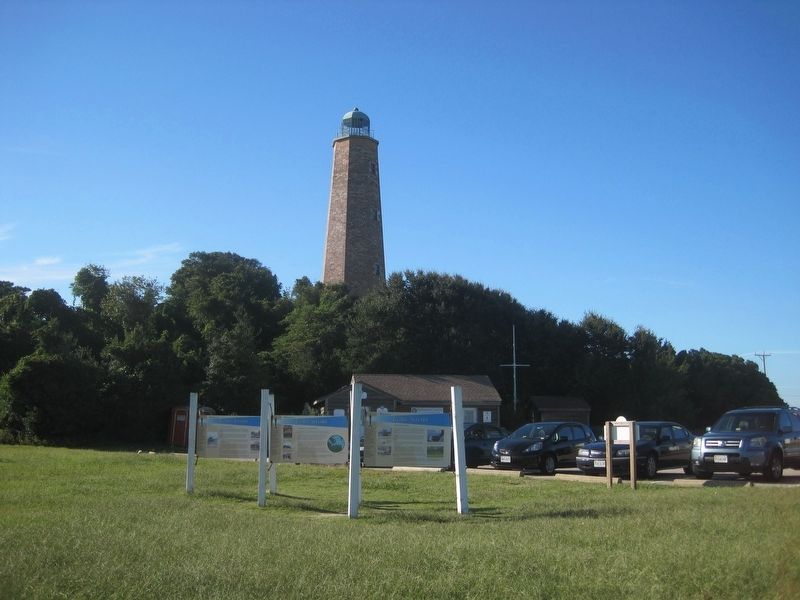
Photographed by Kevin W., September 27, 2014
3. Fort Story Marker
The Lighter, Amphibian, Air Cushion Vehicle (LACV-30) was the third generation of amphibious vehicles to replace the LARC family. It was designed to ride on a four foot cushion of air over the water and over land. A completely new modern facility, including a flyway into the water, was built on the western portion of the post to accommodate these vehicles. The LACV was a noisy and maintenance-intensive vehicle and the Army determined to retire the hovercraft from the inventory. The era of amphibious vehicles which had started at Cape Henry in 1946 had come to an end.
[Captions:]
This is an aerial view of an off-load exercise during JLOTS II in September and October 1984. At that time, it was the largest joint exercise ever held on these beaches. More than 3,000 military personnel from the Navy, active Army and Army Reserve components participated.
The workhouse DUKW amphibious vehicle was assigned to Fort Story from 1946 until the early 1960s.
The second generation family of amphibious vehicles that replaced the aging DUKW. From left to right are the LARC LX, the LARC XV and the LARC V. Despite the new vehicles and new nomenclature, the local civilian community continued to all all amphibious vehicles "Ducks."
The Lighter, Amphibian, Air Cushion Vehicle (LACV 30) was the third generation of amphibious vehicles. It was designed to ride on a four foot cushion of air over the water and over land. The use of the air cushion vehicle came to an end in 1994. After 48 years the amphibians departed Cape Henry and the mission of Fort Story changed.
[Sidebar on each side of the marker:]
Welcome

Photographed by Devry Becker Jones (CC0), June 13, 2025
4. The three markers for Welcome to Fort Story
We hope you find your visit to Cape Henry both educational and inspirational.
Erected by the Hampton Roads Naval Museum, the Cape Henry Lighthouse and the Old Coast Guard Station.
Topics. This historical marker is listed in these topic lists: Forts and Castles • Parks & Recreational Areas • Waterways & Vessels. A significant historical year for this entry is 2007.
Location. 36° 55.509′ N, 76° 0.462′ W. Marker is in Virginia Beach, Virginia. It is in Fort Story. It is on Antic Avenue west of Attu Road, on the left when traveling east. Touch for map. Marker is at or near this postal address: 583 Sicily Rd, Virginia Beach VA 23459, United States of America. Touch for directions.

Regionally, this marker is in Hampton Roads, specifically in Coastal Virginia, and in the Hampton Roads Metropolitan Area. It is also in the American South, specifically in the Upper South, in the Tidewater, and on the Eastern Seaboard. Globally, it is in the North Atlantic Region, North America, the Western Hemisphere, the Western World, and the Anglosphere. Historically, it finds itself in what was once the territory of the Mississippian Culture, one of the original Thirteen Colonies, one of the Confederate States of America, and the Antebellum South.
Other nearby markers. At least 8 other markers are within walking distance of this marker: The Emerging Community / Defending the Chesapeake Bay (here, next to this marker); The Guns of Fort Story / Fort Story Rises from the Dunes (here, next to this marker); "A picturesque spot which impresses all who see it" (a few steps from this marker); Expanding Military Operations at Fort Story (a few steps from this marker); The Cottages of Cape Henry at Fort Story (a few steps from this marker); Cape Henry Railroads (within shouting distance of this marker); Movement and Display of the USS Iowa Battleship Barrel at Cape Henry/Fort Story (within shouting distance of this marker); WW2 16-inch/50 Coast Defense Batteries at Fort Story (within shouting distance of this marker). Touch for a list and map of all markers in Virginia Beach.
Credits. This page was last revised on June 21, 2025. It was originally submitted on June 21, 2025, by Kevin W. of Stafford, Virginia. This page has been viewed 146 times since then and 39 times this year. Photos: 1, 2. submitted on June 21, 2025, by Devry Becker Jones of Washington, District of Columbia. 3. submitted on November 28, 2014, by Kevin W. of Stafford, Virginia. 4. submitted on June 21, 2025, by Devry Becker Jones of Washington, District of Columbia. • Devry Becker Jones was the editor who published this page.
