Coinjock in Currituck County, North Carolina — The American South (South Atlantic)
Albemarle & Chesapeake Canal
Supply Route for Blue and Gray
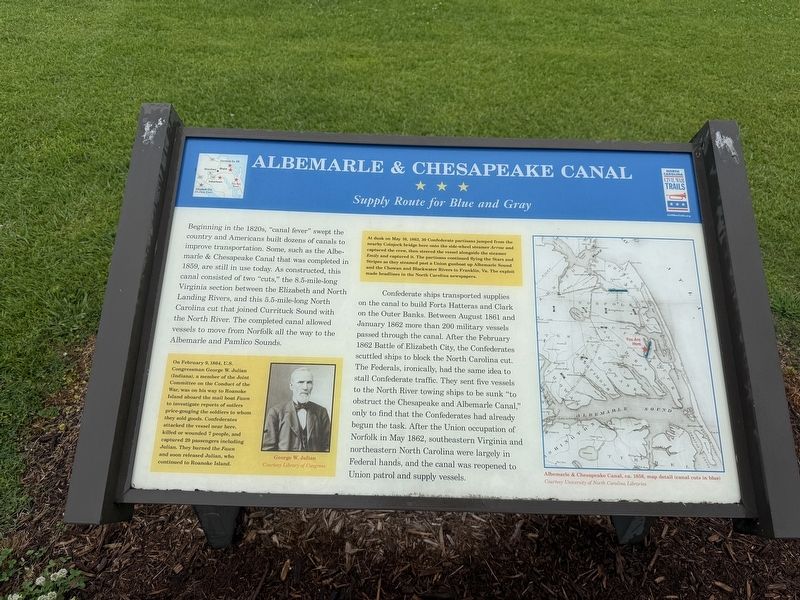
Beginning in the 1820s, "canal fever" swept the country and Americans built dozens of canals to improve transportation. Some, such as the Albemarle & Chesapeake Canal that was completed in 1859, are still in use today. As constructed, this canal consisted of two "cuts," the 8.5-mile-long Virginia section between the Elizabeth and North Landing Rivers, and this 5.5-mile-long North Carolina cut that joined Currituck Sound with the North River. The completed canal allowed vessels to move from Norfolk all the way to the Albemarle and Pamlico Sounds.
Confederate ships transported supplies on the canal to build Forts Hatteras and Clark on the Outer Banks. Between August 1861 and January 1862 more than 200 military vessels passed through the canal. After the February 1862 Battle of Elizabeth City, the Confederates scuttled ships to block the North Carolina cut. The Federals, ironically, had the same idea to stall Confederate traffic. They sent five vessels to the North River towing ships to be sunk "to obstruct the Chesapeake and Albemarle Canal," only to find that the Confederates had already begun the tasks. After the Union
this page online
[Sidebar:]
On February 9, 1864, U.S. Congressman George W. Julian (Indiana), a member on the Joint Committee on Conduct of the War, was on his way to Roanoke Island aboard the mail boat Fawn to investigate reports of sutlers price-gouging the soldiers to whom they sold goods. Confederates attacked the vessel near here, killed or wounded 7 people, and captured 29 passengers including Julian. They burned Fawn and soon released Julian, who continued to Roanoke Island.
[Sidebar:]
At dusk on May 16, 1863, 30 Confederate partisans jumped from the nearby Coinjock bridge here onto the side-wheel steamer Arrow and captured the crew, then steered the vessel alongside the steamer Emily and captured it. The partisans continued flying the Stars and Stripes as they steamed past a Union gunboat up Albemarle Sound and the Chowan and Blackwater Rivers to Franklin, Va. The exploit made headlines in the North Carolina newspapers.
Erected by North Carolina Civil
Topics and series. This historical marker is listed in these topic lists: Industry & Commerce • War, US Civil • Waterways & Vessels. In addition, it is included in the North Carolina Civil War Trails series list. A significant historical month for this entry is January 1862.
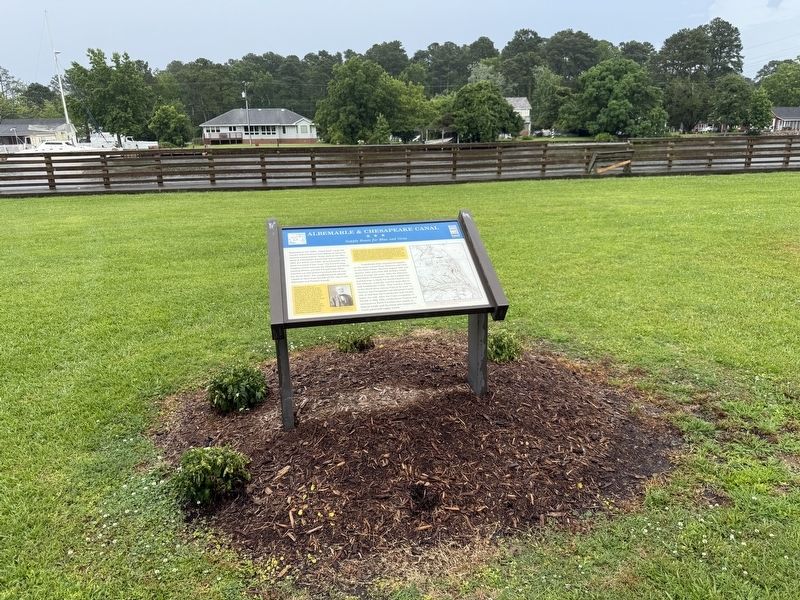
Location. 36° 20.832′ N, 75° 57.052′ W. Marker is in Coinjock, North Carolina, in Currituck County. It is on Coinjock Canal Road north of Worth Guard Road, on the right when traveling north. Touch for map. Marker is at or near this postal address: 132 Old Coinjock Canal Rd, Coinjock NC 27923, United States of America. Touch for directions.

Regionally, this marker is in the Coastal Plain and in the Hampton Roads Metropolitan Area. It is also in the American South, specifically in the Upper South, in the Tidewater, and on the Eastern Seaboard. Globally, it is in the North Atlantic Region, North America, the Western Hemisphere, the Western World, and the Anglosphere. Historically, it finds itself in what was once the territory of the Mississippian Culture, one of the original Thirteen Colonies, one of the Confederate States of America, and the Antebellum South.
Other nearby markers. At least 8 other markers are within 7 miles of this marker, measured as the crow flies: Currituck County Veterans Memorial Park (a few steps from this marker); American Liberty Anniversary Elm (within shouting distance of this marker); a different marker also named Albemarle and Chesapeake Canal (approx. half a mile away); Betsy's Ride (approx. one mile away); Hijacking Maple Leaf (approx. 5.4 miles away); Ray T. Adam's Landing Strip (approx. 6.8 miles away); Land of the Wild Goose (approx. 6.8 miles away); The Whalehead Club Restoration (approx. 6.8 miles away). Touch for a list and map of all markers in Coinjock.
Other markers no longer nearby. Albemarle and Chesapeake Canal (was here, next to this marker but has been replaced with another marker now near it); Maple Leaf (was approx. 5.4 miles away but has been replaced with another marker now near it).
Related marker. Click here for another marker that is related to this marker. This marker has replaced the linked marker.
Credits. This page was last revised on June 21, 2025. It was originally submitted on June 21, 2025, by Devry Becker Jones of Washington, District of Columbia. This page has been viewed 326 times since then and 46 times this year. Photos: 1, 2. submitted on June 21, 2025, by Devry Becker Jones of Washington, District of Columbia.
