Greenville in Pitt County, North Carolina — The American South (South Atlantic)
Federals Occupy Greenville
"The bridge … was destroyed"
| — | Potter's Raid | — |
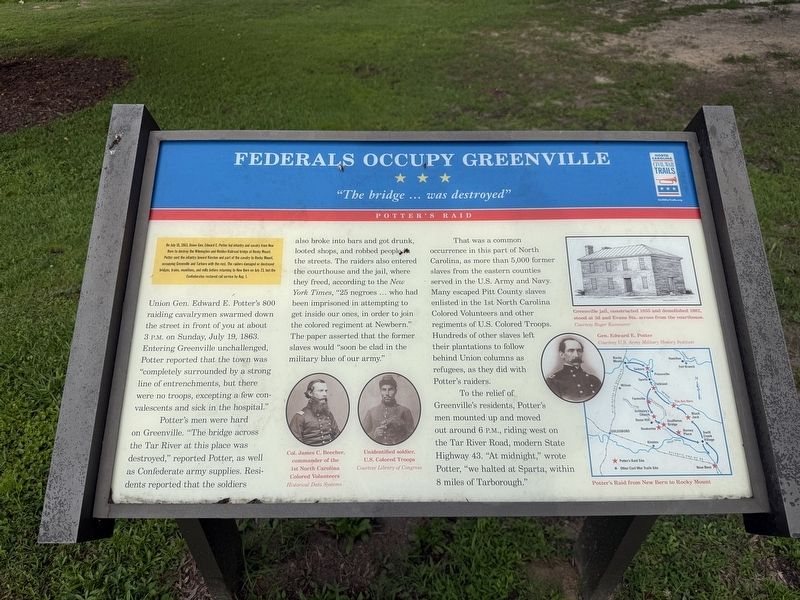
On July 18, 1863, Union Gen. Edward E. Potter led infantry and cavalry from New Bern to destroy the Wilmington and Weldon Railroad bridge at Rocky Mount. Potter sent the infantry toward Kinston and part of the cavalry to Rocky Mount, occupying Greenville and Tarboro with the rest. The raiders damaged or destroyed bridges, trains, munitions, and mills before returning to New Bern on July 23, but the Confederates restored rail service by Aug. 1.
Union Gen. Edward E. Potter's 800 raiding cavalrymen swarmed down the street in front of you at about 3 P.M. on Sunday, July 19, 1863. Entering Greenville unchallenged Potter reported that the town was "completely surrounded by a strong line of entrenchments, but there were no troops, excepting a few convalescents and sick in the hospital."
Potter's men were hard on Greenville. "The bridge across the Tar River at this place was destroyed," reported Potter, as well as Confederate army supplies. Residents reported that the soldiers also broke into bars and got drunk, looted shops, and robbed people in the streets. The raiders also entered the courthouse and the jail, where they
this page online
That was a common occurrence in this part of North Carolina, as more than 5,000 former slaves from the eastern counties served in the U.S. Army and Navy. Many escaped Pitt County slaves enlisted in the 1st North Carolina Colored Volunteers and other regiments of U.S. Colored Troops. Hundreds of other slaves left their plantations to follow behind Union columns as refugees, as they did with Potter's raiders.
To the relief of Greenville's residents, Potter's men mounted up and moved out around 6 P.M., riding west on the Tar River Road, modern State Highway 43. "At midnight," wrote Potter, "we halted at Sparta, within 8 miles of Tarborough."
[Captions:]
Co. James C. Beecher, commander of the 1st North Carolina Colored Volunteers
Historical Data Systems
Unidentified soldier, U.S. Colored Troops
Courtesy Library of Congress
Greenville jail, constructed 1855 and demolished 1882, stood at 3d and Evans Sts. across from the courthouse.
Courtesy Robert Kammerer
Gen Edward E. Potter
Courtesy U.S. Army Military History Institute
Potter's Raid from New Bern to Rocky Mount
Erected by North
Topics and series. This historical marker is listed in these topic lists: Abolition & Underground RR • African Americans • War, US Civil. In addition, it is included in the North Carolina Civil War Trails series list. A significant historical date for this entry is July 18, 1863.
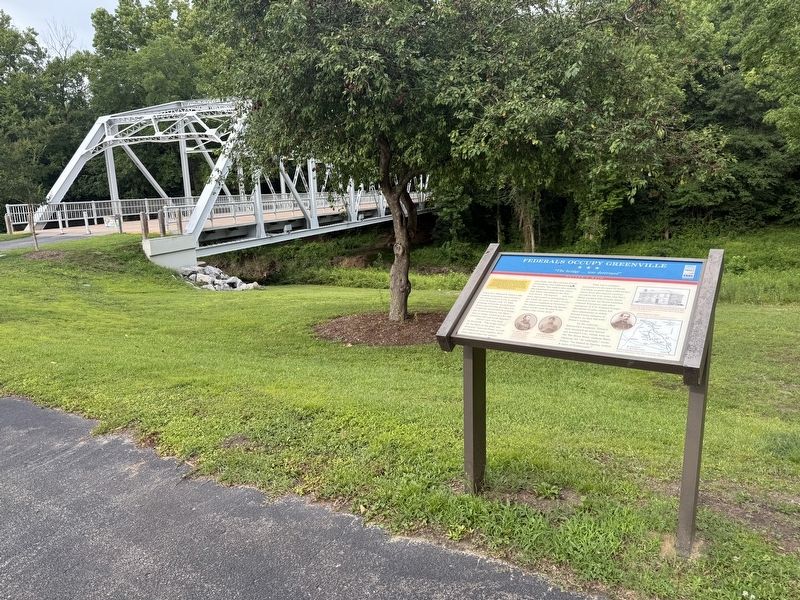
Location. 35° 36.888′ N, 77° 22.083′ W. Marker is in Greenville, North Carolina, in Pitt County. It is on East 1st Street east of Reade Street, on the left when traveling east. Touch for map. Marker is at or near this postal address: 508 E 1st St, Greenville NC 27858, United States of America. Touch for directions.

Regionally, this marker is in North Carolina’s Coastal Plain. It is also in the American South, specifically in the Upper South, and on the Eastern Seaboard. Globally, it is in the North Atlantic Region, North America, the Western Hemisphere, the Western World, and the Anglosphere. Historically, it finds itself in what was once the territory of the Mississippian Culture, one of the original Thirteen Colonies, one of the Confederate States of America, and the Antebellum South.
Other nearby markers. At least 8 other markers are within walking distance of this marker: Town Commons Park Bridge (a few steps from this marker); a different marker also named Town Commons Park Bridge (about 300 feet away, measured in a direct line); Stuart Aronson (approx. 0.2 miles away); Hurricane Floyd in Greenville (approx. 0.2 miles away); Native Americans in the Tar River Valley (approx. 0.2 miles away); Pitt County Supreme Sacrifice and Veterans Memorial (approx. ¼ mile away); Early Black Health Professionals (approx. ¼ mile away); Town Common & Urban Renewal (approx. ¼ mile away). Touch for a list and map of all markers in Greenville.
Another marker is no longer nearby. Greenville (was within shouting distance of this marker but has been replaced with another marker now near it).
Credits. This page was last revised on June 23, 2025. It was originally submitted on June 23, 2025, by Devry Becker Jones of Washington, District of Columbia. This page has been viewed 152 times since then and 46 times this year. Photos: 1, 2. submitted on June 23, 2025, by Devry Becker Jones of Washington, District of Columbia.
