
Walhalla in Oconee County, South Carolina — The American South (South Atlantic)
Cherokee Path
Photographed by J. J. Prats, May 18, 2025
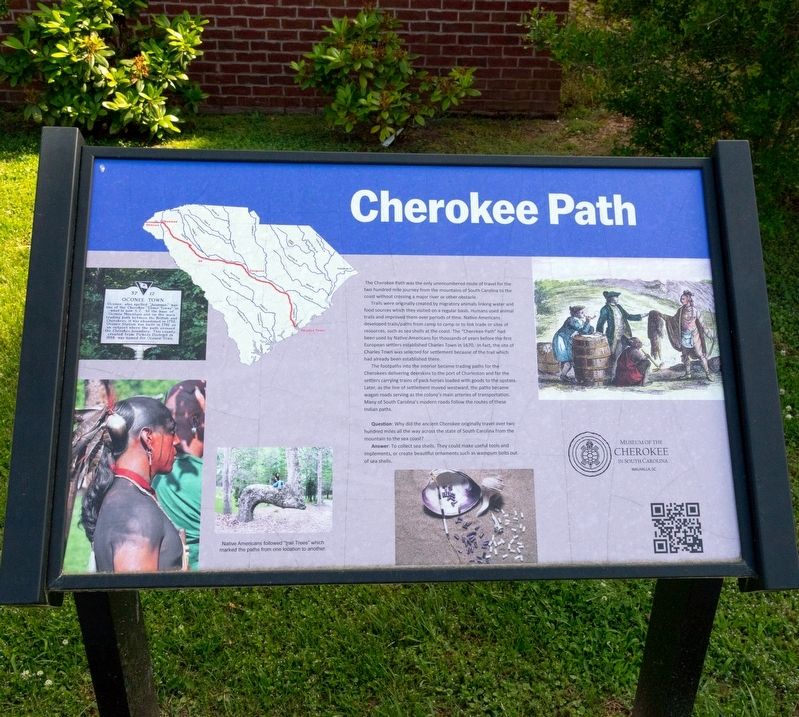
1. Cherokee Path Marker
Trails were originally created by migratory animals linking water and food sources which they visited on a regular basis. Humans used animal trails and improved them over periods of time. Native Americans developed trails/paths from camp to camp or to link trade or sites of resources, such as sea shells at the coast. The “Cherokee Path” had been used by Native Americans for thousands of years before the first European settlers established Charles Town in 1670. In fact, the site of Charles Town was selected for settlement because of the trail which had already been established there.
The footpaths into the interior became trading paths for the Cherokees delivering deerskins to the port of Charleston and for the settlers carrying trains of pack horses loaded with goods to the upstate. Later, as the line of settlement moved westward, the paths became wagon roads serving as the colony’s main arteries of transportation. Many
this page online
Question: Why did the ancient Cherokee originally travel over two hundred miles all the way across the state of South Carolina from the mountain to the sea coast?
Answer: To collect sea shells. They could make useful tools and implements, or create beautiful ornaments such as wampum belts out of sea shells.
Erected by Museum of the Cherokee in South Carolina — Walhalla SC.
Topics. This historical marker is listed in these topic lists: Indigenous Peoples and Communities • Roads & Vehicles • Settlements & Settlers. A significant historical year for this entry is 1670.
Location. 34° 45.866′ N, 83° 4.094′ W. Marker is in Walhalla, South Carolina, in Oconee County. It is on Short Street west of South Tugaloo Street, on the left when traveling west. Touch for map. Marker is at or near this postal address: 50 Short St, Walhalla SC 29691, United States of America. Touch for directions.

Regionally, this marker is in South Carolina’s and pstate, in the Foothills, in the Golden Corner. It is also in the American South, specifically in the
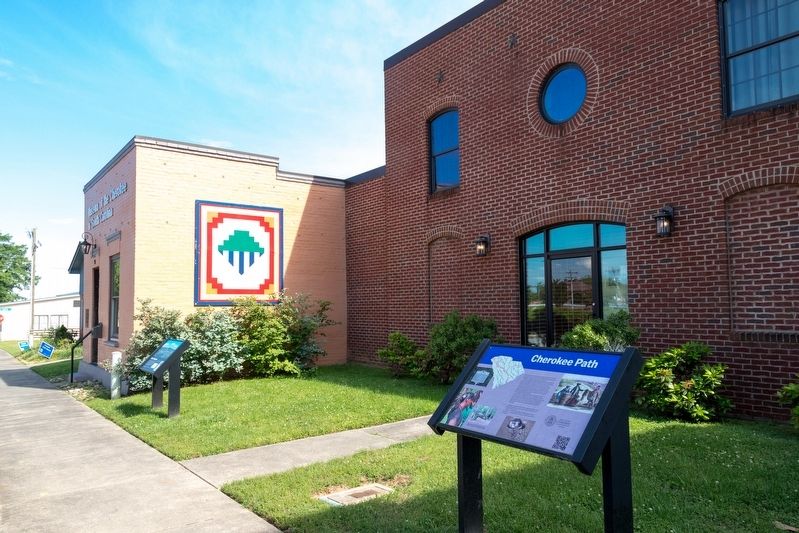
Photographed by J. J. Prats, May 18, 2025
2. Cherokee Path Marker
Other nearby markers. At least 8 other markers are within walking distance of this marker: Oconee Mountain (here, next to this marker); Colonel R.T. Jaynes (within shouting distance of this marker); Patriot's Hall: Oconee Veterans Museum (within shouting distance of this marker); The Lynching of Allen Green (within shouting distance of this marker); Gen. John A. Wagener (within shouting distance of this marker); Oconee County Veterans Memorial (about 300 feet away, measured in a direct line); Combat Infantrymen Monument (about 300 feet away); The Silver Rose (about 300 feet away). Touch for a list and map of all markers in Walhalla.
More about this marker. This interpretive panel is illustrated with a map, four photographs and a colored drawing.
The map shows the Cherokee Path. There is a photograph of the Oconee Town historical marker No. 32-12, a photograph of Cherokee man in his paint and headdress., a photograph of shells and beads, and a photograph captioned “Native Americans followed ‘trail trees’ which marked the paths from one location to another.” The drawing shows a Cherokee traders trading pelts with European settlers.
Also see . . . Wikipedia entry. Excerpt:
The Cherokee Path (or Keowee path) was the primary route of English and Scots traders from Charleston to Columbia, South Carolina in Colonial America. It was the way they reached Cherokee towns and territories along the upper Keowee River and its tributaries. In its lower section it was known as the Savannah River. They referred to these towns along the Keowee and Tugaloo rivers (in modern Georgia) as the Lower Towns, in contrast to the Middle Towns in Western North Carolina and the Overhill Towns in present-day southeastern Tennessee west of the Appalachian Mountains. ...(Submitted on June 23, 2025, by J. J. Prats of Powell, Ohio.)
The path was mapped in 1730 by George Hunter, the Surveyor-General of the Province of South Carolina. He noted that it ran 145 miles from Charlestown to the Congarees, a fort at the confluence of the Saluda and Broad rivers. (This site later was designated as the state capital and named Columbia.) The Path continued across the western frontier to the colonial settlement of Ninety Six, indicated on the map by the number “96.”
Credits. This page was last revised on June 24, 2025. It was originally submitted on June 23, 2025, by J. J. Prats of Powell, Ohio. This page has been viewed 360 times since then and 92 times this year. Photos: 1, 2. submitted on June 23, 2025, by J. J. Prats of Powell, Ohio.
