Apalachicola in Franklin County, Florida — The American South (South Atlantic)
Magnolia Cemetery “Colored Sections “
Apalachicola Black History Trail

Photographed by Brandon D Cross, June 18, 2025
1. Magnolia Cemetery “Colored Sections “ Marker
Some historians opine that African Americans placed great emphasis on the Homegoing Service for two reasons: one was prohibitions against the gathering of the enslaved for burials for fear that the enslaved would plot rebellions to free themselves from their condition of servitude.
After the Civil War and Emancipation, burial societies (benevolent associations) were established in African American communities throughout the country to ensure that their "Homegoing Celebration" was carried out in a way that was respectful and honorable. Apalachicola's
this page online
In 1913, the City of Apalachicola Florida adopted an ordinance regarding burials in Magnolia Cemetery, located in the north of town. Section 123 of the ordinance read as follows: "The north half of the south quarter of Magnolia Cemetery shall be used as a burial ground for white paupers and the south half of the south quarter of said cemetery is and shall be used as a burial ground for colored paupers."
“The west quarter of said cemetery shall be used as a burial ground for colored people who desire to buy lots therein, and all that portion of said cemetery on the river side of Central Avenue is and shall be used as a burial ground for white people.”
The "Colored Section of Magnolia Cemetery" is the final resting place for the remains of those listed below as well as so many more deserving of our remembrance:
• Isaiah Abram • Minnie Barefield • Breedloves • George & Mary Clark • Mary Thomas
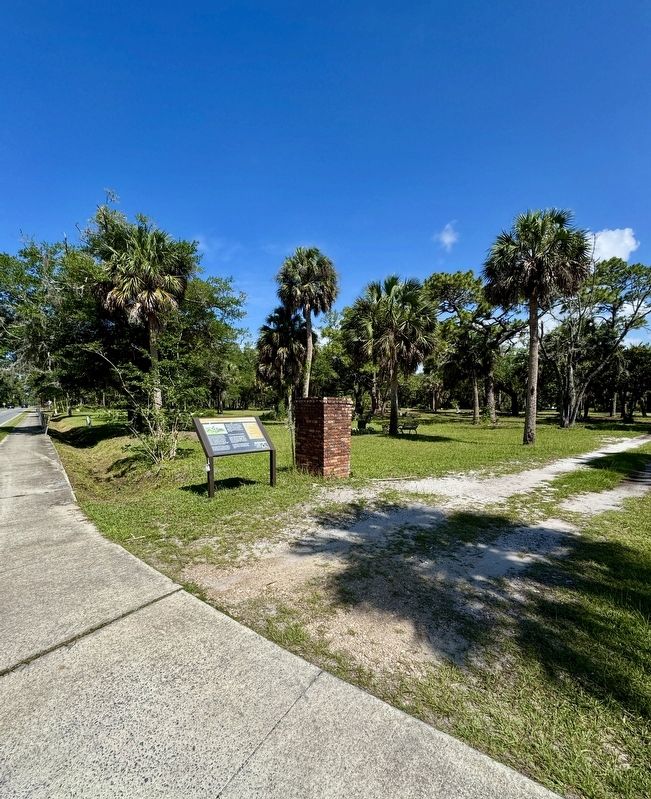
Photographed by Brandon D Cross, June 18, 2025
2. Magnolia Cemetery “Colored Sections“ Marker
Read more about the people and places of Apalachicola's Black History Trail by scanning the QR code above or by visiting cityofapalachicola.com.
Erected by Produced in cooperation with the Florida Department of State Division of Historical Resources, North Florida African American Corridor Project, City of Apalachicola and the Franklin County Tourist Development Council.
Topics. This historical marker is listed in these topic lists: African Americans • Cemeteries & Burial Sites • Civil Rights. A significant historical year for this entry is 1913.
Location. 29° 43.882′ N, 85° 0.204′ W. Marker is in Apalachicola, Florida, in Franklin County. It is at the intersection of 12th Street and 24th Avenue, on the right when traveling north on 12th Street. The marker is located near the entrance to Magnolia Cemetery. Touch for map. Marker is at or near this postal address: 341 12th Street, Apalachicola FL 32320, United States of America. Touch for directions.

Regionally, this marker is on the Florida Panhandle. It is also in the American South, specifically in the Deep South, and on the Gulf Coast. Globally, it is in the North Atlantic Region, North America, a Gulf of Mexico state, the Western Hemisphere, the Western World, and the Anglosphere. Historically, it finds itself in what was once New Spain, the territory of the Mississippian Culture, one of the Confederate States of America, and the Antebellum South.
Other nearby markers. At least 8 other markers are within walking distance of this marker: Chief Master Sergeant Herbert Eugene Smith (about 300 feet away, measured in a direct line); Veterans Memorial (about 300 feet away); Paul Laurence Dunbar School (approx. 0.4 miles away); Historic Franklin Square (approx. 0.6 miles away); Holy Family Church & School (approx. 0.6 miles away); First Born Church of the Living God (approx. 0.6 miles away); Dr. Alvin Wentworth Chapman (approx. ¾ mile away); St. Paul African Methodist Episcopal Church (approx. 0.8 miles away). Touch for a list and map of all markers in Apalachicola.
Also see . . .
1. Apalachicola Black History Trail. (Submitted on June 24, 2025, by Brandon D Cross of Flagler Beach, Florida.)
2. Apalachicola Historic Landmarks. (Submitted on June 24, 2025, by Brandon D Cross of Flagler Beach, Florida.)
Credits. This page was last revised on June 24, 2025. It was originally submitted on June 24, 2025, by Brandon D Cross of Flagler Beach, Florida. This page has been viewed 148 times since then and 40 times this year. Photos: 1, 2. submitted on June 24, 2025, by Brandon D Cross of Flagler Beach, Florida. • Andrew Ruppenstein was the editor who published this page.
