Redcar in Redcar and Cleveland, England, United Kingdom — Northwestern Europe (the British Isles)
Redcar Pier
Photographed by Ray Gurganus, April 23, 2025
1. Redcar Pier Marker
4,000 People visited the pier on the first day
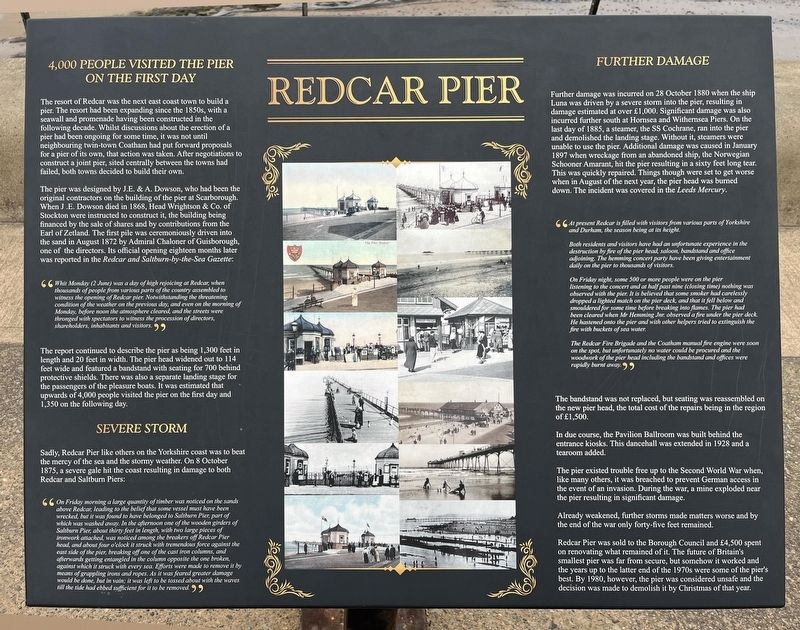
The resort of Redcar was the next east coast town to build a pier. The resort had been expanding since the 1850s, with a seawall and promenade having been constructed in the following decade. Whilst discussions about the erection of a pier had been ongoing for some time, it was not until neighbouring twin-town Coatham had put forward proposals for a pier of its own, that action was taken. After negotiations to construct a joint pier, sited centrally between the towns had failed, both towns decided to build their own.
The pier was designed by J.E. & A. Dowson, who had been the original contractors on the building of the pier at Scarborough. When J.E. Dowson died in 1868, Head Wrightson & Co. of Stockton were instructed to construct it, the building being financed by the sale of shares and by contributions from the Earl of Zetland. The first pile was ceremoniously driven into the sand in August 1872 by Admiral Chaloner of Guisborough, one of the directors. Its official opening eighteen months later was reported in the Redcar and Saltburn-by-the-Sea Gazette:
"Whit Monday (June) was a day of high rejoicing on Redcar, when thousands of people from various parts of the country assembled to witness the opening of Redcar pier notwithstanding the threatening condition of the weather on the previous day, and even on the morning of Monday before noon the atmosphere cleared, and the streets were thronged with spectators to witness the procession of directors shareholders, inhabitants and visitors."The
this page online
Severe Storm
Sadly, Redcar Pier like others on the Yorkshire coast was to beat the mercy of the sea and the stormy weather. On 8 October 1875, a severe gale hit the coast resulting in damage to both Redcar and Saltburn Piers:
"On Friday morning a large quantity of timber was noticed on the sands above Redcar leading to the belief that some vessel must have been wrecked, but it was found to have belonged to Saltburn Pier, part of which was washed away In the afternoon one of the wooden girders of Saltburn Pier, about thirty feet in length, with two large pieces of ironwork attached was noticed among the breakers offer head, and about four o'clock it struck with tremendous force against the east side of the pier, breaking off one of the cast iron columns, and afterwards getting entangled in the column opposite the one broken against which it struck with every sea Efforts were made so remove it by means of grappling irons and ropes. As it was feared greater damage would be done, but in vain; it was left to be tossed about with the waves till the tide had ebbed sufficient for it to be removed."Further Damage
Further
Photograph from marker
2. Redcar Pier
"At present Redcar is filled with visitors from various parts of Yorkshire and Durham, the season being height.
Both residents and visitors have had an unfortunate experience in the destruction by fire of the pier head saloon, bands and and office adjoining. The hemming concert party have been giving entertainment daily on the pier to thousands of visitors.
On Friday night, some 500 or more people were on the pier listening to the concert and at half past nine (closing time) nothing was observed with the pier. It is believed that some smoker had carelessly dropped a lighted match on the pier deck, and that it fell below and smouldered for some time before breaking into flames. The pier had been cleared when Mr Hemming Jnr observed a fire under the pier deck. He hastened onto the pier and with other helpers tried to extinguish the fire with buckets of sea water.
The Redcar Fire Brigade and the Coatham manual fire engine were soon on the spot, but unfortunately no water could be procured and the woodwork of the pier head including the bandstand and offices were rapidly burnt away."
The
Photograph from marker
3. Redcar Pier
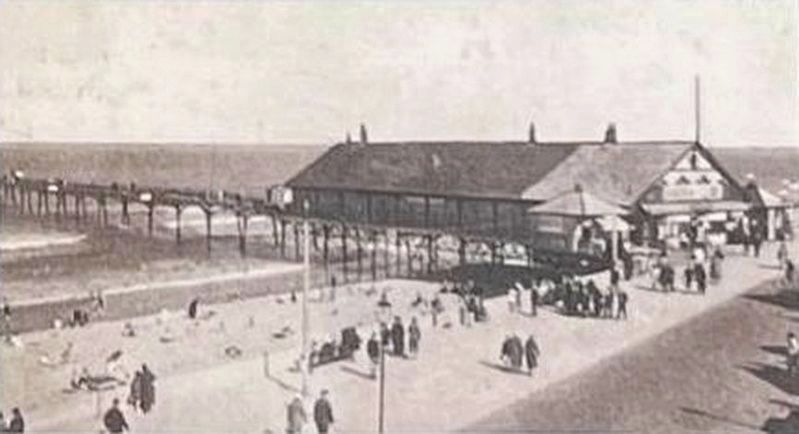
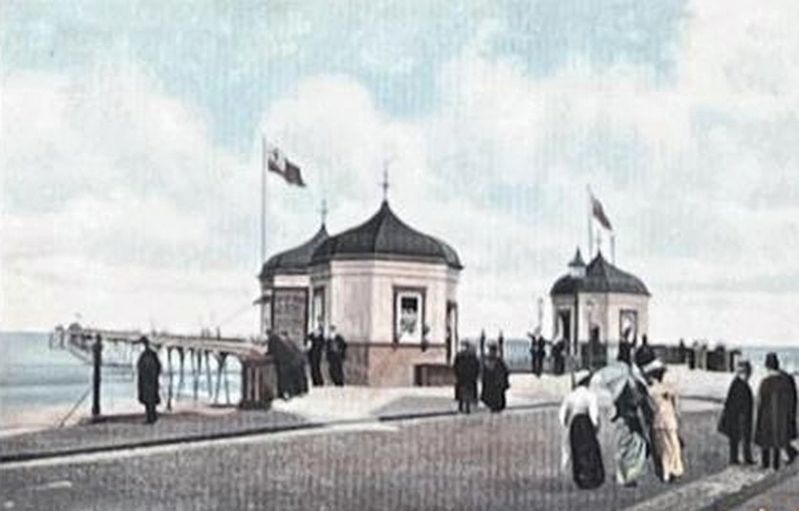
In due course, the Pavilion Ballroom was built behind the entrance kiosks. This dancehall was extended in 1928 and a tearoom added.
The pier existed trouble free up to the Second World War when, like many others, it was breached to prevent German access in the event of an invasion. During the war, a mine exploded near the pier resulting in significant damage.
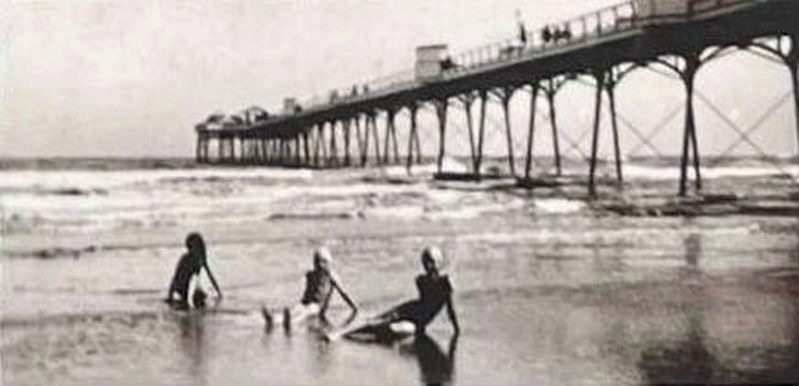
Already weakened, further storms made matters worse and by the end of the war only forty-five feet remained.
Redcar Pier was sold to the Borough Council and £4,500 spent on renovating what remained of it. The future of Britain's smallest pier was far from secure, but somehow it worked and the years up to the latter end of the 1970s were some of the pier's best. By 1980, however, the pier was considered unsafe and the decision was made to demolish it by Christmas of that year.
Topics. This historical marker is listed in these topic lists: Disasters • Parks & Recreational Areas • Waterways & Vessels.
Location. 54° 37.075′ N,
Photograph from marker
4. Redcar Pier Marker

Regionally, this marker is in North East England. Globally, it is on the Atlantic Ocean, in the North Atlantic Region, in Europe, in Atlantic Europe, on one of the British Isles, in the Western World, and in the Anglosphere. Historically, it finds itself in what was once the Roman Empire.
Other nearby markers. At least 8 other markers are within 13 kilometers of this marker, measured as the crow flies: The Birger (here, next to this marker); The War Memorial - Guisborough (approx. 9.1 kilometers away); The de Brus Cenotaph (approx. 9.1 kilometers away); A Trophy from Sebastopol (approx. 11.5 kilometers away); The Bombardment of the Hartlepools (approx. 11.5 kilometers away); a different marker also named Bombardment of the Hartlepools (approx. 11.5 kilometers away); a different marker also named
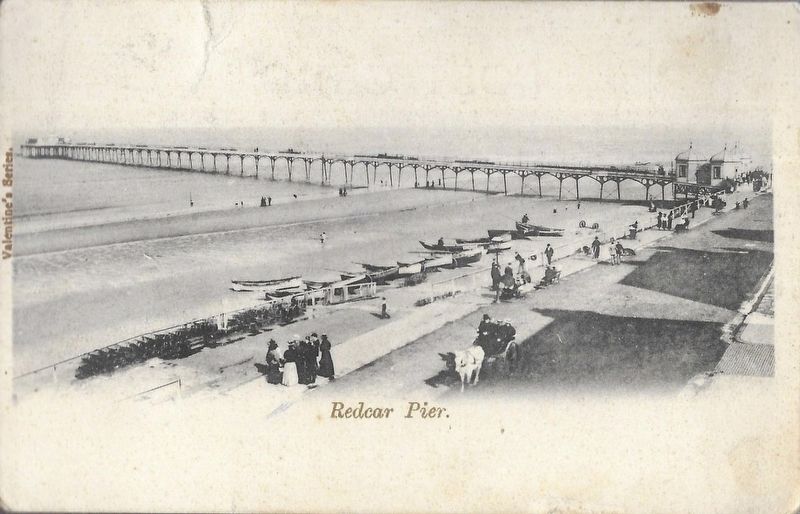
Photographed by John Valentine and Son, circa 1903
5. Redcar Pier
Credits. This page was last revised on July 8, 2025. It was originally submitted on July 4, 2025, by Ray Gurganus of Washington, District of Columbia. This page has been viewed 139 times since then and 43 times this year. Photos: 1, 2, 3, 4. submitted on July 4, 2025, by Ray Gurganus of Washington, District of Columbia. 5. submitted on July 8, 2025. • Andrew Ruppenstein was the editor who published this page.
