Manchester in Coffee County, Tennessee — The American South (East South Central)
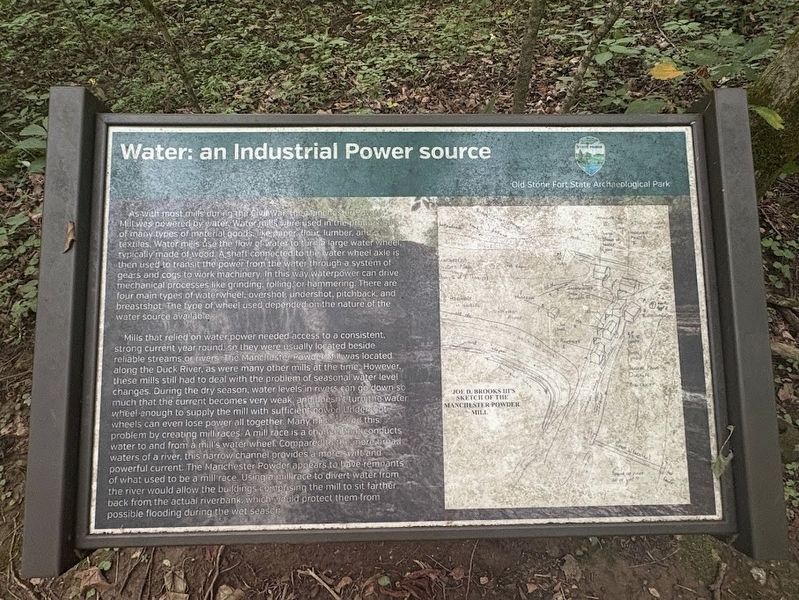
Water: an Industrial Power Source
| — | Old Stone Fort State Archaeological Park | — |
Photographed by Darren Jefferson Clay, June 28, 2025
1. Water: an Industrial Power Source Marker
Mills that relied on water power needed access to a consistent, strong current year round, so they were usually located beside reliable streams or rivers. The Manchester Powder Mill was located along the Duck River, as were many other mills at the time. However, these mills still had to deal with the problem of seasonal water level changes. During the dry season, water levels in rivers can go down so much that the current becomes very weak,
this page online
Erected by Tennessee State Parks.
Topics. This historical marker is listed in these topic lists: Environment • Industry & Commerce • War, US Civil.
Location. 35° 28.817′ N, 86° 6.643′ W. Marker is in Manchester, Tennessee, in Coffee County. It can be reached from Stone Fort Dr south of U.S. 41, on the right when traveling south. Touch for map. Marker is in this post office area: Manchester TN 37355, United States
Photographed by Darren Jefferson Clay, June 28, 2025
2. Water: an Industrial Power Source Marker

Regionally, this marker is in Middle Tennessee and in the Highland Rim. It is also in the American South and specifically in the Upper South. Globally, it is in North America, the Western Hemisphere, the Western World, and the Anglosphere. Historically, it finds itself in what was once the territory of the Mississippian Culture, one of the Confederate States of America, and the Antebellum South.
Other nearby markers. At least 8 other markers are within walking distance of this marker: Powder Production (about 300 feet away, measured in a direct line); Powder Storage and Distribution (about 400 feet away); Patterns in Mound Wall Construction (about 500 feet away); Mills Interrupt the Walls (approx. 0.2 miles away); The Long Back Wall (approx. ¼ mile away); The Uses of Water in Different Cultures (approx. 0.3 miles away); The Mound Walls Meet the Cliffs (approx. 0.4 miles away); The Old Stone Fort and the Stone Fort Paper Co. (approx. 0.4 miles away). Touch for a list and map of all markers in Manchester.
Credits. This page was last revised on July 8, 2025. It was originally submitted on July 6, 2025, by Darren Jefferson Clay of Duluth, Georgia. This page has been viewed 95 times since then and 22 times this year. Photos: 1, 2. submitted on July 6, 2025, by Darren Jefferson Clay of Duluth, Georgia. • James Hulse was the editor who published this page.
