Haynes Township near Harrisville in Alcona County, Michigan — The American Midwest (Great Lakes)
Get Into Your Sanctuary
⎯⎯⎯
Thunder Bay National Marine Sanctuary
| — | Great Lakes Maritime Heritage Trail | — |
Photographed by Mark Parker, June 24, 2025
1. Get Into Your Sanctuary Sentinels Marker
Get Into Your Sanctuary
Sanctuary Sentinels
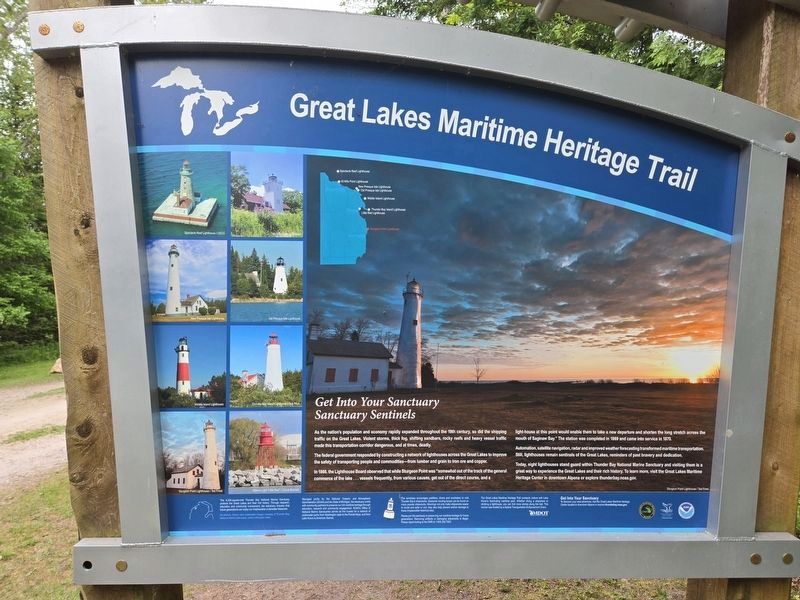
As the nation's population and economy rapidly expanded throughout the 19th century, so did the shipping traffic on the Great Lakes. Violent storms, thick fog, shifting sandbars, rocky reefs and heavy vessel trafic made this transportation corridor dangerous, and at times, deadly.
The federal government responded by constructing a network of lighthouses across the Great Lakes to improve the safety of transporting people and commodities - from lumber and grain to iron ore and copper.
In 1866, the Lighthouse Board observed that while Sturgeon Point was "somewhat out of the track of the general commerce of the lake...vessels frequently, from various causes, get out of the direct course, and a light-house at this point would enable them to take a new departure and shorten the long stretch across the mouth of Saginaw Bay." The station was completed in 1869 and came into service in 1870.
Automation, satellite navigation, radar and improved weather forecasting transformed maritime transportation. Stil, lighthouses remain sentinels of he Great Lakes, reminders of past bravery
this page online
Today, eight lighthouses stand guard within Thunder Bay National Marine Sanctuary and visiting them is a great way to experience the Great Lakes and their rich history. To learn more, visit the Great Lakes Maritime Heritage Center in downtown Alpena or explore thunderbay.noaa.gov.
Photo credit Sturgeon Point Lighthouse / Ted Fines
(Lighthouses top left to bottom right)
Spectacle Reef lighthouse / USCG • New Presque Isle Lighthouse • Middle Island Lighthouse • Sturgeon Point Lighthouse / Ted Fines • Old Presque Isle Lighthouse • Thunder Bay Island Lighthouse / Bob Wick • Alpena Light "Little Red" Lighthouse / Chuck Bennett
The 4,300-square-mile Thunder Bay National Marine Sanctuary protects the Great Lakes and their rich history. Through research, education, and community involvement, the sanctuary endures that future generations can enjoy our irreplaceable underwater treasures.
Managed jointly by the National Oceanic and Atmospheric Administration (NOAA) and the State of Michigan, the sanctuary works with community partners to preserve our rich maritime heritage through education, research and community engagement. NOAA's Office of National Marine Sanctuaries serves as the trustee for a network of underwater parks from Washington state to the Florida Keys, and from Lake Huron to American Samoa. The sanctuary encourages paddlers, divers, and snorkelers to visit Thunder Bay's shipwrecks. Seasonal mooring buoys can be found on many popular shipwrecks. Moorings not only make shipwrecks easier to locate and safer to visit, they also help prevent anchor damage to these irreplaceable historical sites.
The Great Lakes Maritime Heritage Trail connects visitors with Lake Huron's fascinating maritime past. Whether, diving a shipwreck or climbing a lighthouse, you can find more storiess along the trail. This marker was funded by a federal Transportation Enhancement Grant and by the Northeast Michigan Council of Governments
Please join the sanctuary in preserving our maritime heritage for future generations. Removing artifacts or damaging shipwrecks is illegal. Please report looting to the DNR 1-800-292-7500.
All artwork, historic and underwater images courtesy of the Thunder Bay National Marine Sanctuary unless otherwise noted.
Thunder Bay National Marine Sanctuary
Shipwreck Alley
For

Photographed by Mark Parker, June 24, 2025
2. Thunder Bay National Marine Sanctuary Marker Side
With extraordinary growth comes increased adversity. Fire, ice, collisions and storms have claimed hundreds of vessels, including pioneer steamboats, majestic wooden scooners and huge steel freighters.
Get Into Your Sanctuary
Today, the 4,300 square-mile Thunder Bay National Marine Sanctuary protects an incredible collection of 200 shipwrecks. Preserved in clear, fresh Lake Huron water, they offer world-class diving, snorkeling and paddling opportunities, and they are here for you. Get into your sanctuary by climbing the steps of a lighthouse; getting your feet wet on a snorkel expedition; taking a glass bottom boat or kayak tour; or plunging below the waves to explore a majestic schooner. To learn more about Thunder Bay National Marine Sanctuary, visit the Great Lakes Marime Heritage Center
Photographed by Mark Parker, June 24, 2025
3. Get Into Your Sanctuary / Thunder Bay National Marine Sanctuary Marker
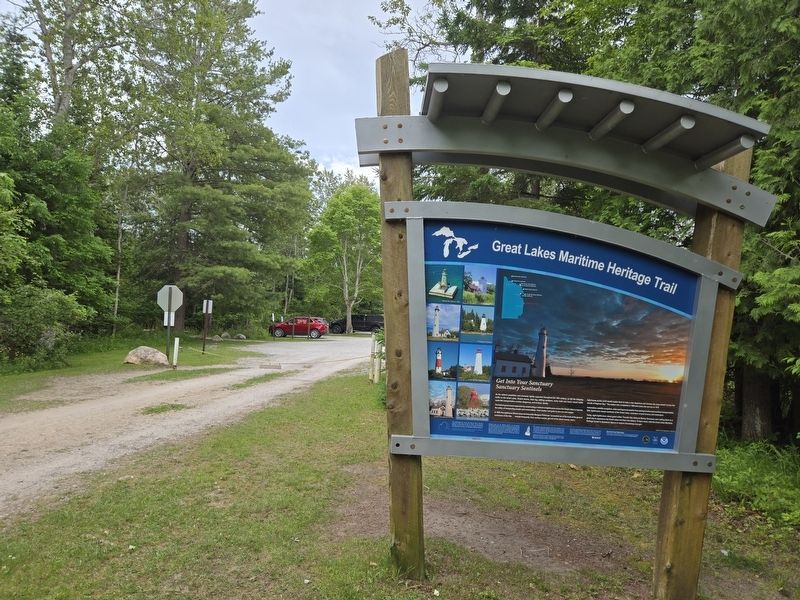
Located near the parking lot for Sturgeon Point Lighthouse
The 4,300-square-mile Thunder Bay National Marine Sanctuary protects the Great Lakes and their rich history. Through research, education, and community involvement, the sanctuary endures that future generations can enjoy our irreplaceable underwater treasures.
Managed jointly by the National Oceanic and Atmospheric Administration (NOAA) and the State of Michigan, the sanctuary works with community partners to preserve our rich maritime heritage through education, research and community engagement. NOAA's Office of National Marine Sanctuaries serves as the trustee for a network of underwater parks from Washington state to the Florida Keys, and from Lake Huron to American Samoa. The sanctuary encourages paddlers, divers, and snorkelers to visit Thunder Bay's shipwrecks. Seasonal mooring buoys can be found on many popular shipwrecks. Moorings not only make shipwrecks easier to locate and safer to visit, they also help prevent anchor damage to these irreplaceable historical sites.
The Great Lakes Maritime Heritage Trail connects visitors with Lake Huron's fascinating maritime past. Whether, diving a shipwreck or climbing a lighthouse, you can find more storiess along the trail. This marker was funded by a federal Transportation Enhancement Grant and by the Northeast Michigan Council of Governments
Please join the sanctuary in preserving our maritime heritage for future generations. Removing artifacts or damaging shipwrecks is illegal. Please report looting to the DNR 1-800-292-7500.
All artwork, historic and underwater images courtesy of the Thunder Bay National Marine Sanctuary unless otherwise noted.
Erected by Michigan Department of Natural Resources, Thunder Bay National Marine Sanctuaries, NOAA.
Topics and series. This historical marker is listed in these topic lists: Parks & Recreational Areas • Waterways & Vessels. In addition, it is included in the Lighthouses, and the National Oceanic and Atmospheric Administration (NOAA) series lists. A significant historical year for this entry is 1869.
Location. 44° 42.703′ N, 83° 16.372′ W. Marker is near Harrisville, Michigan, in Alcona County. It is in Haynes Township. It is on Point Road east of Spruce Trailways Road, on the left when traveling east. The marker is near parking lot at the trailhead to Sturgeon Point Lighthouse trail. Touch for map. Marker is at or near this postal address: 6071 Point Rd, Harrisville MI 48740, United States of America. Touch for directions.

Regionally, this marker is in Northern Michigan Lower Peninsula and in one of the Lake Huron Shore counties. It is also in the American Midwest. Globally, it is in North America, in the Great North Woods, on the Great Lakes, in the Western Hemisphere, in the Western World, and in the Anglosphere. Historically, it finds itself in what was once the Northwest Territory.
Other nearby markers. At least 8 other markers are within walking distance of this marker: Alcona County Schools (within shouting distance of this marker); Bailey School (within shouting distance of this marker); The "Bernice D" (within shouting distance of this marker); a different marker also named Bernice D (within shouting distance of this marker); Rudder Unknown (about 400 feet away, measured in a direct line); U.S. Coast Guard Watchtower Alarm Bell (about 400 feet away); Rudder "Marine City" (about 400 feet away); Marine City (about 400 feet away). Touch for a list and map of all markers in Harrisville.
Credits. This page was last revised on July 12, 2025. It was originally submitted on July 7, 2025, by Mark Parker of Hickory, North Carolina. This page has been viewed 147 times since then and 30 times this year. Photos: 1, 2, 3. submitted on July 7, 2025, by Mark Parker of Hickory, North Carolina. • J. Makali Bruton was the editor who published this page.
