Waverly in Bremer County, Iowa — The American Midwest (Upper Plains)
Ira & Asenath Sturdevant House
Photographed by Jason Voigt, June 18, 2025
1. Ira & Asenath Sturdevant House Marker
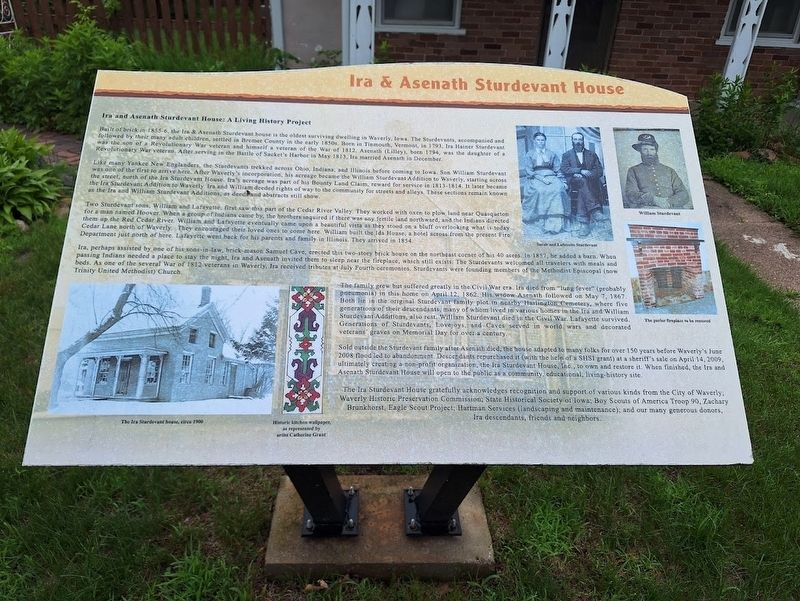
Ira and Asenath Sturdevant House: A Living History Project
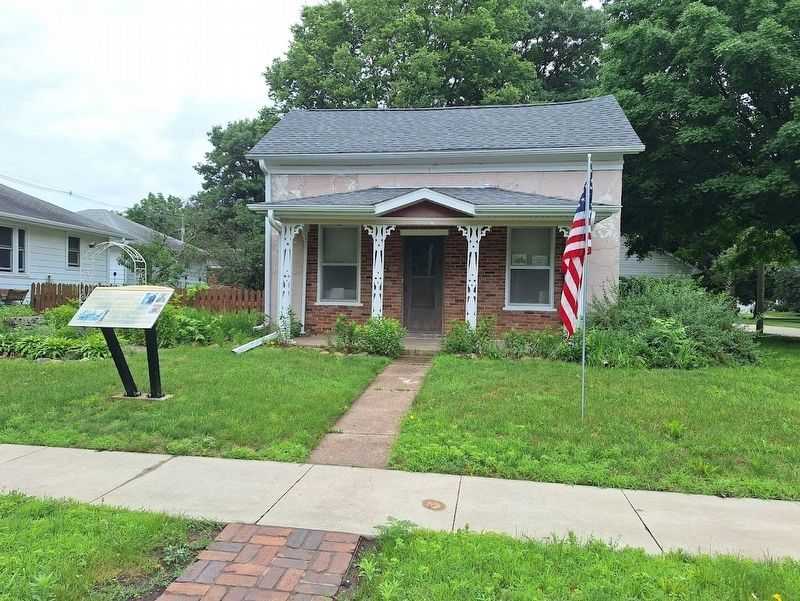
Built of brick in 1855-6, the Ira & Asenath Sturdevant house is the oldest surviving dwelling in Waverly, Iowa. The Sturdevants, accompanied and followed by their many adult children, settled in Bremer County in the early 1850s. Born in Tinmouth, Vermont, in 1793, Ira Hainer Sturdevant was the son of a Revolutionary War veteran and himself a veteran of the War of 1812. Asenath (Lilley), born 1794, was the daughter of a Revolutionary War veteran. After serving in the Battle of Sacket's Harbor in May 1813, Ira married Asenath in December.
Like many Yankee New Englanders, the Sturdevants trekked across Ohio, Indiana, and Illinois before coming to Iowa. Son William Sturdevant was one of the first to arrive here. After Waverly's incorporation, his acreage became the William Sturdevant Addition to Waverly, starting across the street, north of the Ira Sturdevant House. Ira's acreage was part of his Bounty Land Claim, reward for service in 1813-1814. It later became the Ira Sturdevant Addition to Waverly. Ira and William deeded rights of way to the community for
this page online
Two Sturdevant sons, William and Lafayette, first saw this part of the Cedar River Valley. They worked with oxen to plow land near Quasqueton for a man named Hoover. When a group of Indians came by, the brothers inquired if there was any fertile land northward, and the Indians directed them up the Red Cedar River. William and Lafayette eventually came upon a beautiful vista as they stood on a bluff overlooking what is today Cedar Lane north of Waverly. They encouraged their loved ones to come here. William built the Ida House, a hotel across from the present Fire Department just north of here. Lafayette went back for his parents and family in Illinois. They arrived in 1854.
Ira, perhaps assisted by one of his sons-in-law, brick-mason Samuel Cave, erected this two-story brick house on the northeast corner of his 40 acres. In 1857, he added a barn. When passing Indians needed a place to stay the night, Ira and Asenath invited them to sleep near the fireplace, which still exists. The Sturdevants welcomed
Photographed by Jason Voigt, June 18, 2025
2. Ira & Asenath Sturdevant House Marker
The family grew but suffered greatly in the Civil War era. Ira died from "lung fever" (probably pneumonia) in this home on April 12, 1862. His widow Asenath followed on May 7, 1867. Both lie in the original Sturdevant family plot to nearby Harlington Cemetery, where five generations of their descendants, many of whom lived in various homes in the Ira and William Sturdevant Additions, also rest. William Sturdevant died in the Civil war. Lafayette survived. Generations of Sturdevants, Lovejoys, and Caves served in world wars and decorated veterans' graves on Memorial Day for over a century.
Sold outside the Sturdevant family after Asenath died, the house adapted to many folks for over 150 years before Waverly's June 2008 flood led to abandonment. Descendants repurchased it (with the help of a SHSI grant) at a sheriff's sale on April 14, 2009, ultimately creating a non-profit organization, the Ira Sturdevant House, Inc., to own and restore it. When finished, the Ira and Asenath Sturdevant House will open to the public as a community, educational, living-history site.
The Ira Sturdevant House gratefully acknowledges recognition and support of various kinds from the City of Waverly; Waverly Historic Preservation Commission; State Historical Society of Iowa; Boy Scouts of America Troop 90, Zachary Brunkhorst, Eagle Scout Project; Hartman Services (landscaping and maintenance); and our many generous donors, Ira descendants, friends and neighbors.
Topics. This historical marker is listed in these topic lists: Indigenous Peoples and Communities • Settlements & Settlers • War, US Civil. A significant historical date for this entry is April 12, 1862.
Location. 42° 43.3′ N, 92° 28.322′ W. Marker is in Waverly, Iowa, in Bremer County. It is on 1st Street Southeast south of 4th Avenue Southwest, on the right when traveling south. Touch for map. Marker is at or near this postal address: 502 1st St SE, Waverly IA 50677, United States of America. Touch for directions.

Regionally, this marker is in North Iowa. It is also in the American Midwest and in the Corn Belt. Globally, it is in North America, the Western Hemisphere, the Western World, and the Anglosphere. Historically, it finds itself in what was once the territory of the Mississippian Culture and also the Louisiana Purchase.
Other nearby markers. At least 8 other markers are within walking distance of this marker: Railroad Memories (about 500 feet away, measured in a direct line); Rock Island Railroad (approx. 0.2 miles away); Rock Island Depot (approx. ¼ mile away); The Bremer Avenue Bridge over the Cedar River (approx. 0.3 miles away); Waverly Cedar River Dam (approx. 0.3 miles away); a different marker also named Waverly Cedar River Dam (approx. 0.3 miles away); a different marker also named Waverly Cedar River Dam (approx. 0.3 miles away); a different marker also named Waverly Cedar River Dam (approx. 0.3 miles away). Touch for a list and map of all markers in Waverly.
Credits. This page was last revised on July 7, 2025. It was originally submitted on July 7, 2025, by Jason Voigt of Glen Carbon, Illinois. This page has been viewed 209 times since then and 58 times this year. Photos: 1, 2. submitted on July 7, 2025, by Jason Voigt of Glen Carbon, Illinois.
