Rogers Township in Rogers City in Presque Isle County, Michigan — The American Midwest (Great Lakes)
The Rogers City Shoreline During the Lumber Era

Photographed by Mark Parker, June 24, 2025
1. The Rogers City Shoreline During the Lumber Era Marker
One of the hallmarks of Rogers City today is it's magnificent shoreline with one of the finest marinas on the Great Lakes and includes playgrounds, the pavilion, basketball courts, boat launching and fish cleaning facilities, performance shell, Mariners' Memorial, the bathing beach, and the Huron Sunrise Trail. All are accented by acres of luscious green grass on the west side and the blue waters of Lake Huron on the east side. For many area residents and visitors, it's a small piece of paradise. It wasn't always that way, however. In fact, Rogers City's popular user-oriented beach area is a product of the last seventy-five years.
Rogers City was founded as a lumbering community during Michigan's "lumber boom" in the second half of the nineteenth century. From it's founding in 1871, until around 1950, the area that is today Lakeside Park, was dominated by commercial enterprises. The "fish docks" were located adjacent to a small harbor just to the north of today's marina. Numerous companies operated fish tugs out of the harbor. In the years before World War II, thousands of tons of whitefish, lake trout, and chubs were
this page online
The shoreline from the fish docks south to Woodward Avenue was dominated by the major actors in the city's timber industry. At the peak of the lumber boom, the shoreline was dominated by three massive docks, shown in the illustration in the top left. The docks were designed primarily to ship logs and lumber, but they also handled visits by passenger and cargo vessels.
From north to south were the Bertram Docks at the end of Huron Avenue — on the sight of the old Molitor dock, the Larke dock at the end of Michigan Avenue, and the Hoeft dock at the end of Erie Street. The Bertram Sawmill was located at the base of their dock, as shown on the plat. The sprawling mill operations of the Hoeft family and their various commercial partners were located from Erie Street all the way to Woodward Avenue. Their huge sawmill, shown in the right-hand photo, was located off the end of Ontario Street. Towering piles of logs awaiting sawing blanketed the landscape both north and south of the mill.
Young people from the community frequently swam around the docks, a practice that was not encouraged
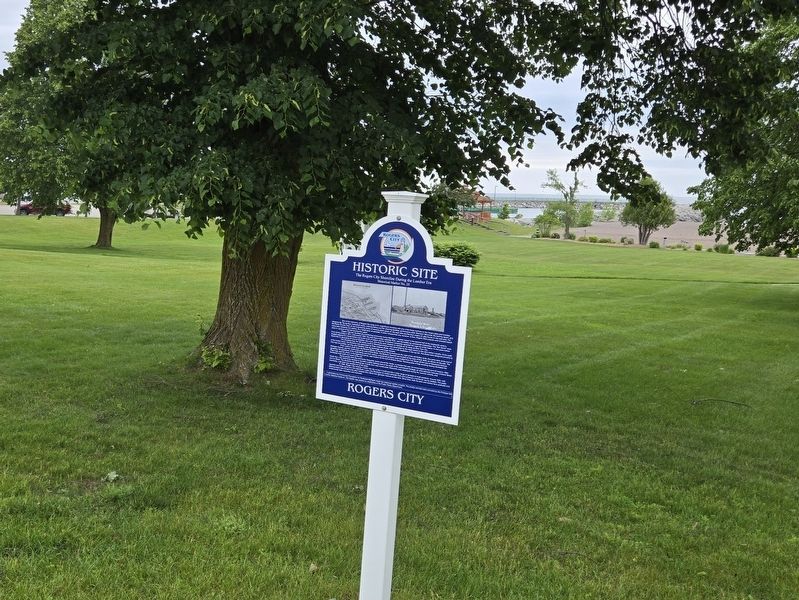
Photographed by Mark Parker, June 24, 2025
2. The Rogers City Shoreline During the Lumber Era Marker at Lakeside Park
In 1945, Rogers City became a home rule city so that it could provide a wider range of services to local residents. Around 1950, with sawmills and docks gone from the waterfront, a plan was developed to create Lakeside Park and construct a marina for use by boaters. The public bathing beach was moved to the area between Erie Street and Michigan Avenue at that time. Since then, both the park and marina have gradually and continuously been expanded and improved.
A grant from the Community Foundation for Northeast Michigan made this historical marker possible. The photos and text were provided by the Presque Isle County Historical Museum. The Marker was erected by employees of the Public Works Department.
Erected by Community Foundation for Northeast Michigan and Employees of the Public Works Department. (Marker Number 20.)
Topics. This historical marker is listed in these topic lists: Horticulture & Forestry • Industry & Commerce • Parks & Recreational Areas • Waterways & Vessels. A significant historical year for this entry is 1945.
Location. 45° 25.24′ N, 83° 48.721′ W. Marker is in Rogers City, Michigan, in Presque Isle County. It is in Rogers Township. It is on South Lake Street south of East Erie Street, on the left when traveling south. The marker is near South Lake Street at Lakeside Park. Touch for map. Marker is at or near this postal address: 120 S Lake St, Rogers City MI 49779, United States of America. Touch for directions.

Regionally, this marker is in Northern Michigan Lower Peninsula and in one of the Lake Huron Shore counties. It is also in the American Midwest. Globally, it is in North America, in the Great North Woods, on the Great Lakes, in the Western Hemisphere, in the Western World, and in the Anglosphere. Historically, it finds itself in what was once the Northwest Territory.
Other nearby markers. At least 8 other markers are within walking distance of this marker: Calcite - The World's Largest Limestone Quarry (about 300 feet away, measured in a direct line); Calcite Employee Housing (about 400 feet away); The Founders of Rogers City (about 700 feet away); Rogers City Sailors Memorial (about 700 feet away); Schooners (about 800 feet away); Thunder Bay National Marine Sanctuary (about 800 feet away); Site of Gumm Furniture Store (approx. 0.2 miles away); Site of Emil & Lizzie Poch Hardware Store (approx. 0.2 miles away). Touch for a list and map of all markers in Rogers City.
Credits. This page was last revised on July 13, 2025. It was originally submitted on July 8, 2025, by Mark Parker of Hickory, North Carolina. This page has been viewed 88 times since then and 17 times this year. Photos: 1, 2. submitted on July 8, 2025, by Mark Parker of Hickory, North Carolina. • J. Makali Bruton was the editor who published this page.
