Mackinac Island in Mackinac County, Michigan — The American Midwest (Great Lakes)
Resting Place of the Ancestors
| — | Native American Cultural History Trail | — |

Photographed by Joel Seewald, July 1, 2025
1. Resting Place of the Ancestors Marker, Side One
Side 1
The connection to water transcends worlds for the Anishnaabek. Thousands of ancestors are buried near the water. In many cases, the dead were laid to rest on the islands of Gitchi-Gumee (the Great Lakes). The Straits of Mackinac islands all have burials on them, many over 1,000 years old.
The Anishnaabek endured many cultural changes under French, British, and finally American rule. One tradition that has endured, and remains a cornerstone of Anishnaabek beliefs, is caring for the dead.
Top left image caption: Government surveyor Bela Hubbard sketched this Anishnaabek village, including a pole used to hang offerings to spirits and ancestors, in 1836.
Side 2
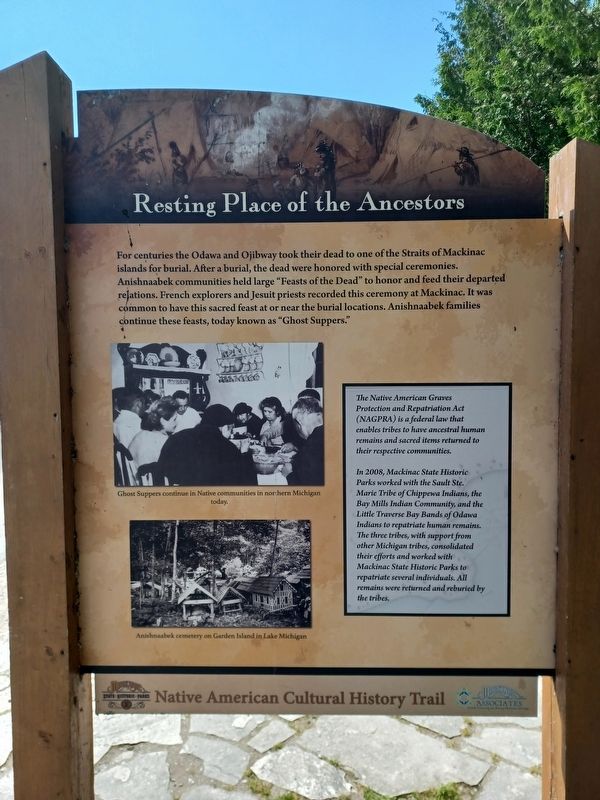
For centuries the Odawa and Ojibway took their dead to one of the Straits of Mackinac islands for burial. After a burial, the dead were honored with special ceremonies. Anishnaabek communities held large "Feasts of the Dead" to honor and feed their departed relations. French explorers and Jesuit priests recorded this ceremony at Mackinac. It was common to have this sacred feast at or near the burial locations. Anishnaabek families continue these feasts,
this page online
Inset box:
The Native American Graves Protection and Repatriation Act (NAGPRA) is a federal law that enables tribes to have ancestral human remains and sacred items returned to their respective communities.
In 2008, Mackinac State Historic Parks worked with the Sault Ste. Marie Tribe of Chippewa Indians, the Bay Mills Indian Community, and the Little Traverse Bay Bands of Odawa Indians to repatriate human remains. The three tribes, with support from other Michigan tribes, consolidated their efforts and worked with Michigan State Historic Parks to repatriate several individuals. All remains were returned and reburied by the tribes.
Top left image caption: Ghost suppers continue in Native communities in northern Michigan today.
Bottom left image caption: Anishnaabek cemetery on Garden Island in Lake Michigan
Erected 2017 by Mackinac State Historic Parks and Mackinac Associates.
Topics. This historical marker is listed in these topic lists: Cemeteries & Burial Sites • Indigenous Peoples and Communities. A significant historical year for this entry is 1836.
Location. 45° 51.827′ N, 84° 36.684′ W.
Photographed by Joel Seewald, July 1, 2025
2. Resting Place of the Ancestors Marker, Side Two

Regionally, this marker is on the Upper Peninsula and on the Straits of Mackinac. It is also in the American Midwest. Globally, it is in North America, in the Great North Woods, on the Great Lakes, in the Western Hemisphere, in the Western World, and in the Anglosphere. Historically, it finds itself in what was once the Viceroyalty of New France and also the Northwest Territory.
Other nearby markers. At least 8 other markers are within walking distance of this marker: Sugar Loaf (approx. 0.3 miles away); Fort Holmes (approx. half a mile away); a different marker also named Fort Holmes (approx. half a mile away); Gitchie Manitou (approx. half a mile away); Arch Rock: Unsurpassed in Nature's Handiwork (approx. half a mile away); Arch Rock (approx. half a mile away); Sanilac Arch (approx. half a mile away);

Photographed by Joel Seewald, July 1, 2025
3. Resting Place of the Ancestors Marker
Credits. This page was last revised on July 10, 2025. It was originally submitted on July 9, 2025, by Joel Seewald of Madison Heights, Michigan. This page has been viewed 127 times since then and 29 times this year. Photos: 1, 2, 3. submitted on July 9, 2025, by Joel Seewald of Madison Heights, Michigan.
