Kure Beach in New Hanover County, North Carolina — The American South (South Atlantic)
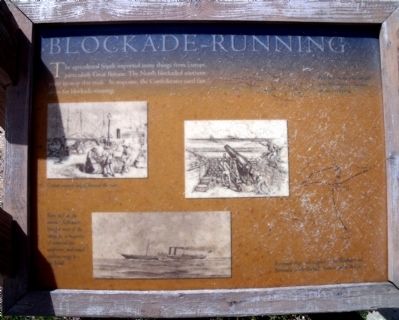
Blockade-Running
Photographed by Bernard Fisher, March 11, 2010
1. Blockade-Running Marker
The agricultural South imported many things from Europe, particularly Great Britain. The North blockaded southern ports to stop this trade. In response, the Confederates used fast ships for blockade-running.
(captions)
Cotton exports helped finance the war.
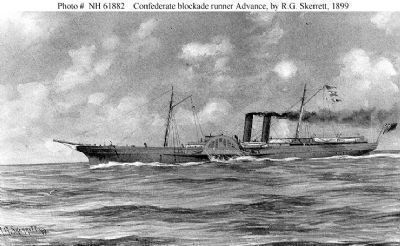
Ships such as the steamer Advance brought most of the weapons, a majority of material for uniforms, and much civilian cargo to the South.
Railroads carried vital supplies from Wilmington to southern armies in Virginia
European ships took supplies to the Bahamas and Bermuda, where blockade runners picked them up.
Erected by Fort Fisher State Historic Site. (Marker Number 2.)
Topics. This historical marker is listed in these topic lists: Forts and Castles • War, US Civil • Waterways & Vessels.
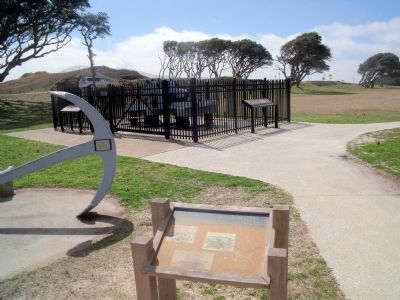
Location. Marker has been reported missing. It was located near 33° 58.284′ N, 77° 55.081′ W. Marker was in Kure Beach, North Carolina, in New Hanover County. It could be reached from Fort Fisher Boulevard South (U.S. 421) near Battle Acre Road. This marker is located along the quarter-mile
this page online

Regionally, this marker was in the Coastal Plain and on the Cape Fear Coast. It was also in the American South, specifically in the Upper South, in the Tidewater, and on the Eastern Seaboard. Globally, it was in the North Atlantic Region, North America, the Western Hemisphere, the Western World, and the Anglosphere. Historically, it found itself in what was once the territory of the Mississippian Culture, one of the original Thirteen Colonies, one of the Confederate States of America, and the Antebellum South.
Other nearby markers. At least 8 other markers are within walking distance of this location: 1st Battle Of Fort Fisher - December, 1864: A "Fiasco" (within shouting distance of this marker); A Desolate Spit Of Land (within shouting distance of this marker); Fort Fisher & the Civil War (about 300 feet away, measured in a direct line); The Whole Garrison Has Gone To Gardening (about 300 feet away); 32 Pounder Naval Cannon
Photographed by Bernard Fisher, March 11, 2010
2. Blockade-Running Marker
Other markers no longer nearby. A Trophy of War (was a few steps from this marker but has been confirmed missing); Fort Fisher’s Armstrong Cannon (was a few steps from this marker but has been confirmed missing); History Trail (was within shouting distance of this marker but has been confirmed missing); Growth of Fort Fisher, 1861-1862 (was within shouting distance of this marker but has been confirmed missing); Fort Fisher Since 1865 (was about 300 feet away but has been replaced with another marker now near it); Lamb Expands the Fort, 1862-1865 (was about 300 feet away but has been confirmed missing).
Also see . . .
1. Fort Fisher. North Carolina Historic Sites (Submitted on March 15, 2010, by Bernard Fisher of Richmond, Virginia.)
2. The Blockade Runners Race of 1864. Cape Fear Historical Institute (Submitted on March 18, 2010, by Bernard Fisher of Richmond, Virginia.)
Photographed by R.G. Skerrett, 1899
3. Advance (Blockade Running Steamer, 1863-1864)
Advance, a 902-ton side-wheel steamer, was built at Greenock, Scotland, in 1862 for use as a River Clyde packet. Purchased by the State of North Carolina under the name Lord Clyde in 1863, she was renamed Advance (a name frequently given as A.D. Vance), and put to work running the Federal blockade. She was one of the most successful Confederate blockade runners, making more than twenty voyages before her capture by USS Santiago de Cuba off Wilmington, North Carolina, on 10 September 1864. Taken into the United States Navy soon thereafter, she served as USS Advance until June 1865, when she was renamed Frolic. Sepia wash drawing courtesy of the U.S. Navy Art Collection, Washington, D.C., U.S. Naval Historical Center Photograph [NH 61882].
Credits. This page was last revised on July 16, 2025. It was originally submitted on March 15, 2010, by Bernard Fisher of Richmond, Virginia. This page has been viewed 895 times since then and 25 times this year. Last updated on July 15, 2025, by Evan Dwyer of Richmond, Virginia. Photos: 1, 2. submitted on March 15, 2010, by Bernard Fisher of Richmond, Virginia. 3. submitted on March 16, 2010, by Bernard Fisher of Richmond, Virginia.
