Kure Beach in New Hanover County, North Carolina — The American South (South Atlantic)
Blockade-Running
Photographed by Bernard Fisher, March 11, 2010
1. Blockade-Running Marker
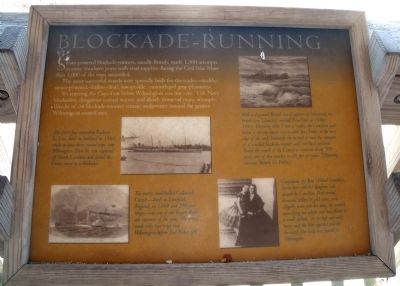
Steam-powered blockade-runners, usually British, made 1,300 attempts to enter Southern ports with vital supplies during the Civil War. More than 1,000 of the trips succeeded.
The most successful vessels were specially built for the trade—stealthy, steam-powered, shallow-draft, low-profile, camouflaged gray phantoms.
Yet entering the cape fear below Wilmington was not easy. U.S. navy blockaders, dangerous coastal waters, and shoals thwarted many attempts. Wrecks of 34 blockade-runners remain underwater around the greater Wilmington coastal area.
(captions)
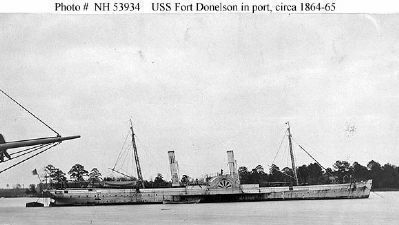
The 268-foot steamship Robert E. Lee, built in Scotland in 1860, made at least seven round trips into Wilmington. Then she was captured off North Carolina and joined the Union navy as a blockader.
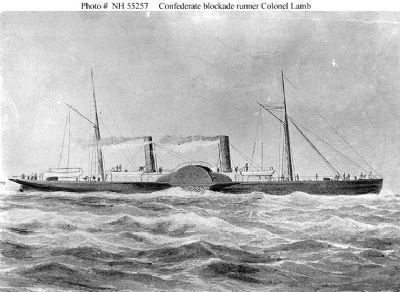
The costly, steel-hulled Colonel Lamb—built in Liverpool, England, in 1864 and 280 feet long—was one of the largest blockade runners of the war. The vessel made only two trips into Wilmington before Fort Fisher fell.
With a disguised British naval captain in command, the brand-new Condor reached New Inlet in October 1864. Drawing only 7 feet of water, the Condor just before a stormy dawn ran toward Fort Fisher at the very edge of the surf. Suddenly she turned to miss the remains of a wrecked blockade-runner and ran hard aground. Today the wreck of the Condor remains about 700 yards east of this marker in 20 feet of water. (Painting courtesy Martin D. Peebles)
Confederate spy Rose O’Neal Greenhow, shown here with her daughter, was aboard theCondor.
this page online
Erected by Fort Fisher State Historic Site. (Marker Number 13.)
Topics. This historical marker is listed in these topic lists: Forts and Castles • War, US Civil • Waterways & Vessels. A significant historical month for this entry is October 1864.
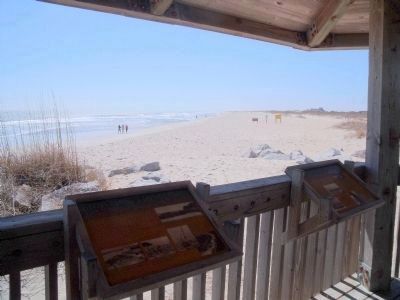
Location. Marker is missing. It was located near 33° 58.08′ N, 77° 55.165′ W. Marker was in Kure Beach, North Carolina, in New Hanover County. It could be reached from Battle Acre Road near Fort Fisher Boulevard South (U.S. 421). This marker is located in the oceanfront gazebo at the "Battle Acre" tour stop. Touch for map. Marker was in this post office area: Kure Beach NC 28449, United States of America. Touch for directions.

Regionally, this marker was in the Coastal Plain and on the Cape Fear Coast. It was also in the American South, specifically in the Upper South, in the Tidewater, and on the Eastern Seaboard. Globally,
Photographed by Bernard Fisher, March 11, 2010
2. Site of the Condor wreck 700 yds offshore.
Other nearby markers. At least 8 other markers are within walking distance of this location: The Columbiad Battery (within shouting distance of this marker); "How Grand a Fame It Watches Over": The Fort Fisher Monument (about 600 feet away, measured in a direct line); Fort Fisher Monument (about 600 feet away); Headquarters of Fort Fisher (about 600 feet away); …A Light House And Dwelling House At Federal Point (about 600 feet away); W.H.C. Whiting (about 800 feet away); Fort Fisher (about 800 feet away); a different marker also named Fort Fisher (approx. 0.2 miles away). Touch for a list and map of all markers in Kure Beach.
Another marker is no longer nearby. Fighting the Sea - Saving the Fort (was here, next to this marker but has been confirmed missing).
Also see . . .
1. Fort Fisher. North
circa 1864
3. USS Fort Donelson (1864-1865).
Previously the British steamship Giraffe (built 1860) and the Confederate Blockade Runner Robert E. Lee.
USS Fort Donelson, a 642-ton iron-hulled side-wheel gunboat, was built in 1860 at Glasgow, Scotland, as the commercial steamer Giraffe. In 1862 she became the Confederate blockade runner Robert E. Lee and, during the next year, successfully penetrated the Federal blockade of the South more than twenty times. While attempting to reach Wilmington, North Carolina, on 9 November 1863, the ship was captured by the U.S. Navy ships James Adger and Iron Age.
Purchased in January 1864, converted to a warship and placed in commission in June 1864, Fort Donelson was sent back to the waters off North Carolina as a unit of the North Atlantic Blockading Squadron. Her most notable action was participation in the mid-January 1865 operation that captured Fort Fisher, thus eliminating Wilmington as a blockade-running port. Some months later, when ordered to the Gulf of Mexico, she was found to be in poor condition and was sent back north. USS Fort Donelson was decommissioned at Philadelphia, Pennsylvania, in August and sold in October 1865. She subsequently returned to civilian employment under the name Isabella and, in 1869, became the Chilean Navy ship Concepcion. U.S. Naval Historical Center [Photo NH 53934]
USS Fort Donelson, a 642-ton iron-hulled side-wheel gunboat, was built in 1860 at Glasgow, Scotland, as the commercial steamer Giraffe. In 1862 she became the Confederate blockade runner Robert E. Lee and, during the next year, successfully penetrated the Federal blockade of the South more than twenty times. While attempting to reach Wilmington, North Carolina, on 9 November 1863, the ship was captured by the U.S. Navy ships James Adger and Iron Age.
Purchased in January 1864, converted to a warship and placed in commission in June 1864, Fort Donelson was sent back to the waters off North Carolina as a unit of the North Atlantic Blockading Squadron. Her most notable action was participation in the mid-January 1865 operation that captured Fort Fisher, thus eliminating Wilmington as a blockade-running port. Some months later, when ordered to the Gulf of Mexico, she was found to be in poor condition and was sent back north. USS Fort Donelson was decommissioned at Philadelphia, Pennsylvania, in August and sold in October 1865. She subsequently returned to civilian employment under the name Isabella and, in 1869, became the Chilean Navy ship Concepcion. U.S. Naval Historical Center [Photo NH 53934]
2. The Blockade Runners Race of 1864. Cape Fear Historical Institute (Submitted on March 18, 2010, by Bernard Fisher of Richmond, Virginia.)
circa 1864
4. Steamship Colonel Lamb (Blockade Runner, 1864)
Colonel Lamb, a 1788-ton side-wheel steamer, was built at Liverpool, England, in 1864 for employment running the Federal blockade of the Confederate coast. She successfully ran into the port of Wilmington, North Carolina, in late November 1864 and escaped back to sea the next month. In January 1865, with east coast blockade running at an end, she went to the Gulf of Mexico but was found unsuitable for operation into Galveston, Texas, and returned to England a few months later. Reportedly sold to Greek interests and renamed Bouboulina, she was destroyed in an explosion while loading munitions at Liverpool in 1866 or 1867. U.S. Naval Historical Center [Lithograph NH 55257]
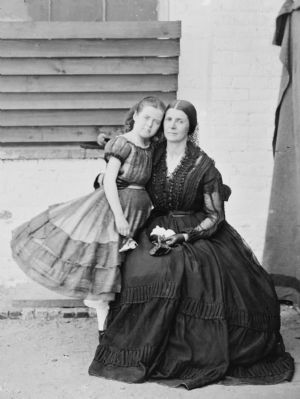
Photographed by Brady, circa 1863
5. Mrs. Greenhow & Daughter
Library of Congress [LC-BH832- 2492]
Credits. This page was last revised on July 18, 2025. It was originally submitted on March 16, 2010, by Bernard Fisher of Richmond, Virginia. This page has been viewed 2,250 times since then and 77 times this year. Last updated on July 15, 2025, by Evan Dwyer of Richmond, Virginia. Photos: 1, 2, 3, 4, 5. submitted on March 16, 2010, by Bernard Fisher of Richmond, Virginia.
