Otsego Lake Township near Gaylord in Otsego County, Michigan — The American Midwest (Great Lakes)
Otsego Lake State Park
Photographed by Joel Seewald, July 2, 2025
1. Otsego Lake State Park Marker
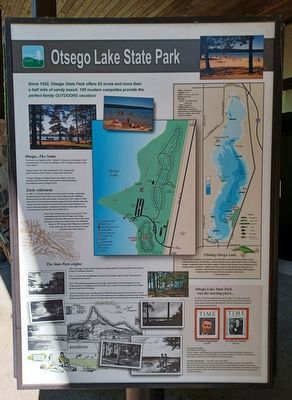
Since 1922, Otsego State Park offers 62 acres and more than a half mile of sandy beach. 155 modern campsites provide the perfect family OUTDOORS vacation!
Otsego...The Name
The county was originally called "Okkuddo", a Iroquian word meaning "sickly" or "stomach pain". The name was changed in 1843 to Otsego, thought to mean "clear water".*
*Otsego County, New York, established in 1791, interprets the Native American word "Otsego" to mean "place of the rock".
* Otsego, Michigan in Allegan County was settled in 1831 and originally called Pine Creek. The post office called itself Allegan, but changed its name to Otsego in 1835.
Early settlement
In 1868, A. A. Dwight brought a crew of men north to Otsego, constructing log cabins along Crooked Lake, now known as Manuka Lake. Hardships, however, drove the men from the area. In the spring of 1869, Charles S. Brink and a crew of 14 men came and cleared acreage for farming. Brink's wife, Jane, was the first white woman in the county. Brink and his men embarked on a serious lumbering operation, including the building of many dams in the area and commencing log drives
this page online
Those early lumbering days gave way to post-Civil War homesteading and the birth of Otsego Lake Village. Eventually, construction followed of a lumber mill, homes, businesses, a library, town hall, a school and a Methodist church. In 1875, Otsego Lake Village was established as the county seat, but within two years, the county seat was moved north to Gaylord.
The State Park origins
1920 –The Otsego County Board of Supervisors appropriated five hundred dollars for the purchase of land "for state park purposes."
1921 – A 54-acre tract was identified on the east side of Otsego Lake for a park. That same year, 24 more acres were secured.
1922 – With additional appropriation, the acreage was purchased, with the exception of a strip of land owned by the Michigan Central Railroad. Upon receipt of the land, Otsego County deeded the land to the State of Michigan.
1933-38 – During this time, the park greatly benefited from the improvements done by the Civilian Conservation Corp. (CCC). The CCC built the bathhouse, store buildings, campground toilet buildings, shelters, pump house and roads. Its 1937
Photographed by Joel Seewald, July 2, 2025
2. Otsego Lake State Park Marker
Fishing Otsego Lake
Otsego Lake contains a very diverse and stable fish community that is based on both natural reproduction and stocking. Natural reproduction sustains yellow perch, rock bass, bluegill, smallmouth bass and black crappie. Northern pike numbers are enhanced by the rearing marsh operations. Walleye and lake sturgeon populations are dependent on stocking. Growth rates are good for all species indicating the biological capacity of the lake has not been exceeded and the lake is quite productive.
Otsego Lake State Park was the meeting place...
In 1942, Dr. Robert Oppenheimer and Dr. Arthur H. Compton, chose the out-of -the-way spot of Otsego Lake State Park to discuss the development of the atomic bomb during World War II. The two world renown scientists, met at the present beach area.
Dr. Arthur H. Compton
1927 Nobel Prize for Physics.
In 1941, Compton was Chairman of the National Academy of Sciences Committee to Evaluate Use of Atomic Energy in War. During World War II, he was instrumental in the creation of the first nuclear chain reaction, which led to the development of the first atomic bomb.
Dr. Robert Oppenheimer "The Father of the Atomic Bomb"
American physicist best known as the scientific director of the Manhattan Project, the World War II effort to develop the first nuclear weapons at the secret Los Alamos National Laboratory in New Mexico. After the was, Oppenheimer was chief advisor to the newly created United States Atomic Energy Commission and used that position to lobby for international control of nuclear power and to avert the nuclear arms race with the Soviet Union.
Erected by Michigan Department of Natural Resources and Environment.
Topics. This historical marker is listed in these topic lists: Parks & Recreational Areas • Science & Medicine • Settlements & Settlers • War, World II. A significant historical year for this entry is 1922.
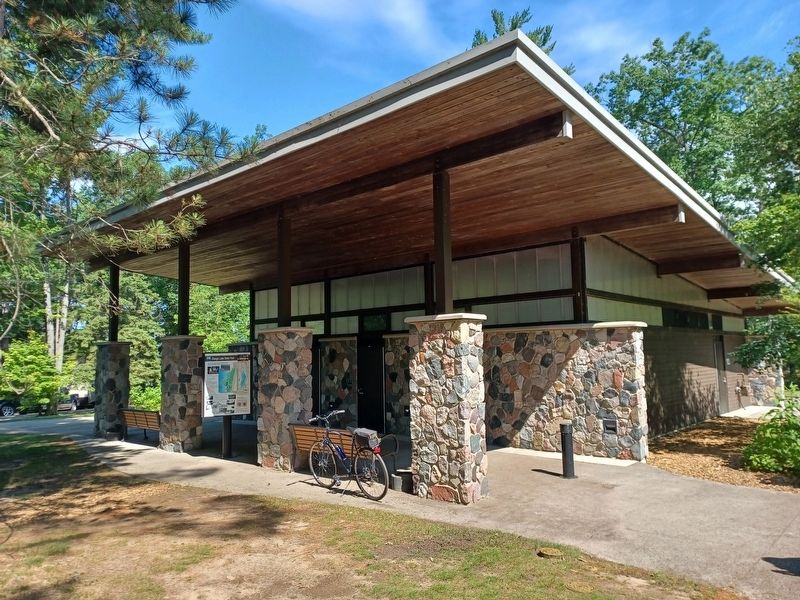
Location. 44° 55.711′ N, 84° 41.448′ W. Marker is near Gaylord, Michigan, in Otsego County. It is in Otsego Lake Township. It can be reached from Old US Highway 27 South 0.9 miles north of Mancelona Road (County Highway F-38), on the left when traveling north. Marker is in Otsego Lake State Park at the South Campground restrooms. Touch for map. Marker is at or near this postal address: 7136 Old US Hwy 27 S, Gaylord MI 49735, United States of America. Touch for directions.

Regionally, this marker is in Northern Michigan Lower Peninsula. It is also in the American Midwest. Globally, it is in North America, the Great North Woods, the Western Hemisphere, the Western World, and the Anglosphere. Historically, it finds itself in what was once the Northwest Territory.
Other nearby markers. At least 8 other markers are within 7 miles of this marker, measured as the crow flies: A different marker also named Otsego Lake State Park (approx. 0.2 miles away); Waters (approx. 3.4 miles away); History of the Bottle Fence (approx. 3½ miles away); First Congregational Church (approx. 6.8 miles away); Hogan's Jewelers (approx. 6.9 miles away); Elk, Oil and the Environment (approx. 6.9 miles away); Purple Heart Memorial (approx. 6.9 miles away); Otsego County (approx. 6.9 miles away). Touch for a list and map of all markers in Gaylord.
Additional commentary.
1. Identical marker
An identical, though badly faded, marker can be found near the beach about 0.25 mile away.
— Submitted July 15, 2025, by Joel Seewald of Madison Heights, Michigan.
Credits. This page was last revised on July 15, 2025. It was originally submitted on July 15, 2025, by Joel Seewald of Madison Heights, Michigan. This page has been viewed 332 times since then and 122 times this year. Photos: 1, 2. submitted on July 15, 2025, by Joel Seewald of Madison Heights, Michigan.
