Near Fairburn in Custer County, South Dakota — The American Midwest (Upper Plains)
Custer State Park: A Legacy of Conservation and Preservation
Photographed by Daniel Barriball, June 12, 2025
1. Custer State Park: A Legacy of Conservation and Preservation Marker
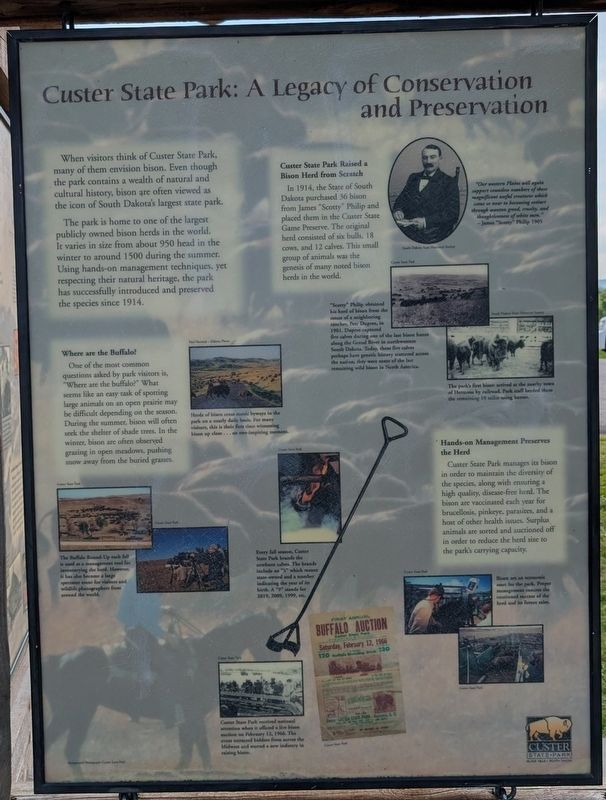
The park is home to one of the largest publicly owned bison herds in the world. It varies in size from about 950 head in the winter to around 1500 during the summer. Using hands-on management techniques, yet respecting their natural heritage, the park has successfully introduced and preserved the species since 1914.
Custer State Park Raised a Bison Herd from Scratch
In 1914, the State of South Dakota purchased 36 bison from James "Scotty" Philip and placed them in the Custer State Game Preserve. The original herd consisted of six bulls, 18 cows, and 12 calves. This small group of animals was the genesis of many noted bison herds in the world.
"Our western Plains will again support countless numbers of these magnificent useful creatures which came so near to becoming extinct through wanton greed, cruelty, and thoughtlessness of white men."—James "Scotty" Philip 1905
History photo captions: "Scotty" Philip obtained
this page online
The park's first bison arrived at the nearby town of Hermosa by railroad. Park staff herded them the remaining 10 miles using horses.
Where are the Buffalo?
One of the most common questions asked by park visitors is, "Where are the buffalo?" What seems like an easy task of spotting large animals on an open prairie may be difficult depending on the season. During the summer, bison will often seek the shelter of shade trees. In the winter, bison are often observed grazing in open meadows, pushing snow away from the buried grasses.
Bison photo caption: Herds of bison cross scenic byways in the park on a nearly daily basis. For many visitors, this is their first time witnessing bison up close...an awe-inspiring moment.
Hands-on Management Preserves the Herd
Custer State Park manages its bison in order to
Photographed by Daniel Barriball, June 12, 2025
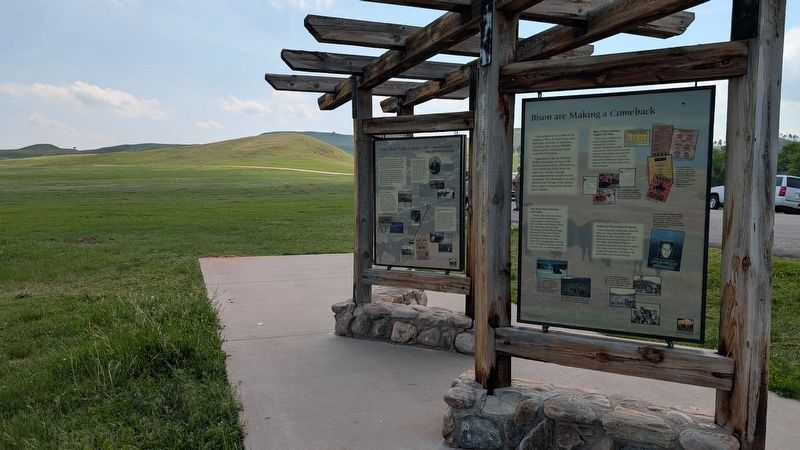
2. Custer State Park: A Legacy of Conservation and Preservation Marker in context
This marker is the left panel.
Bison management photo captions: The Buffalo Round-Up each fall is used as a management tool for inventorying the herd. However, it has also become a large spectator event for visitors and wildlife photographers from around the world.
Every fall season, Custer State Park brands the newborn calves. The brands include an "S" which means state-owned and a number indicating the year of its birth. A "9" stands for 2019, 2009, 1999, etc.
Custer State Park received national attention when it offered a live bison auction on February 12, 1966. The event attracted bidders from across the Midwest and started a new industry in raising bison.
Bison are an economic asset for the park. Proper management ensures the continued success of the herd and its future sales.
Erected by Custer State Park.
Topics. This historical marker is listed in these topic lists: Animals • Environment • Parks & Recreational Areas. A significant historical year for this entry is 1914.
Location. 43° 38.453′ N, 103° 22.052′ W. Marker is near Fairburn, South Dakota, in Custer County. It is on Csp Road 1, on the left when traveling west. This marker is located along the Wildlife Loop Road within Custer State Park. Touch for map. Marker is at or near this postal address: 13442 Csp Rd 1, Custer SD 57730, United States of America. Touch for directions.

Regionally, this marker is in West River and in Greater Rapid City. It is also in the American Black Hills, in the Lewis & Clark Corridor, on the prairies, and on the Northern Plains. Globally, it is in North America, the Western Hemisphere, the Western World, and the Anglosphere. Historically, it finds itself in what was once Rupert’s Land and also the Louisiana Purchase.
Other nearby markers. At least 8 other markers are within 7 miles of this marker, measured as the crow flies: The Buffalo: More Than an Animal-A Way of Life (here, next to this marker); America's First Environmental Success Story (here, next to this marker); Market Hunting was a Gruesome Business (here, next to this marker); Bison are Making a Comeback (here, next to this marker); Bison: Symbol of the American West (here, next to this marker); The Buffalo Corrals (approx. 1.2 miles away); Wind Cave National Park (approx. 5 miles away); Exposing the Past (approx. 6.9 miles away). Touch for a list and map of all markers in Fairburn.
Credits. This page was last revised on July 19, 2025. It was originally submitted on July 15, 2025, by Daniel Barriball of Chesterton, Indiana. This page has been viewed 132 times since then and 30 times this year. Photos: 1, 2. submitted on July 15, 2025, by Daniel Barriball of Chesterton, Indiana. • Andrew Ruppenstein was the editor who published this page.
